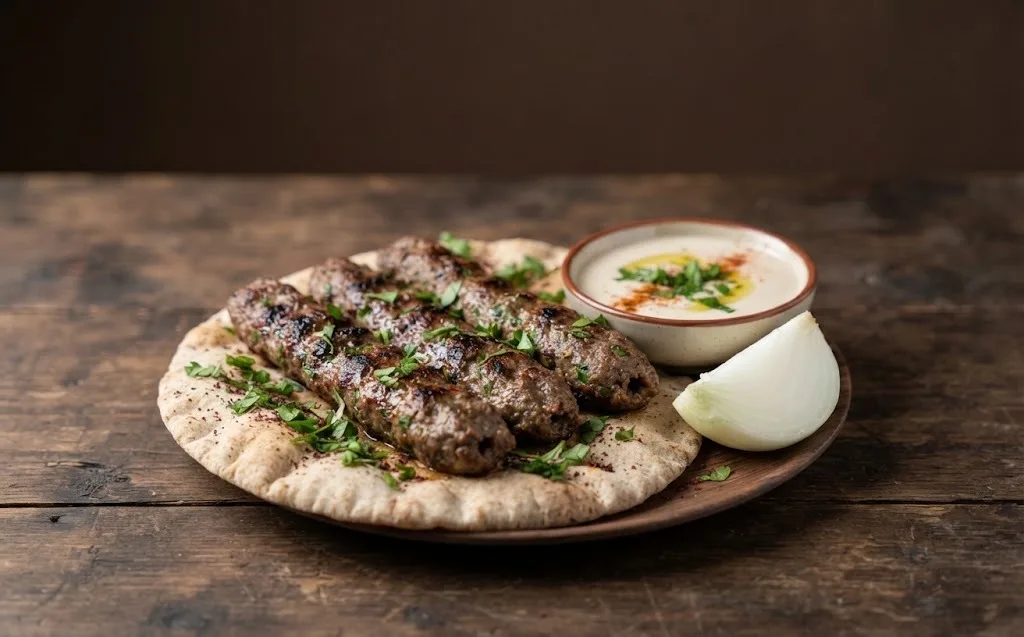
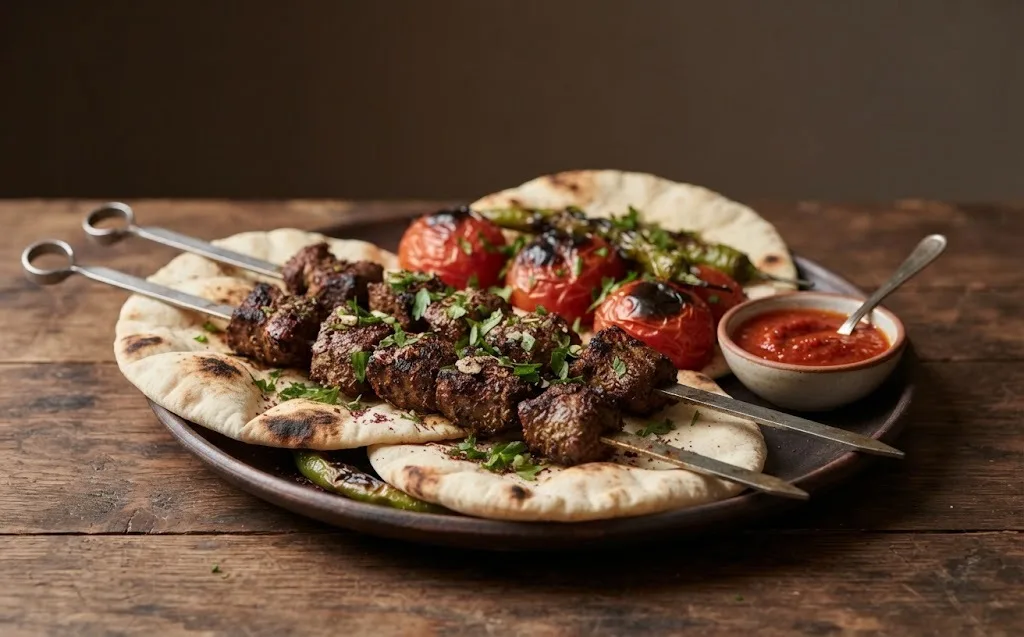
Iraq's beloved minced-lamb skewer, notably fatty and coarsely ground, pressed long and thin onto wide blades and eaten folded into samoon or tannour bread with sumac onions and amba. Baghdad kebab houses judge themselves on the meat's char-to-juice ratio alone.
Also known as kabab Iraqi, kebab araqi, kabab al-iraqi.
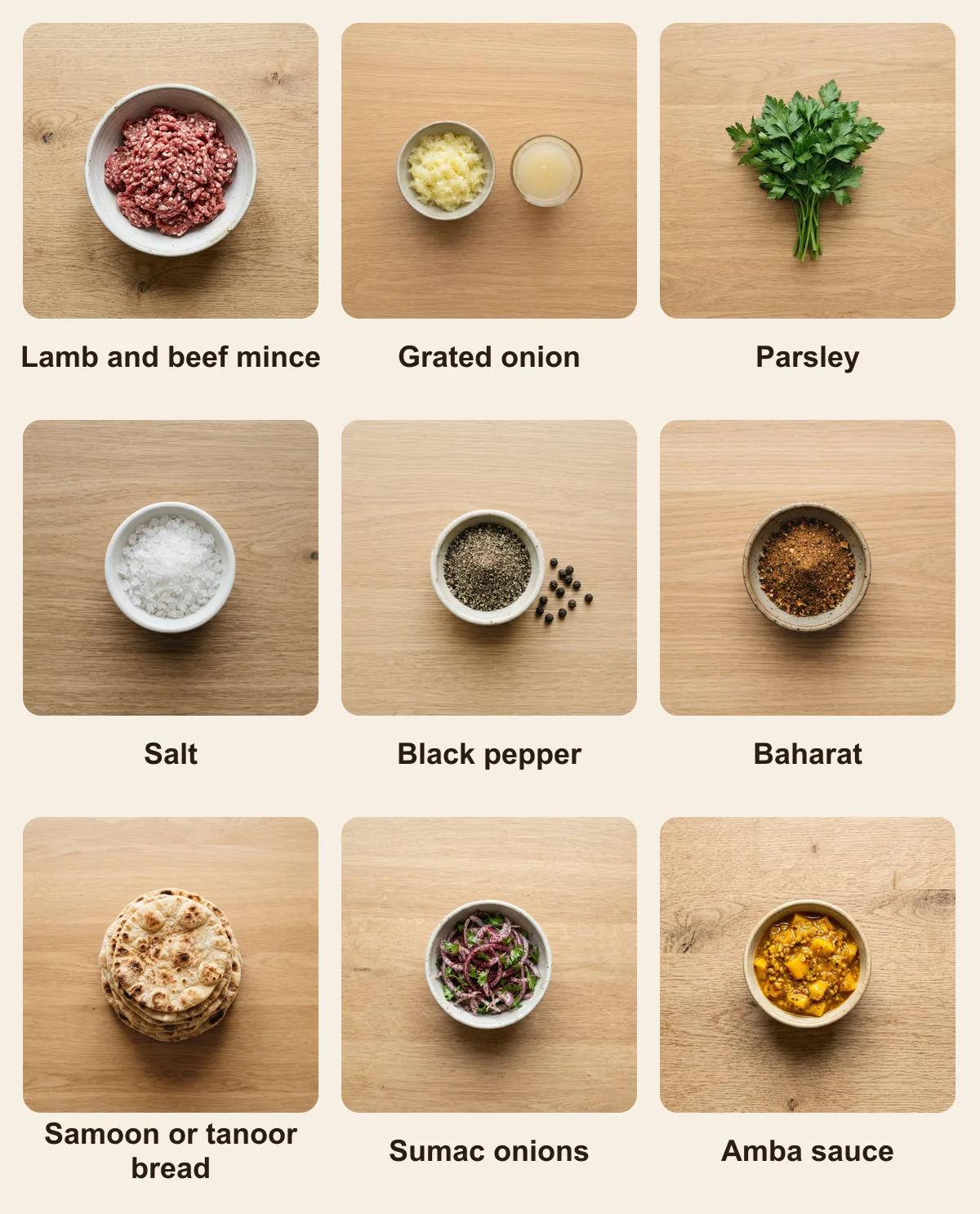
Ingredients
- 700 g coarsely minced lamb and beef (two parts lamb to one beef), 25-30% fat (single grind)
- 1 small onion, grated and squeezed bone dry in a cloth
- 40 g parsley (a large bunch), chopped
- 1.5 tsp salt
- 0.5 tsp black pepper
- 0.25 tsp baharat
- 4 samoon or tanoor breads
- 1 onion sliced with 1 tsp sumac
- amba sauce, to serve
How to make it
- 1
Work the onion, parsley and seasonings through the mince until the mixture turns tacky and clings together; Baghdad kebab keeps its coarse, open grain.
- 2
Chill the mixture 1 h so the fat firms.
- 3
Press long, thin fingers of meat down wide flat skewers, thinner than you think right.
- 4
Grill over fierce coals 3-4 min per side until the crust is mahogany and fat drips freely.
- 5
Drag a piece of bread over the hot skewer to pull the kebab off, and serve with sumac onions and amba.
Pro tip: One coarse grind is the Iraqi signature; knead just until the mass turns tacky and clings to itself — work it smooth and you have made lyulya, not kebab.
Where Iraqi Kebab comes from
Iraqi kebab — kabab iraqi, or simply kabab on any Baghdad street — is the minced lamb-and-beef skewer that anchors Iraq's grill culture. It shares an ancestor with the Turkish Adana and the Syrian kebab halabi, but Iraq took the recipe in a distinct direction: less chilli heat, far more parsley, and a hard commitment to fat from the tail rather than from the shoulder.
It is street food and family food at the same time. The kebabchi shops of Baghdad, Mosul and Basra grill it in the open over long channel grills, and the same mixture appears at home over a small mangal on a Friday. Its inseparable partner is amba, the tart fermented mango pickle that arrived through the Indian Ocean trade and became more Iraqi than Indian. Iraqi Jews later carried it to Israel, and today it dresses shawarma in Israel and Palestine and goes into the sabich sandwich.
How Iraqi Kebab is cooked
The mixture is worked, not mixed. Minced lamb and beef, grated onion squeezed bone dry, a great deal of finely chopped flat-leaf parsley, and baharat go into a bowl and are kneaded by hand until the texture changes and the mass starts to cling to itself in one piece. That stickiness is structural — it is the only thing keeping the meat on a flat skewer over live fire, since Iraqi kebab uses no egg and no breadcrumb.
Wide flat skewers are not a stylistic choice either. A round skewer lets the meat rotate freely and drop; a flat one grips it. The mixture is pressed along the skewer with a wet hand in a long ribbon, ridged slightly with the fingers so the surface catches the heat unevenly and chars in bands. It cooks fast and close to the coals — three or four minutes a side, turned once, and off before the fat has finished running.
Ingredients and shopping
The classic ratio is roughly two parts lamb to one part beef, with the fat coming from lamb tail fat worked into the mince at about a quarter of the total. If tail fat is unavailable, use fatty lamb shoulder and accept a slightly different mouthfeel — what you must not do is compensate with vegetable oil, which will simply run out into the fire. Parsley is a bulk ingredient here, not a herb garnish: a large bunch to half a kilo of meat is normal.
Salt and black pepper carry the seasoning, with only a pinch of baharat, which in Iraq leans warm rather than hot — allspice, cinnamon, coriander, a little cumin. Aleppo-style pepper adds colour and a mild fruity heat. If you want the amba, buy it rather than make it; the jarred Iraqi and Israeli brands are the same product the shops use.
How Iraqi Kebab is served
It comes off the skewer onto flat samoon or khubz, never a plate first, with grilled tomatoes and long green peppers cooked alongside on their own skewer. Raw onion with sumac, a spoon of amba, and a scatter of more parsley finish it. In Baghdad it is eaten with the bread as both plate and cutlery, and the fat soaking into the underside of the loaf is the point, not an accident.
Common mistakes
Wet onion
Grated onion holds an astonishing amount of water, and that water is why kebab slides off the skewer. Squeeze it in a cloth until it stops dripping, then use it.
Under-kneading the mince
If the mixture still looks like loose mince, it will fall apart. Knead for a full three to five minutes until it is tacky and lifts as a single mass.
Warm meat on the skewer
Chill the mixture for an hour and shape it straight from the fridge. Warm fat softens the bind exactly when it needs to be firm.
Grilling too far from the coals
This kebab wants fierce, close heat and a short cook. Held high over a weak fire it dries from the inside out before the crust ever forms.
Skipping the parsley
It is not decoration. Remove it and you have a Turkish kebab with Iraqi spices, not an Iraqi kebab.
Iraqi Kebab: questions and answers
What is the difference between Iraqi kebab and Adana kebab?
Adana is knife-chopped lamb seasoned for heat with red pepper, and legally defined in Turkey. Iraqi kebab uses machine mince, mixes lamb with beef, carries far more parsley, and is spiced warm rather than hot with baharat.
What is amba and do I need it?
Amba is a tart, turmeric-yellow pickled mango sauce. It is the traditional partner and it changes the dish completely — sharp and fruity against the fat. You can eat the kebab without it, but you are eating a different meal.
Can I cook Iraqi kebab without a grill?
Yes. Shape the mixture into flat fingers, get a cast-iron pan or the oven broiler as hot as it goes, and cook them fast with no oil. You lose the smoke but keep the texture, which is the part that matters most.
Why does my kebab fall off the skewer?
Three usual causes: onion that was not squeezed dry, a mixture that was not kneaded to stickiness, and round skewers instead of flat ones. Fix all three and the problem disappears.
Sources and further reading
- Amba (condiment) — Wikipedia
- Authentic Iraqi Kabab Recipe (BBQ) — Hungry Paprikas