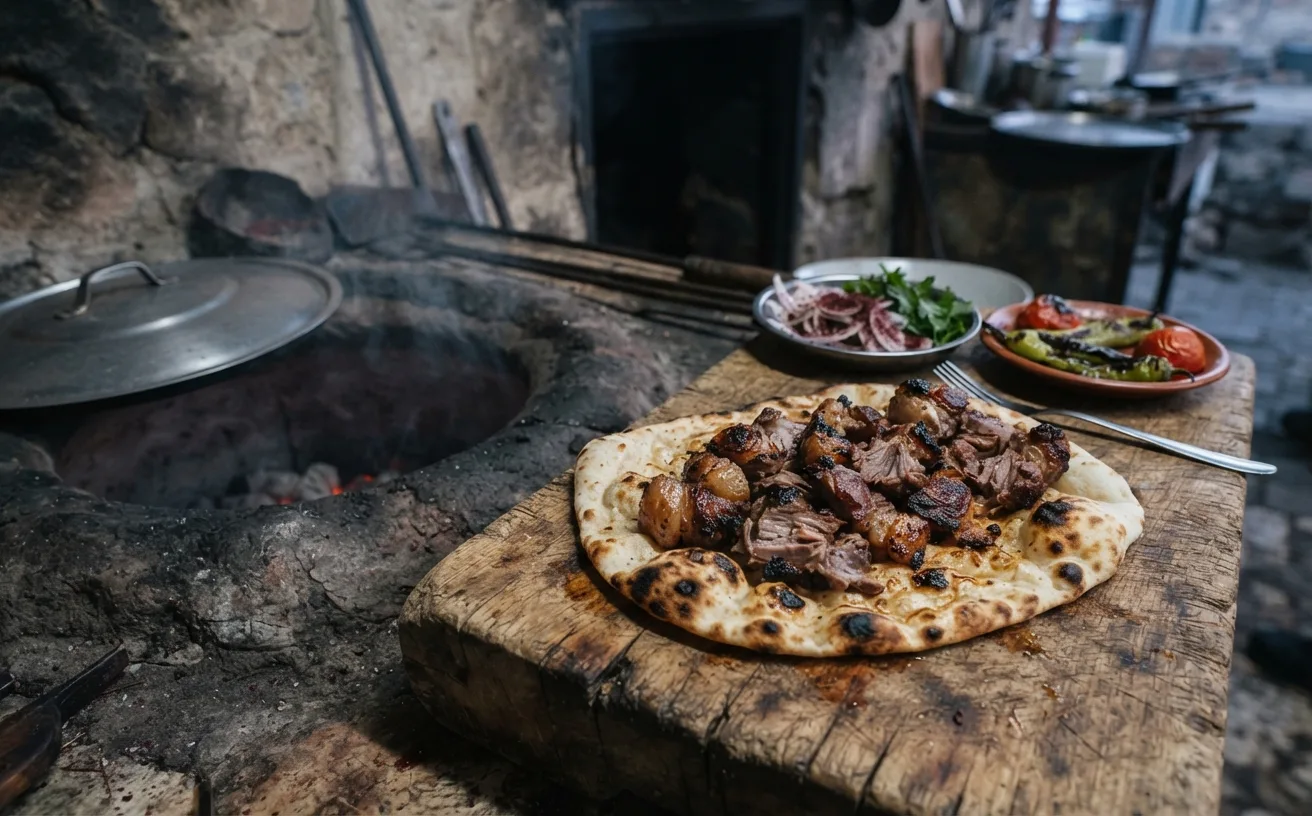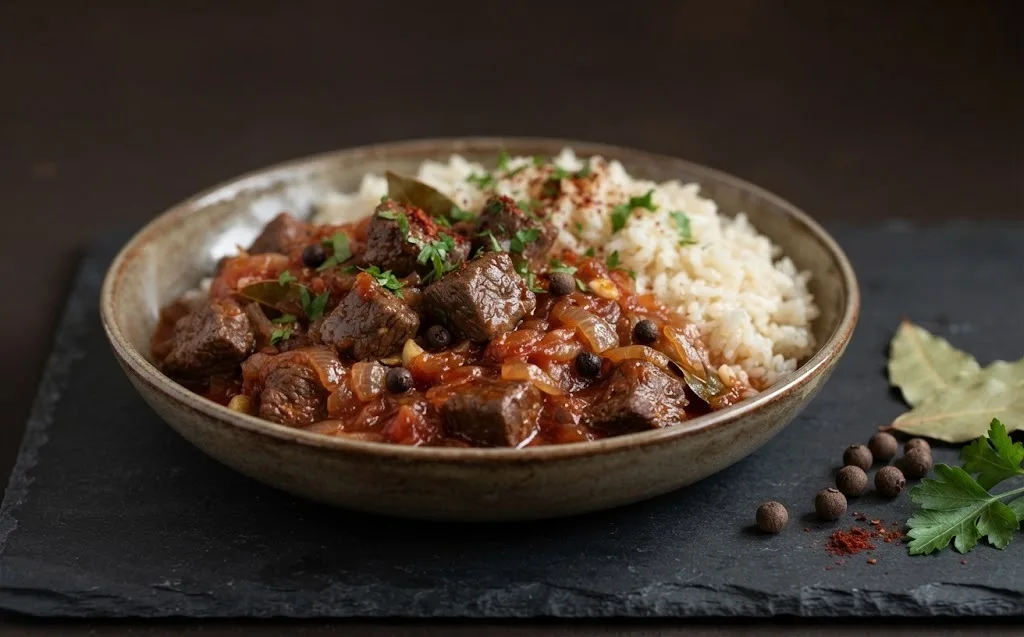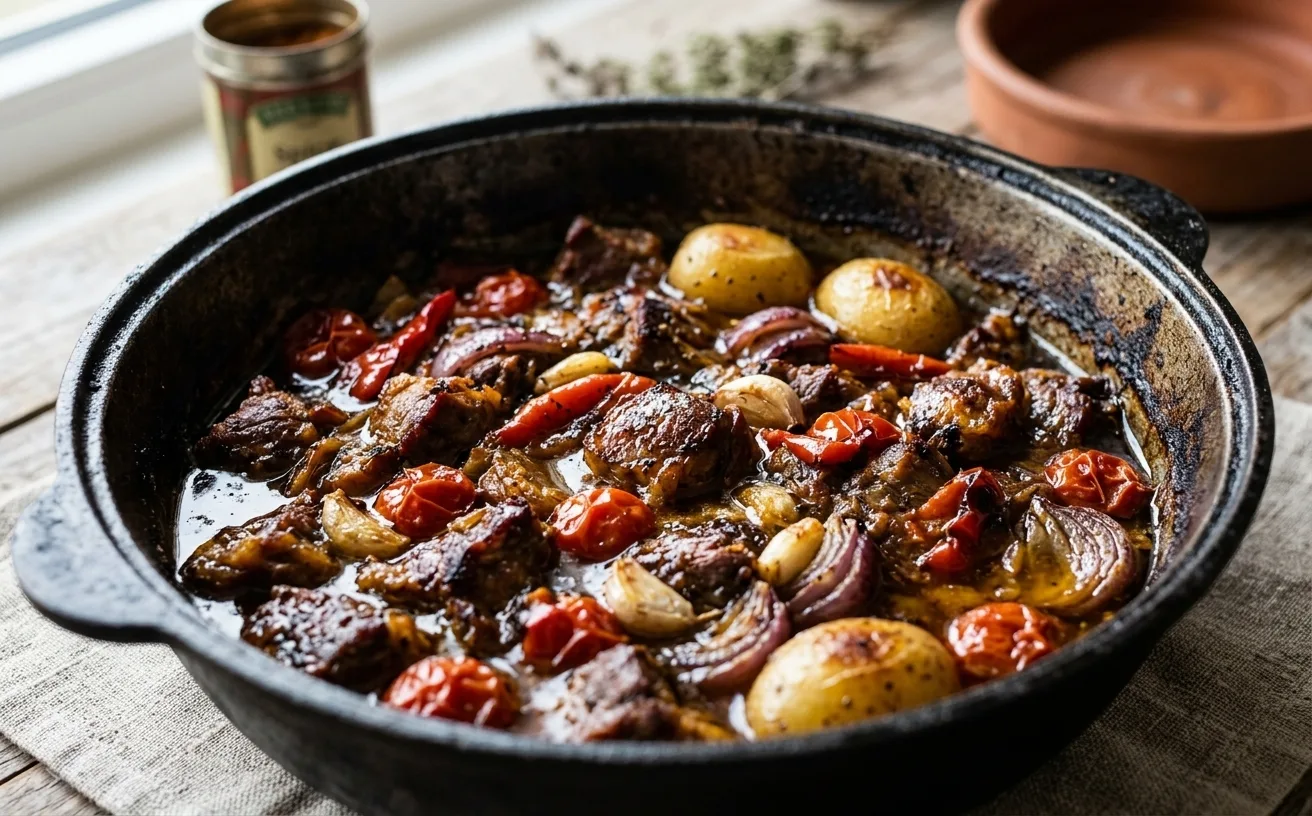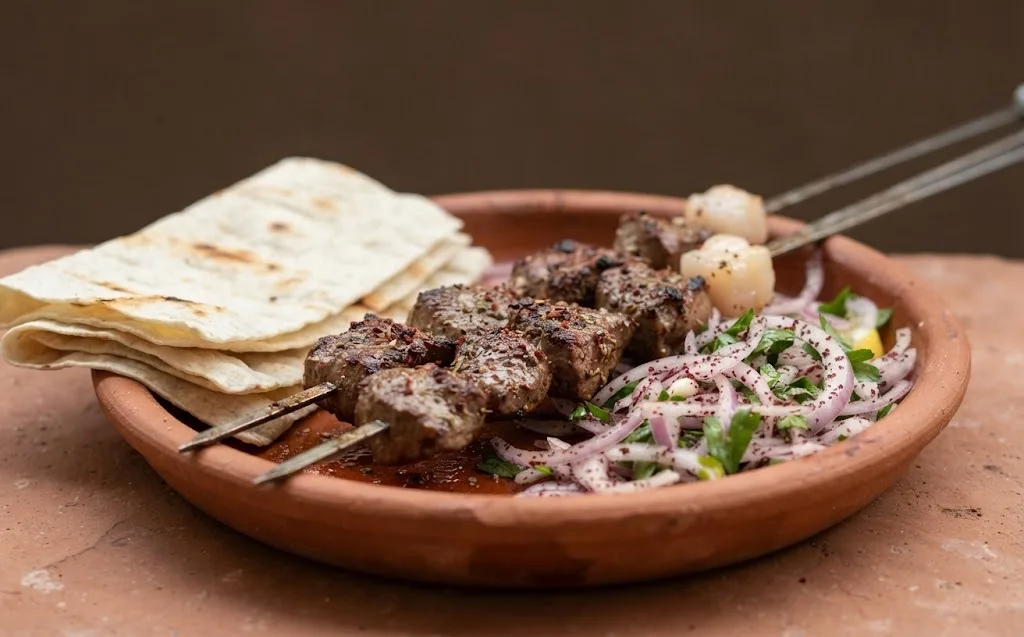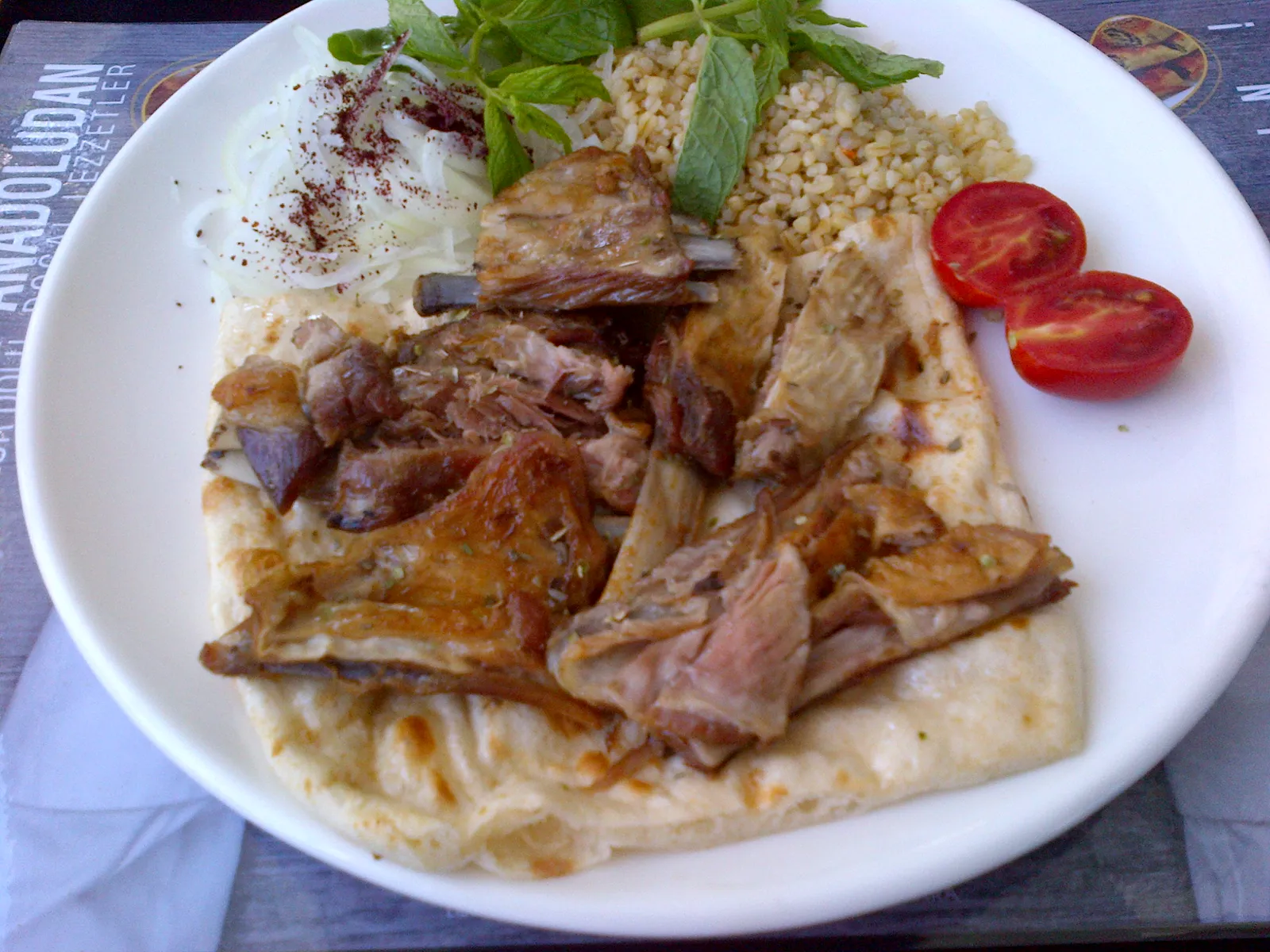
Lamb suspended inside a deep, sealed 'well' oven dug into the ground and roasted by radiant heat, notably in Aydın and central Anatolia. The buried pit gives it a gentler, moister roast than an open tandır.
Also known as well kebab, kuyu tandır.
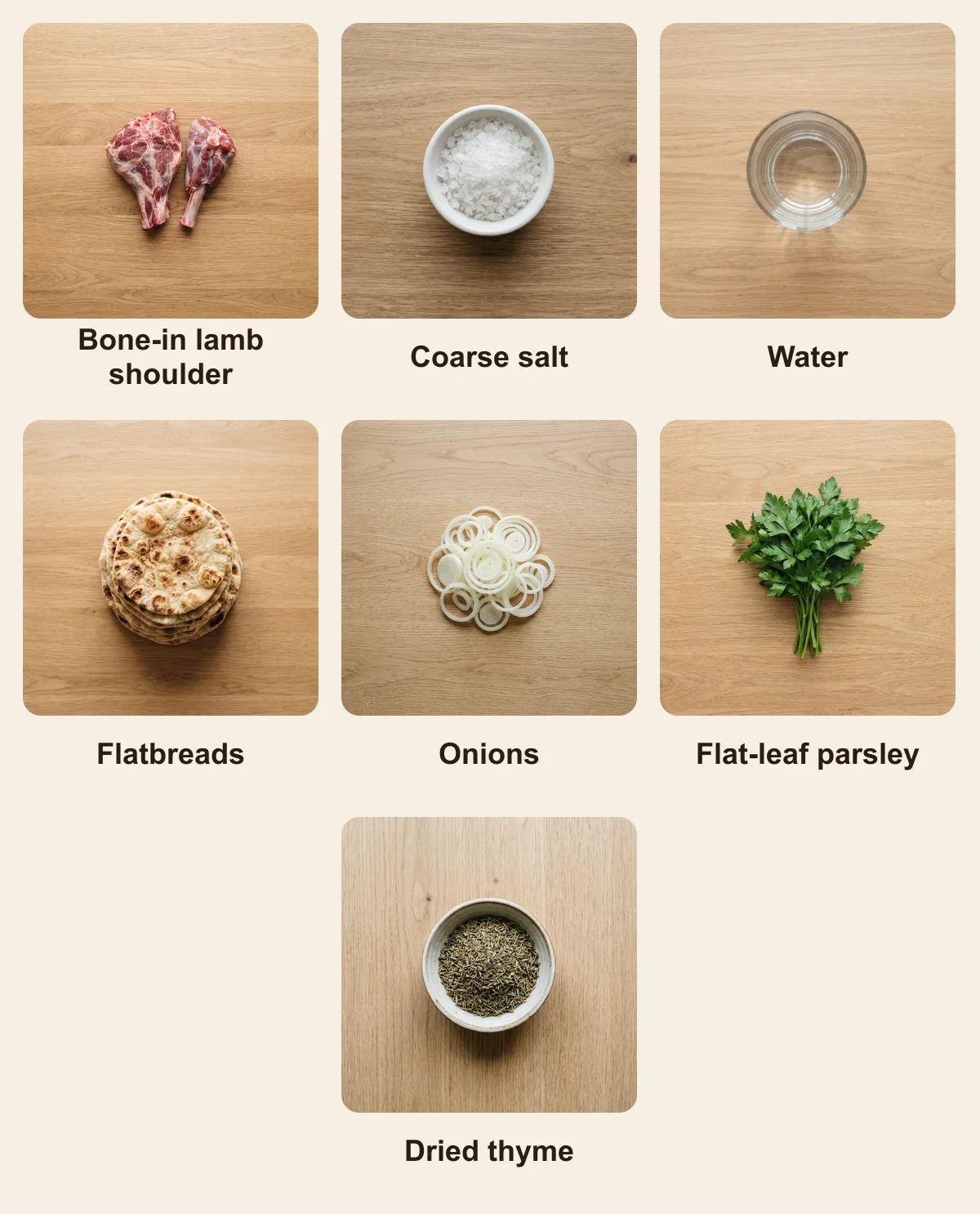
Ingredients
- 2 kg bone-in lamb shoulder
- 20 g coarse salt
- 300 ml water for the oven tray
- 2 flatbreads, warmed
- 2 onions, thinly sliced
- 1 bunch flat-leaf parsley
- 1 tsp dried thyme (optional, for serving)
How to make it
- 1
Rub the shoulder all over with the salt and leave 30 min at room temperature.
- 2
Set the lamb on a rack over a deep tray holding the water, mimicking the humid radiant heat of the well oven.
- 3
Cook at 160 C fan for about 3 h, topping up the water once, until the meat is collapsing off the bone.
- 4
Raise to 220 C for 10 min to take the surface to a burnished gold.
- 5
Rest 20 min, pull into rough chunks and serve on flatbread with onions and parsley.
Pro tip: That tray of water is non-negotiable: a dry oven gives you roast lamb, while steam plus radiant heat gives you kuyu.
Where Kuyu Kebab comes from
Kuyu means well, and that is literally what this is: lamb roasted in a deep shaft dug into the ground and sealed at the top. It is strongest in Aydın in the Aegean and appears in variations across central Anatolia, and it belongs to a family of pit-cooking methods that predates ovens entirely.
In Aydın it is a restaurant speciality with fixed hours — the pit is loaded early and opened at a set time, and when the lamb is gone the day is over. That scarcity is part of the culture around it. Unlike almost every other Turkish kebab, you cannot order it whenever you like.
How Kuyu Kebab is cooked
The pit is fired first with wood until its clay walls are saturated with heat, and the embers are then raked aside or left at the base. Whole lamb carcasses or large sections are hung from hooks so that nothing touches the walls or the fire, and the mouth of the well is sealed, traditionally with a metal lid and a layer of ash or clay.
What follows is radiant, enclosed cooking for three to five hours, closer to a very slow oven than to a grill. Because the shaft is sealed, moisture stays in and the lamb steams as much as it roasts, which is exactly why kuyu kebabı is softer than tandır lamb. The fat renders down and drips away, and the meat pulls off the bone with no resistance.
Ingredients and shopping
This is not a dish that scales down honestly, but a home approximation exists: a bone-in lamb shoulder, heavily salted, roasted on a rack over a tray of water at 160°C fan for about three hours, then blasted at 220°C for ten minutes to firm the outside. It reproduces the sealed, moist, slow logic even if it cannot reproduce the wood.
Seasoning is deliberately minimal in the original — salt, sometimes nothing else. The reason is that a lamb cooked this long develops its own concentrated flavour, and cooks in Aydın consider spice an admission that the lamb was not good enough.
How Kuyu Kebab is served
It is sold and served by weight, laid on flatbread that has been under the meat long enough to absorb the fat, with raw onion, parsley and sometimes a simple pilav. There is no sauce. In Aydın it is eaten at lunchtime and the restaurants that make it properly close when the pit is empty, which locals treat as a feature rather than an inconvenience.
Common mistakes
Pouring liquid over the meat
The water belongs in a pan under the lamb, as in the wells of Denizli and Taşköprü, where it catches the dripping fat and keeps the air moist. Stock or water poured over the meat dilutes exactly the flavour the method concentrates.
Cooking it hot
This is a low, long method. High heat gives you roast lamb, which is a fine thing but not this.
Boneless meat
The bone and the connective tissue around it are what make the result gelatinous rather than merely soft.
Over-seasoning
The tradition is salt and patience. Heavy spicing fights the point of the technique.
Kuyu Kebab: questions and answers
What is the difference between kuyu kebab and tandır?
Both are pit methods, but kuyu uses a deeper sealed shaft where the meat hangs away from the fire and steams as it roasts. Tandır is generally shallower and hotter, giving a drier, more roasted result.
Where is kuyu kebab from?
Aydın province in Turkey's Aegean region is the best-known home of it, with versions across central Anatolia.
Why is it only available at certain hours?
The pit is loaded once and opened at a fixed time. When that day's lamb is sold, service ends — the method does not allow cooking to order.
Sources and further reading
- Pit Kebab — Turkish Foodie
- Kuyu Kebabı — Kültür Portalı (Turkish Ministry of Culture and Tourism)