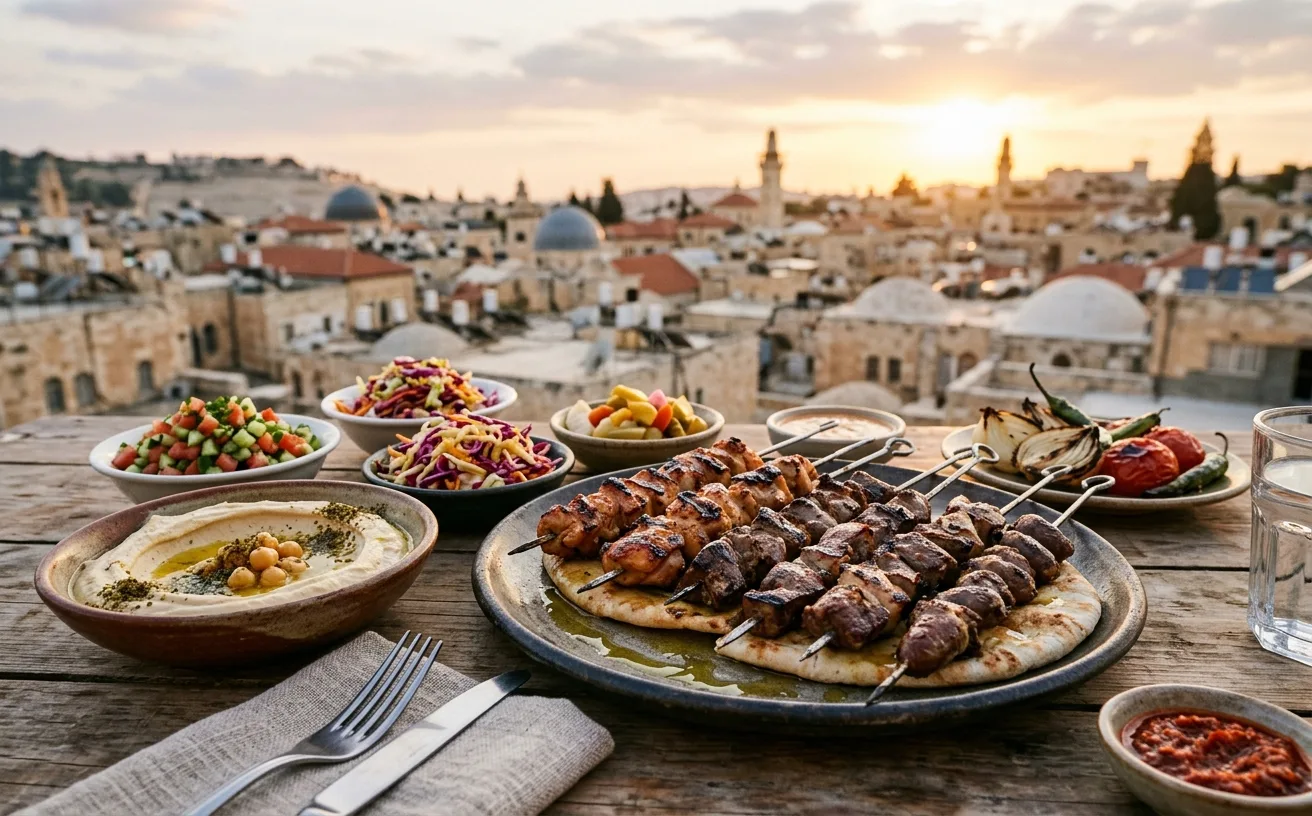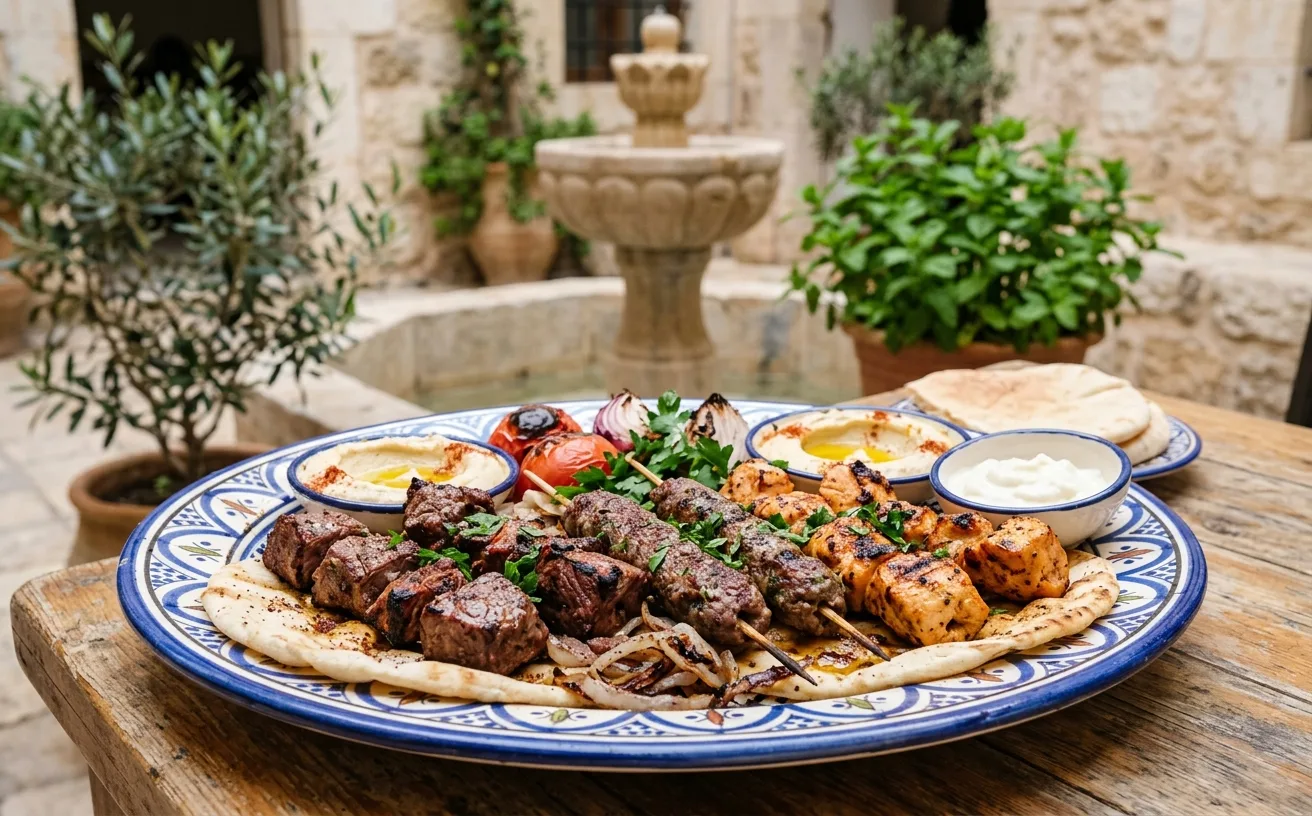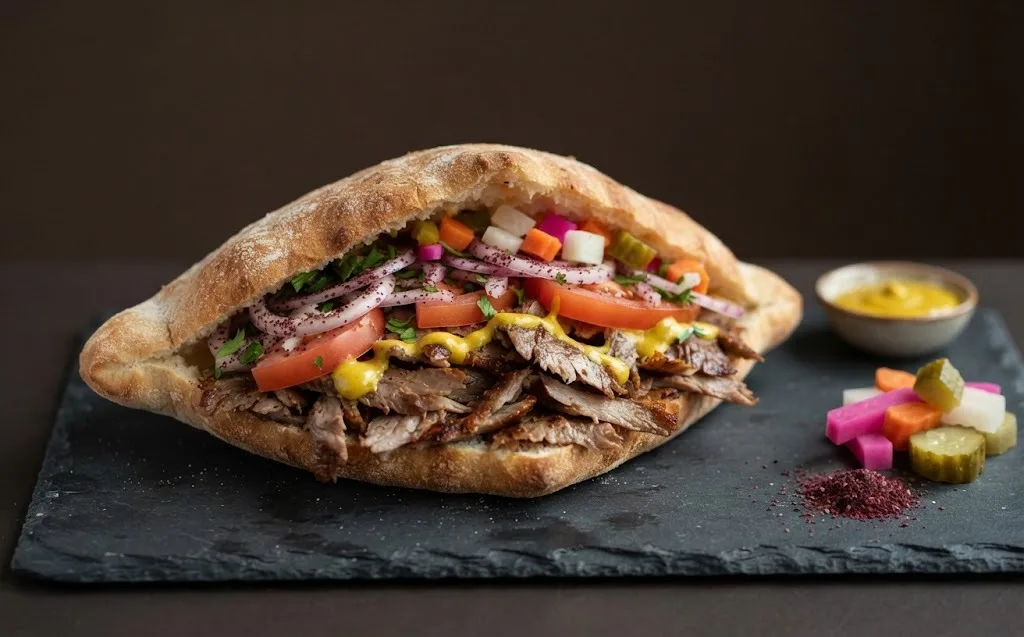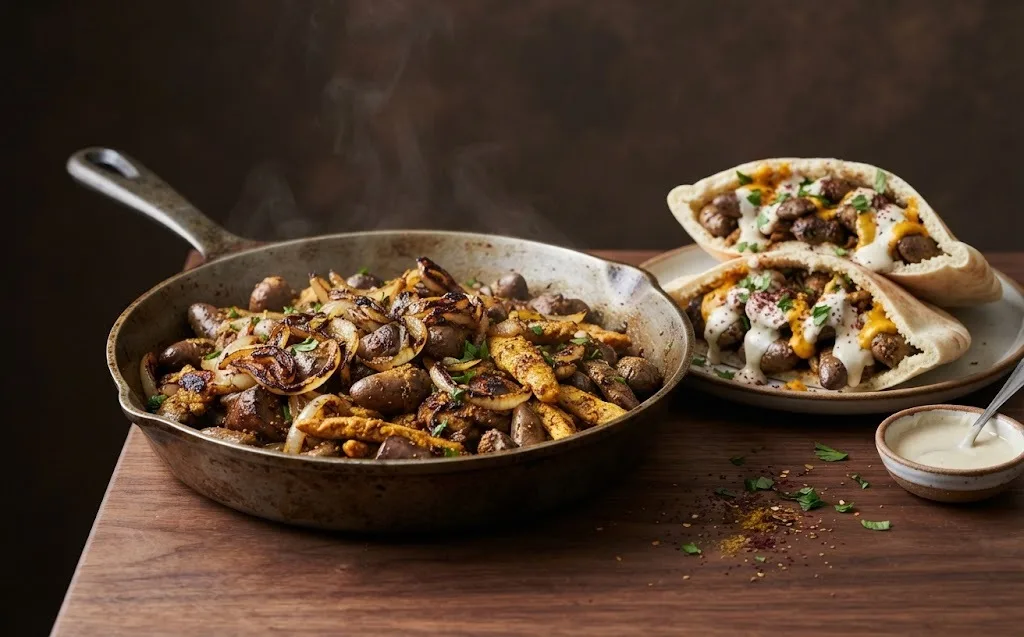
A flat-top griddle scramble of chicken hearts, spleens, livers and lamb bits seared with onion, turmeric, cumin and baharat, credited to grill stalls around Jerusalem's Mahane Yehuda market in the 1960s-70s. Born of kebab-shop offal thrift, it is stuffed into pita or laffa like a skewer meal without the skewer.
Also known as meorav yerushalmi, me'orav, meurav yerushalmi.
Ingredients
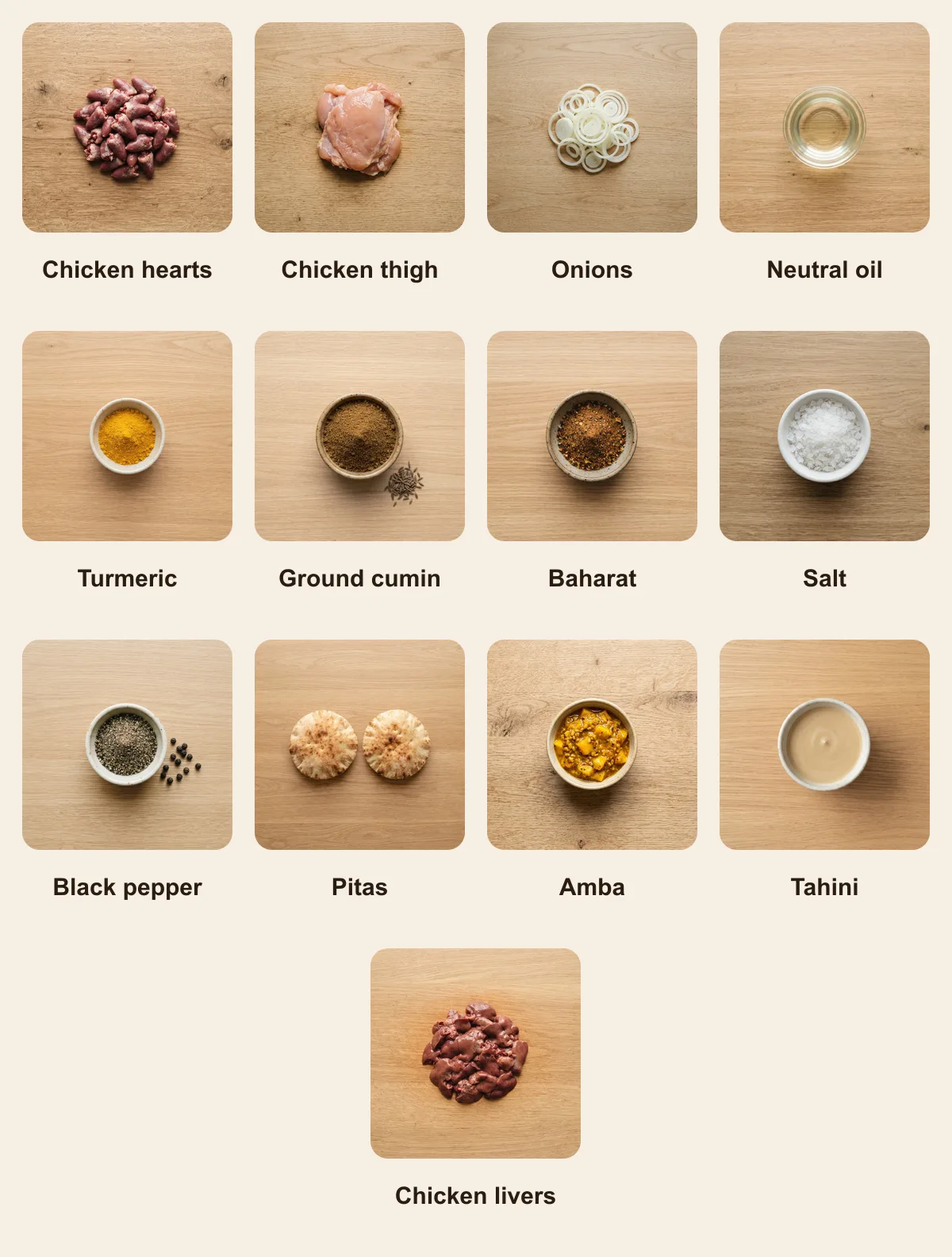
- 300 g chicken hearts, halved
- 300 g chicken livers, cleaned
- 200 g boneless chicken thigh, thin strips
- 2 large onions, sliced
- 3 tbsp neutral oil
- 1 tsp turmeric
- 1 tsp ground cumin
- 1 tsp baharat
- salt and black pepper
- 4 pitas, plus amba and tahini
How to make it
- 1
Get your widest skillet or plancha smoking over maximum heat — this is a griddle dish and crowding is its only enemy.
- 2
Fry the onions in the oil until deeply golden, about 8 minutes, then push them to the edge.
- 3
Sear the hearts and thigh strips hard for 3 minutes without stirring, then add the livers for 2 minutes more.
- 4
Shower in turmeric, cumin, baharat, salt and pepper and toss everything with the onions for a final minute until the spices coat and smell toasty.
- 5
Pack the mix into pitas and finish with stripes of amba and tahini.
Pro tip: Livers go in last and come off just cooked through, with no pink left at the centre; given the full time the hearts need to brown, they turn to chalk.
Where Me'orav Yerushalmi comes from
It is a kebab-shop dish without a skewer, and that is precisely its origin: it uses the parts of the bird that the skewers do not want. It has since become a Jerusalem signature and a fixture on menus across Israel, with the market stalls that invented it still regarded as the benchmark.
How Me'orav Yerushalmi is cooked
This is griddle cooking, not grilling, and the flat-top is essential to the result. The offal is cut small and cooked hard on a very hot surface with sliced onion, so the pieces sear and the onion caramelises into them. There is no liquid at any point; anything that steams turns the offal grey and rubbery.
The order matters because the components differ: hearts and spleens take longest and go on first, livers go on last and need only two or three minutes. Spices go on during cooking rather than as a marinade, so they toast against the hot surface — turmeric especially, which loses its raw edge and turns earthy.
Ingredients and shopping
Chicken hearts and livers from a butcher, spleens too if you can get them, plus a proportion of chicken thigh or lamb for body — many stalls use roughly half offal, half meat. Livers should have their connective tissue trimmed; spleens should be parboiled briefly and any membrane trimmed off.
The spice mix is turmeric, cumin, black pepper and baharat, with coriander or a little cinnamon in some kitchens. Sliced onion in quantity. A cast-iron griddle or the flattest, heaviest pan you own; a wok does not reproduce the effect because the food needs contact with a flat hot surface.
How Me'orav Yerushalmi is served
Stuffed into pita or rolled in laffa with tahini, hummus, salad, pickles and chilli sauce (schug or harif). Chips are common inside the pita as well. It is street food and it is eaten immediately; the offal firms as it cools.
Common mistakes
Cooking everything together
Hearts and spleens need several minutes; livers need only the last two or three. Stagger them or the livers turn to grit.
A crowded pan
Everything steams and greys. Cook in batches on the hottest surface you have.
Marinating
The spices go on during cooking so they toast on the hot metal. A wet marinade prevents the searing this dish depends on.
Not trimming the spleens
Membrane and connective tissue stay tough no matter how long it cooks. Trim them off, and parboil briefly first.
Me'orav Yerushalmi: questions and answers
Why is it called a mixed grill if it is not grilled?
It comes from grill-stall culture and uses grill-shop meat, but it is cooked on a flat-top griddle rather than over coals — which is what gives it its sear.
Where did it originate?
The grill stalls around Mahane Yehuda market in Jerusalem, in the 1960s and 70s, as a way of using the offal the skewers did not take.
Sources and further reading
- Jerusalem mixed grill — Wikipedia
- Mahane Yehuda Market — Wikipedia
- Adventurous Eaters Love This Jerusalem Street Food — The Nosher (My Jewish Learning)