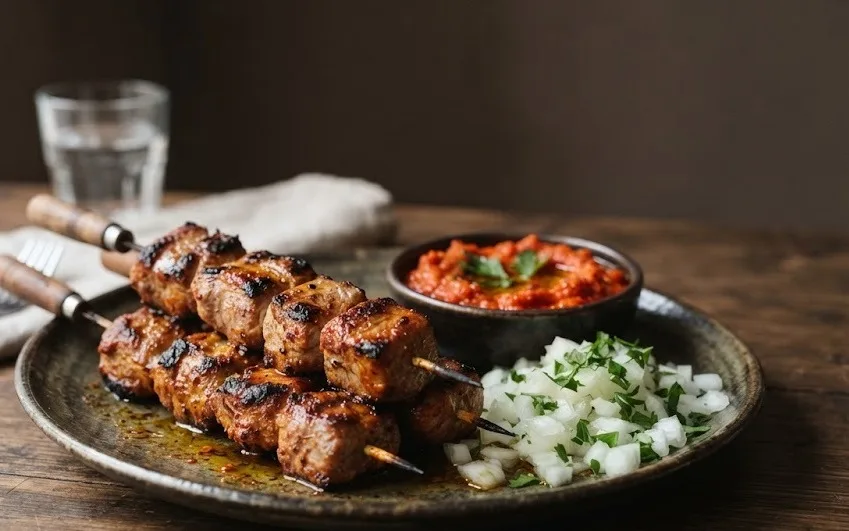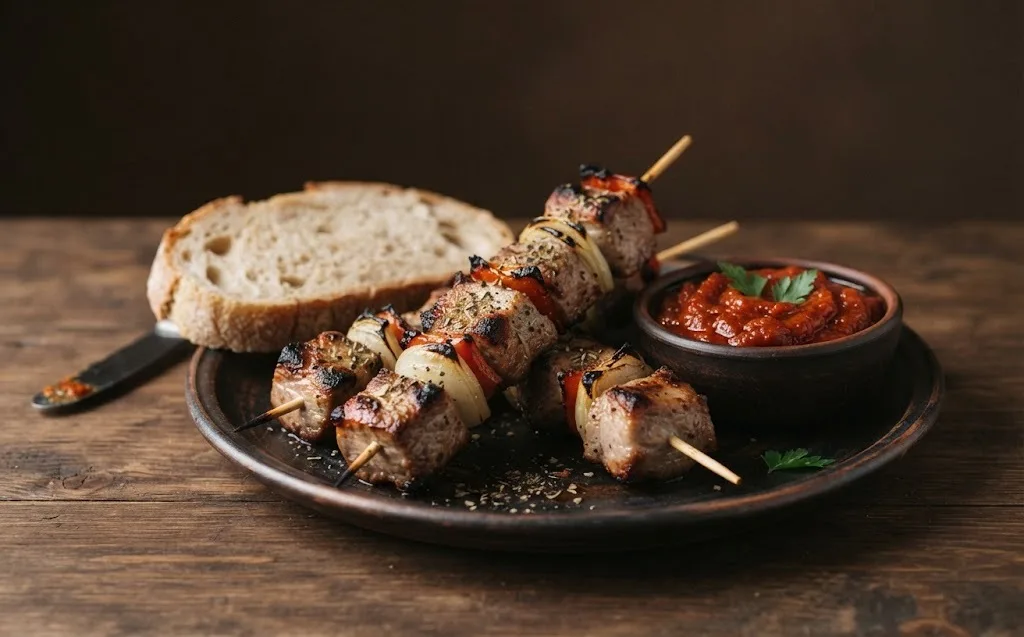
Bulgaria's everyday skewers, a diminutive of the Turkish şiş: cubes of marinated pork or chicken grilled on wooden sticks with peppers, onion, and mushrooms at every skara grill house. The switch from lamb to pork after Ottoman rule is the defining Bulgarian departure from the shish kebab prototype.
Also known as шишчета, shishche, Bulgarian shish.
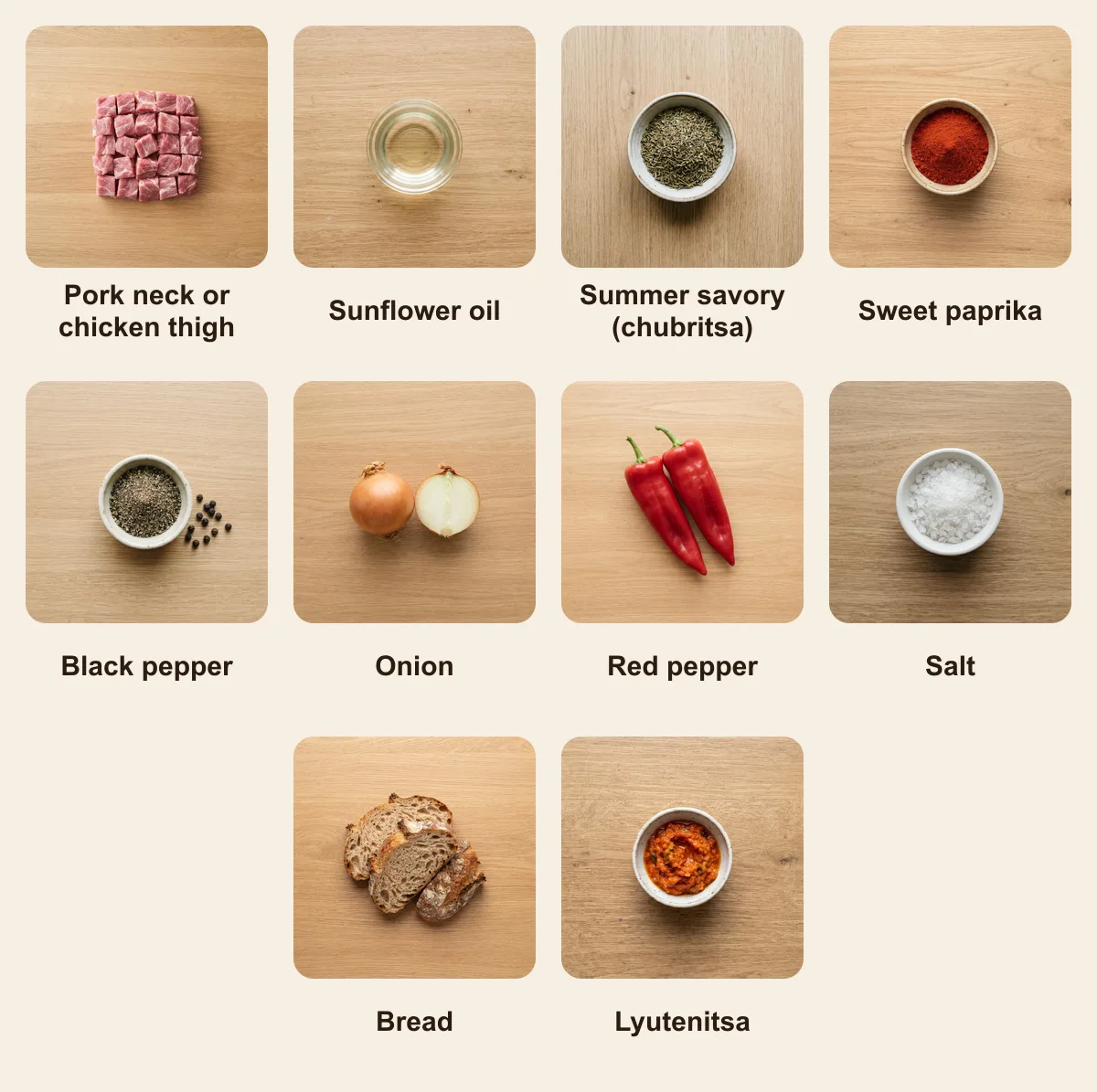
Ingredients
- 700 g pork neck or chicken thigh, in 2 cm cubes
- 2 tbsp sunflower oil
- 1 tbsp dried summer savory (chubritsa)
- 1 tsp sweet paprika
- 1/2 tsp black pepper
- 1 onion, in chunks
- 1 red pepper, in squares
- salt, added only after grilling
- bread and lyutenitsa, to serve
How to make it
- 1
Roll the pork in the oil, chubritsa, paprika and black pepper — no salt yet — and rest 2 hours.
- 2
Alternate meat, onion and pepper pieces on soaked wooden sticks.
- 3
Grill on a skara or grill pan over medium heat 12-14 minutes, turning until the pork chars at the corners and the vegetables slump.
- 4
Salt them as they come off the fire and serve with bread and lyutenitsa.
Pro tip: Chubritsa, not oregano or thyme, is the Bulgarian grill herb — and late salting is the skara master's rule for keeping pork neck juicy.
Where Shishcheta comes from
After the end of Ottoman rule, pork became the default grilling meat across Bulgaria, and shishcheta inherited the Turkish format with the Turkish meat replaced. It is one of the clearest examples in the Balkans of a technique surviving a change of religion.
Turkish format, Bulgarian pork and summer savory
Bulgaria kept the Turkish format and changed the meat. Shish Kebab is lamb, with vegetables grilled on a separate skewer; Shishcheta uses pork neck or shoulder, or chicken thigh, in two-centimetre cubes and threads pepper, onion and mushrooms right alongside, cutting the vegetables larger so they do not burn first. Its marinade of oil, paprika, chubritsa (summer savory) and black pepper differs from the yogurt base of Chicken Shish (Tavuk Shish). Shish Kebab (North American) also mixes meat and vegetables, though with beef or chicken and lemon or vinegar. Like Cop Shish, it goes on soaked wooden sticks. Salt is added only after grilling, and lyutenitsa sits alongside.
Compare: Shish Kebab · Chicken Shish (Tavuk Shish) · Shish Kebab (North American) · Cop Shish
How Shishcheta is cooked
The marinade is typically oil, paprika, savory (chubritsa — the Bulgarian herb that appears in almost everything), garlic and black pepper, often with a little white wine or beer, for a few hours. Savory is the ingredient that makes a shishche taste Bulgarian rather than generic.
Vegetables and meat go on the same skewer here, unlike in Turkey, and Bulgarian grill cooks handle the timing difference by cutting the vegetables in generous pieces and the pork small. Grilling is over medium coals with frequent turning, and the finished skewer is often given a final brush of oil and a dusting of paprika at the pass.
Ingredients and shopping
Pork neck or shoulder in two-centimetre cubes; chicken thigh for the poultry version. Bell peppers in wide squares, onion in thick wedges, and, if you like, whole small mushrooms rather than sliced ones. Wooden skewers are usual and should be soaked.
Chubritsa (summer savory) is the essential Bulgarian herb and is worth sourcing from a Balkan shop; dried thyme is the nearest common substitute but is not the same. Sweet paprika and black pepper complete the marinade; a crushed garlic clove is an optional extra.
How Shishcheta is served
On the skara plate with chips, shopska salad and a pepper relish, or in bread as street food. Lyutenitsa on the side. Rakia before, beer with. In a mehana it is one of the cheaper grill orders and is usually ordered by the piece alongside kebapche and kyufte.
Common mistakes
Cutting the vegetables small
On a mixed skewer they must be larger than the meat or they burn first.
Skipping the savory
Chubritsa is the Bulgarian signature. Without it a shishche is just a generic kebab.
Fierce heat
Mixed skewers with vegetables need medium coals and turning, not a hard sear.
Unsoaked wooden skewers
They char through and break, usually while you are turning them.
Shishcheta: questions and answers
What does shishcheta mean?
It is a Bulgarian diminutive of the Turkish şiş — little skewers.
What meat is used?
Pork most commonly, or chicken. The switch from lamb to pork after Ottoman rule is the defining Bulgarian departure from the shish kebab prototype.
What is chubritsa?
Bulgarian summer savory, the herb used in most Bulgarian grilling. Dried thyme is the nearest substitute but noticeably different.
Do the vegetables go on the same skewer?
In Bulgaria, yes — unlike Turkish practice. Cut them larger than the meat so they do not burn first.
Sources and further reading
- Bulgarian cuisine — Wikipedia
- Bulgarian Cuisine — Plovdiv University, International Relations Office
- Shish — Wikipedia