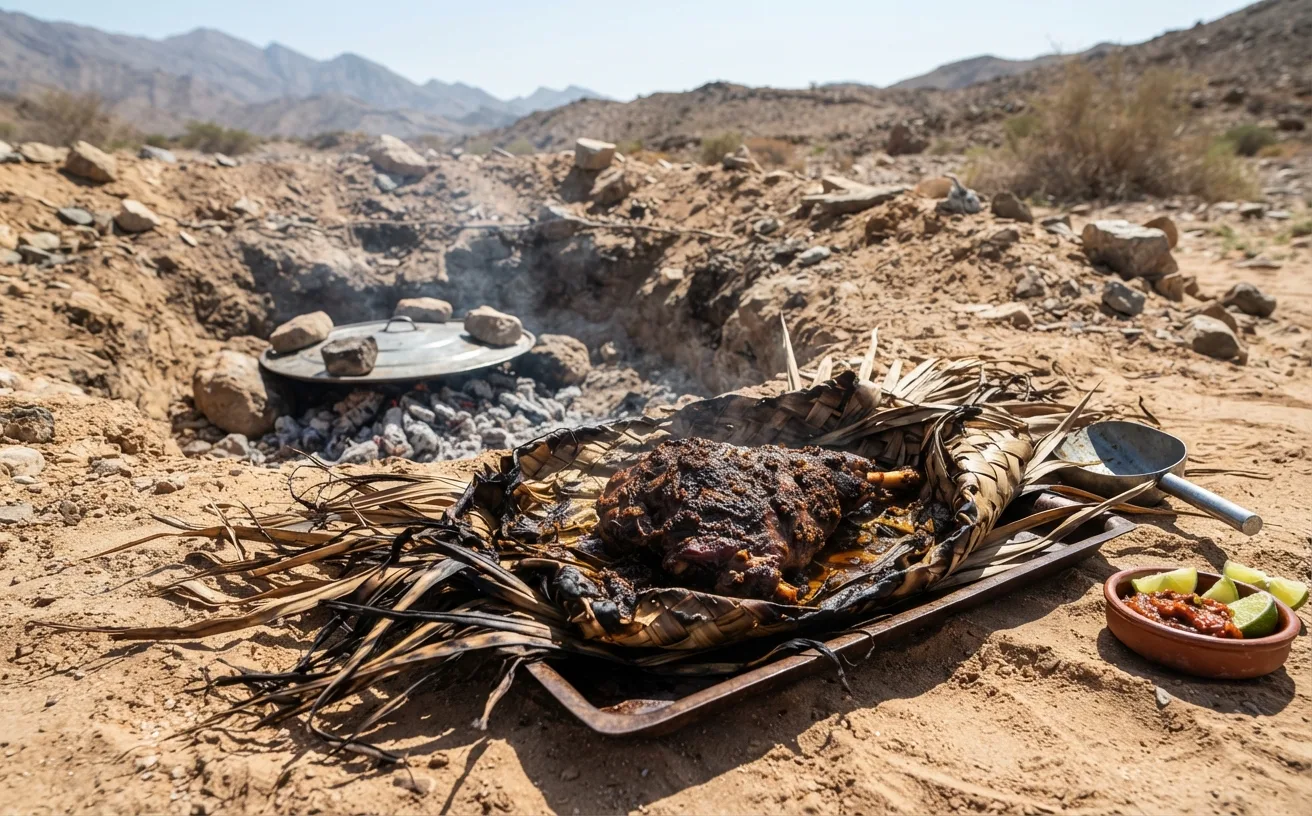
Oman's Eid centerpiece: whole lamb or goat rubbed with date paste, tamarind and a dense spice blend, wrapped in banana or palm-frond leaves and buried in a communal underground ember pit for one to two days. The name simply means 'grilling' in Arabic — the kebab impulse taken to its slowest possible extreme.
Also known as Omani shuwa, shuwa lamb, شواء عماني.
Reference video
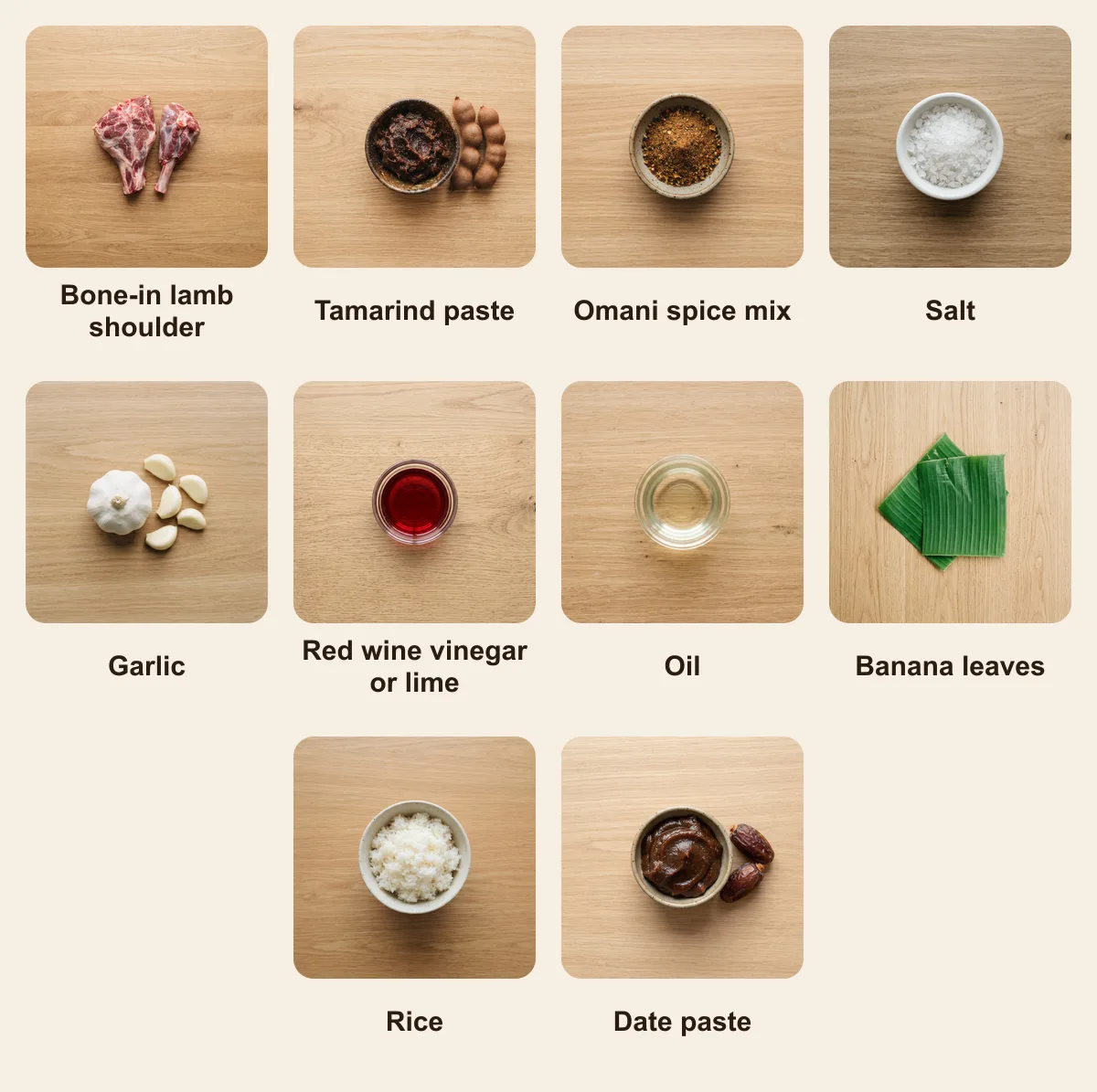
Ingredients
- 1.8 kg lamb shoulder, bone-in
- 3 tbsp date paste
- 2 tbsp tamarind paste
- 2 tbsp Omani spice mix (cumin, coriander, cardamom, clove, chili)
- 1 tbsp salt
- 6 garlic cloves
- 2 tbsp red wine vinegar or lime juice
- 2 tbsp oil
- 2 large banana leaves, plus foil to seal
- cooked rice, to serve
How to make it
- 1
Blend the date paste, tamarind, spices, salt, garlic, vinegar and oil into a thick, almost-black paste and massage it deep into slashes cut across the lamb; rest overnight.
- 2
Wrap the shoulder tightly in banana leaves, then in foil, sealing every seam — shuwa cooks in its own trapped steam like the underground pit it comes from.
- 3
Bake at 120 C for 8-10 hours without opening the parcel.
- 4
Unwrap at the table: the meat should slump off the bone at the touch of a spoon.
- 5
Pile over rice and spoon the leaf-scented juices from the wrapper on top.
Pro tip: The date paste is not garnish sweetness — it blackens into the crust during the long roast and is what separates shuwa from any other slow lamb.
Where Shuwa comes from
It is fundamentally communal. The pit belongs to a family or a neighbourhood, it is opened on a fixed day of Eid, and the labour of digging, firing, wrapping and burying is shared. Omanis measure the year by it, and the dish is inseparable from the occasion in a way that few dishes in this atlas are.
How Shuwa is cooked
The pit is fired with wood until a deep bed of embers forms, and the wrapped meat is lowered in, covered with sand or earth, and sealed completely. From that moment nothing can be checked or adjusted for a day or more, which puts all the skill into the preparation and the sealing.
The leaves are structural. They protect the meat from direct contact with earth and embers, hold the spice paste against the surface, and trap steam so the lamb effectively braises in its own moisture at low temperature for an extraordinarily long time. The result is meat that has passed well beyond tender into something closer to confit.
Ingredients and shopping
The traditional paste is dates or date paste, tamarind, cumin, coriander, chilli, turmeric, garlic, and often dried lime, blended with oil or ghee into a thick rub. Its density matters — a thin marinade would simply wash off over a day underground.
For a domestic version, a bone-in lamb shoulder rubbed with the same paste, wrapped in banana leaves and then foil, and cooked at 120°C for eight to ten hours reproduces the logic if not the smoke. Real banana leaves are available frozen from Asian and Middle Eastern grocers and are worth using for the aroma.
How Shuwa is served
Pulled apart and served over spiced rice on a large communal platter, with the cooking juices poured over, and eaten with the hands. Omani halwa and kahwa afterwards. It is the centrepiece of Eid al-Adha and is eaten across several days of visiting.
Common mistakes
A thin marinade
Over a day of cooking it disappears. The rub must be a thick paste that clings.
Skipping the leaves
They hold the paste, protect the meat and trap steam. Foil alone gives none of the aroma and less of the moisture.
Opening the pit early
Once sealed it cannot be checked. In a domestic oven, the equivalent is resisting the urge to open the door.
Cooking it hot
This is a very low, very long method. High heat gives roast lamb, which is an entirely different dish.
Shuwa: questions and answers
How long does shuwa take?
One to two days buried in a sealed ember pit. It cannot be checked or adjusted once it is in.
What is the spice paste made of?
Dates or date paste, tamarind, cumin, coriander, chilli, turmeric, garlic and often dried lime, blended thick with oil or ghee.
Sources and further reading
- SHUWA (Pit Roasted Lamb Wrapped in Banana Leaves) — Oman Observer
- In pictures: Do you know about Omani Shuwa? — Times of Oman