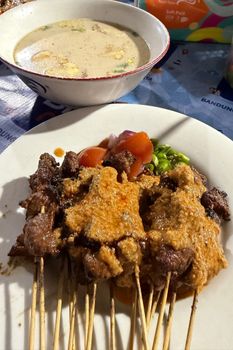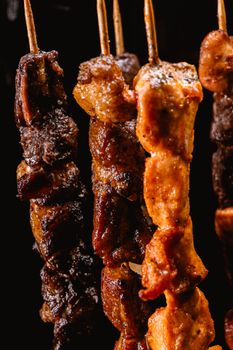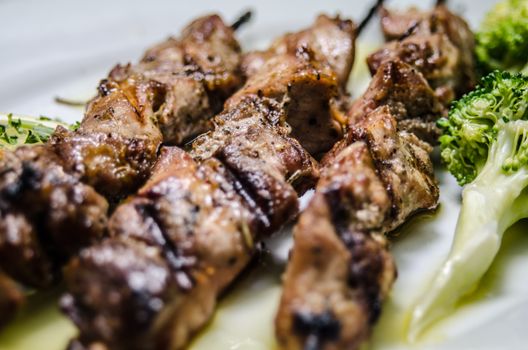
Luanda's roadside grills and beach barracas thread beef or goat onto skewers and fire them over charcoal, seasoned with garlic and the local jindungo chili that stands in for piri-piri. A direct heir of Portuguese churrasco culture, it is standard weekend fare alongside funge and grilled fish at informal street stalls.
Also known as: espetadas angolanas, espetada de cabrito, churrasco de rua
Watch it made
Ingredients
- 700 g beef or goat leg, 4 cm cubes
- 3 garlic cloves, mashed
- 1-2 jindungo chilies (or bird's-eye), minced
- 1 lemon, juiced
- 1 bay leaf, crumbled
- 2 tbsp palm or neutral oil
- 1.5 tsp coarse salt
- 1 red onion, petals, for threading
- crusty bread or funge, to serve
How to make it
- 1
Mash the garlic, jindungo, lemon juice, bay, oil and salt into a rough paste and rub it over the meat; marinate 3 hours.
- 2
Alternate the cubes with onion petals on sturdy skewers.
- 3
Fire over strong charcoal at a Luanda roadside pace — 12 minutes or so, turned every 3, until crusted deep brown.
- 4
Let the sticks stand 3-4 minutes off the heat.
- 5
Serve with bread to catch the chili-lemon drippings, extra jindungo on the side for the brave.
Pro tip: Jindungo heat blooms during grilling — seed the chilies for the marinade and serve whole ones alongside rather than doubling them in the paste.
The story of Angolan espetada
Luanda's roadside grills and beach barracas thread beef or goat onto skewers and fire them over charcoal, seasoned with garlic and the local jindungo chilli that stands in for piri-piri. It is a direct heir of Portuguese churrasco culture and is standard weekend fare alongside funge and grilled fish at informal street stalls.
Jindungo is the Angolan name for the small hot chilli used across the country, and the distinction from Mozambican piri-piri is more linguistic than botanical — both belong to the same family of small African bird chillies that Portuguese traders spread around the world. What differs is how Angola uses it: more often raw, in a table sauce, than cooked into a baste.
The technique that defines it
The marinade is simple and garlic-dominant: crushed garlic, oil, salt, lemon or vinegar and a little jindungo, for a few hours. Angolan grilling is not a heavily spiced tradition and the emphasis falls on the fire and the accompanying sauce rather than on the meat's seasoning.
Grilling is over charcoal at moderate heat with regular turning. Goat, which is common and cheap, needs the longer end of the cook and benefits from a slightly acidic marinade; beef takes less. The jindungo sauce — chilli, garlic, oil, sometimes lemon — is made separately and served on the side.
Choosing your ingredients
Beef or goat in three-centimetre cubes with fat left on. Goat from a younger animal if possible, since the marinade is light. Jindungo or any small hot chilli — bird's-eye works well.
Garlic in quantity, oil, salt, lemon or vinegar. Funge — the cassava or maize porridge — is the traditional starch, though bread and chips are both common at street stalls. A tomato-and-onion salad, and the jindungo sauce on the side.
Mistakes that ruin it
Over-marinating goat in acid
A few hours is enough. Longer and the surface turns soft and grey.
Cooking jindungo into everything
Angolan practice keeps most of the chilli in a table sauce rather than in the marinade. That way the heat is adjustable.
A fierce fire
Moderate charcoal and turning. Goat in particular needs time and dries out over hard heat.
Trimming the fat
With a light marinade there is nothing else keeping the meat moist.
How it is served
Off the skewer with funge, chips or bread, a tomato-and-onion salad and jindungo sauce on the side. Cuca beer. At a beach barraca on a weekend it is ordered by the stick alongside grilled fish, and the meal stretches over an afternoon.
Questions about Angolan espetada
What is jindungo?
The Angolan name for the small hot chilli used across the country — the same family as piri-piri. It is used mostly in a table sauce rather than in marinades.
What is funge?
A stiff cassava or maize porridge, Angola's traditional starch, eaten with grilled meat and fish.
What meat is used?
Beef or goat, in cubes with the fat left on. Goat is common and cheap and needs the longer end of the cook.
How is it different from Mozambican espetada?
Angola keeps the chilli mostly in a side sauce and pairs the meat with funge; Mozambique bastes with piri-piri butter and leans on prawns.