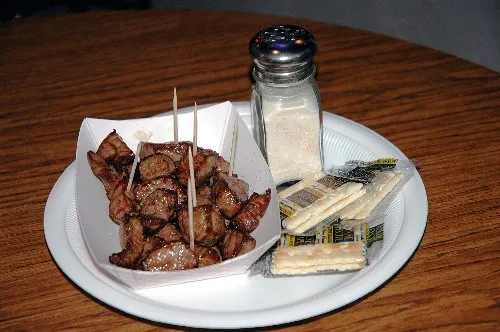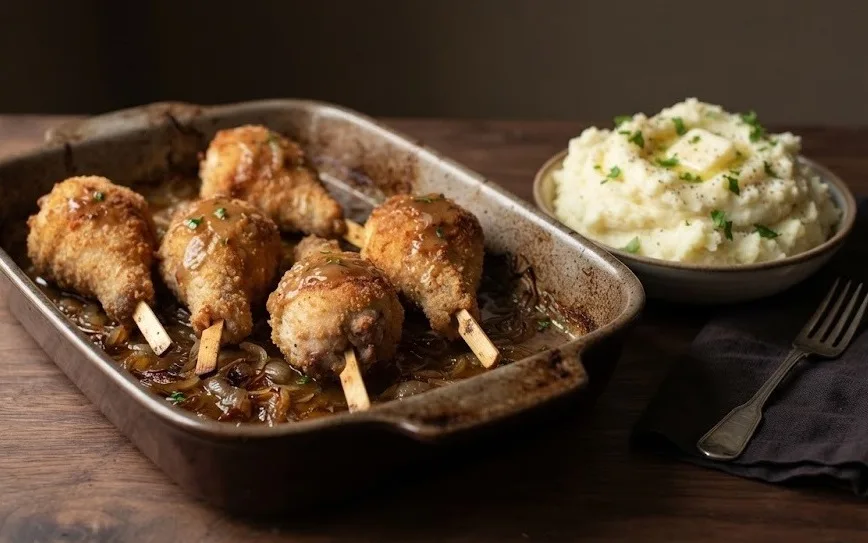
A Depression-era Rust Belt (Pittsburgh, Cleveland, Detroit) skewer of cubed pork and veal molded on a wooden stick, breaded, and fried or braised to imitate a chicken drumstick when chicken cost more than pork. Polish and Eastern European mill-town cooks turned the kebab format into edible trompe-l'oeil.
Also known as mock chicken legs, mock drumsticks, kokoshki.
Reference video
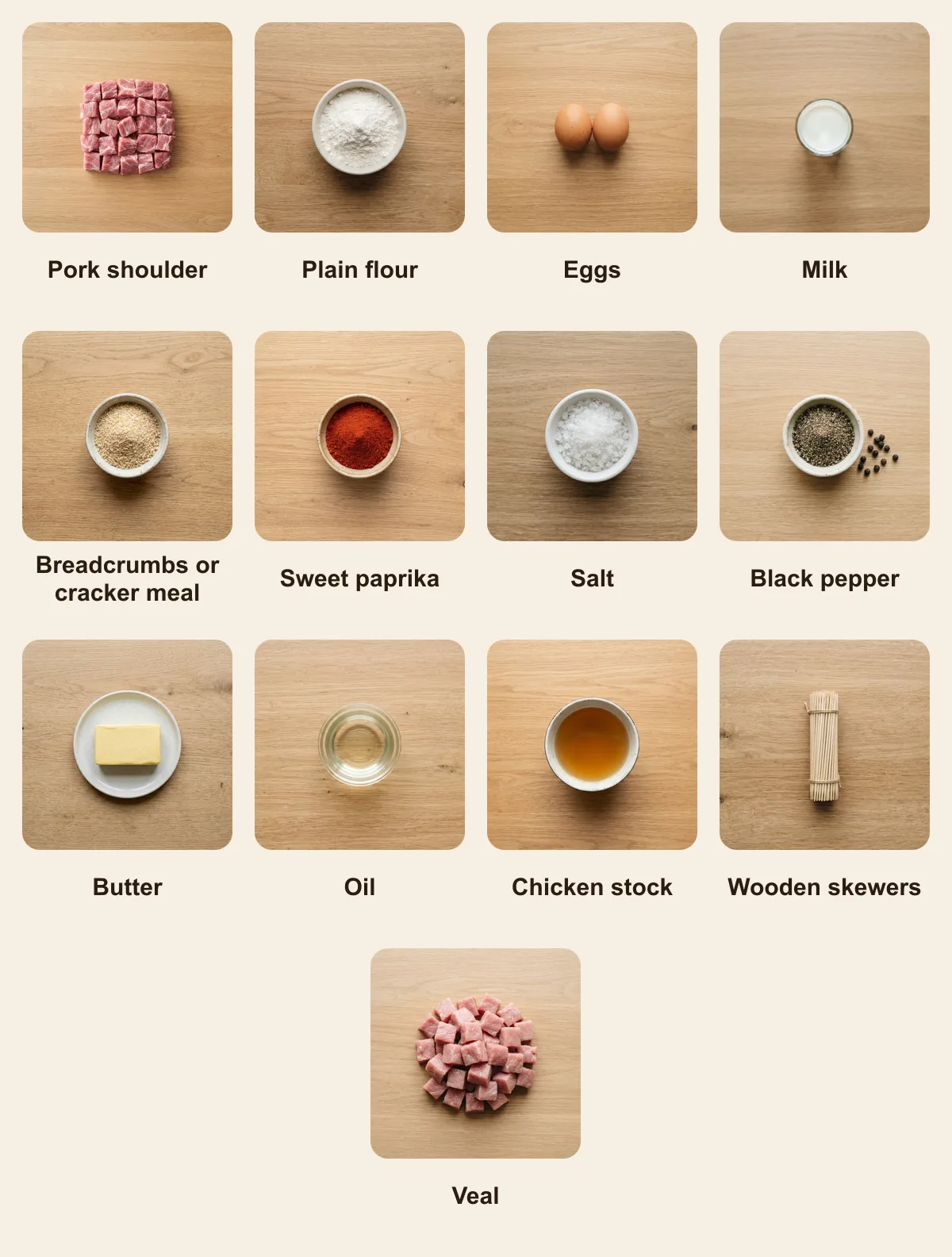
Ingredients
- 500 g pork shoulder and 250 g veal (or all pork), in 3 cm cubes
- 100 g plain flour
- 2 eggs, beaten with 2 tbsp milk
- 120 g dry breadcrumbs or cracker meal
- 1 tsp sweet paprika
- 1 tsp salt and 1/2 tsp black pepper
- 3 tbsp butter and 2 tbsp oil
- 150 ml chicken stock
- 8 short wooden skewers
How to make it
- 1
Thread the pork and veal snugly onto the short skewers so each mimics a little drumstick.
- 2
Season the flour with paprika, salt and pepper, then coat each skewer flour, egg wash, crumbs, pressing so the breading knits.
- 3
Brown on all sides in the butter and oil, 6-8 minutes, to a deep gold.
- 4
Nestle the skewers in a baking dish, pour the stock around (not over) them, cover with foil and bake at 180°C for 45-50 minutes until fork-tender.
- 5
Uncover for a final 10 minutes to re-crisp and serve with the pan juices and mashed potatoes.
Pro tip: There is no chicken in it — the Depression-era magic is the covered braise-bake, which turns cheap pork as tender as the bird it imitated.
Where City chicken comes from
City chicken is a Depression-era Rust Belt dish and one of the most charming pieces of culinary trompe-l'oeil in this atlas: cubes of pork and veal moulded onto a wooden stick, breaded, and fried or braised to imitate a chicken drumstick. It comes from the mill towns of Pittsburgh, Cleveland and Detroit.
The logic was economic and is now inverted. In the 1930s chicken was more expensive than pork and veal in industrial cities, so Polish and Eastern European cooks made a fake drumstick from the cheaper meat. Today the reverse is true, which makes city chicken a dish that costs more than the thing it imitates — and it survives anyway, out of affection.
How City chicken is cooked
The moulding is the point. Cubes of pork and veal are threaded onto a short wooden skewer and pressed into a rough drumstick shape, tapering toward the stick, so that the finished breaded article reads as a leg at a glance. It is a visual joke executed carefully.
The cooking is a two-stage method: breaded and browned in fat first, then covered and braised or baked in a little liquid until the meat is tender. That second stage is essential — pork and veal cubes on a stick, fried alone, would be tough. The braise is what makes it eat like the thing it imitates.
Ingredients and shopping
Pork shoulder with some veal, about two parts pork to one of veal, cut into cubes of about three centimetres. Pork alone is common now that veal is expensive and works acceptably. Short wooden skewers — the traditional ones are flat.
A standard three-stage breading: seasoned flour, beaten egg, then breadcrumb. Butter and a neutral oil for browning. A little stock or water in the pan for the braise, and a lid or foil.
How City chicken is served
With mashed potato and gravy made from the pan, and a vegetable — the Rust Belt Sunday-dinner treatment. It is nostalgia food in Pittsburgh and Cleveland and appears at church suppers and family gatherings more than in restaurants.
Common mistakes
Frying only, without braising
Cubes of pork and veal fried alone are tough. The covered second stage is what tenderises them.
Cubes too large
They will not shape into a drumstick and take too long to cook through.
Too much liquid in the braise
It should be a shallow amount — enough to steam, not enough to strip the breading off.
Skipping the flour stage of the breading
It is what makes the egg adhere. Without it the crumb falls off in the pan.
City chicken: questions and answers
Why is it called city chicken if there is no chicken?
It was made in industrial cities in the 1930s to imitate a chicken drumstick, when chicken was more expensive than pork and veal. The name is the joke.
What meat is used?
Mostly pork, often with some veal; about two parts pork to one of veal. Pork alone is common now that veal is costly.
Sources and further reading
- City chicken — Wikipedia
- The Tale of Two City Chickens — West Hills Gazette