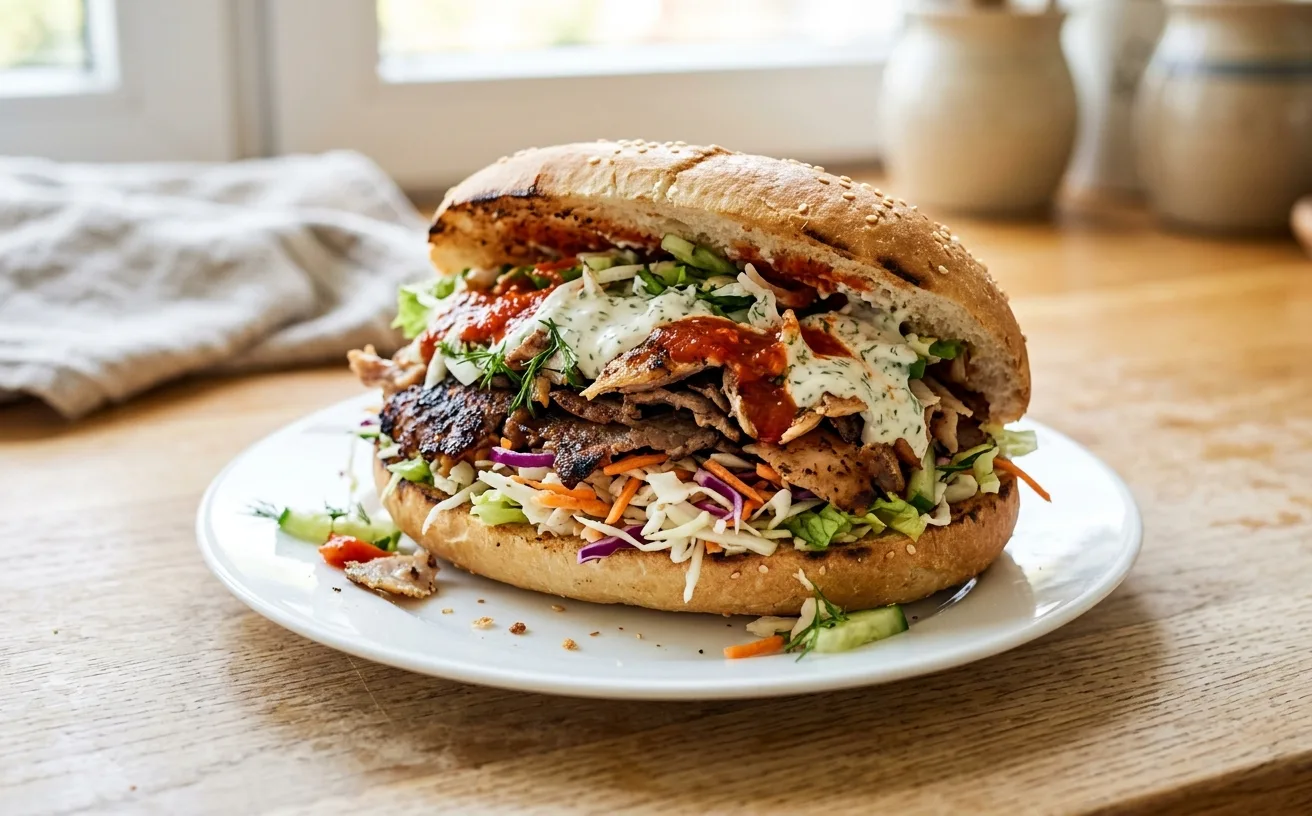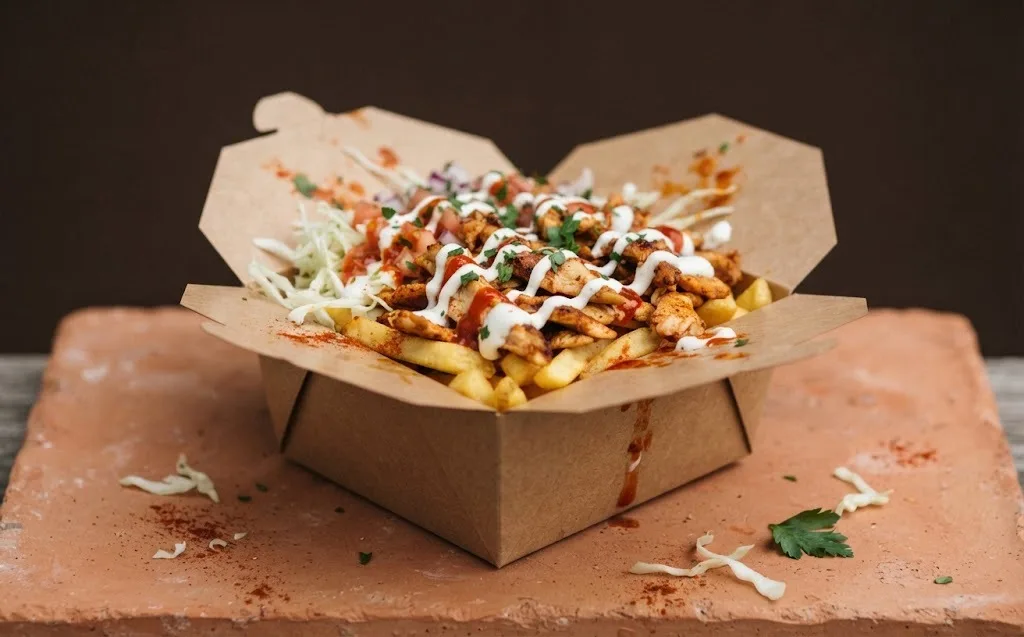
A portable cardboard or plastic box of fries (or rice) topped with shaved doner meat, salad, and sauce, sold at Viennese and German würstelstand-style kebab stands as a one-hand street meal. It is the fast-food-packaging generation of the Central European doner tradition.
Also known as Dönerbox, doner box, kebab box.
Reference video
Ingredients
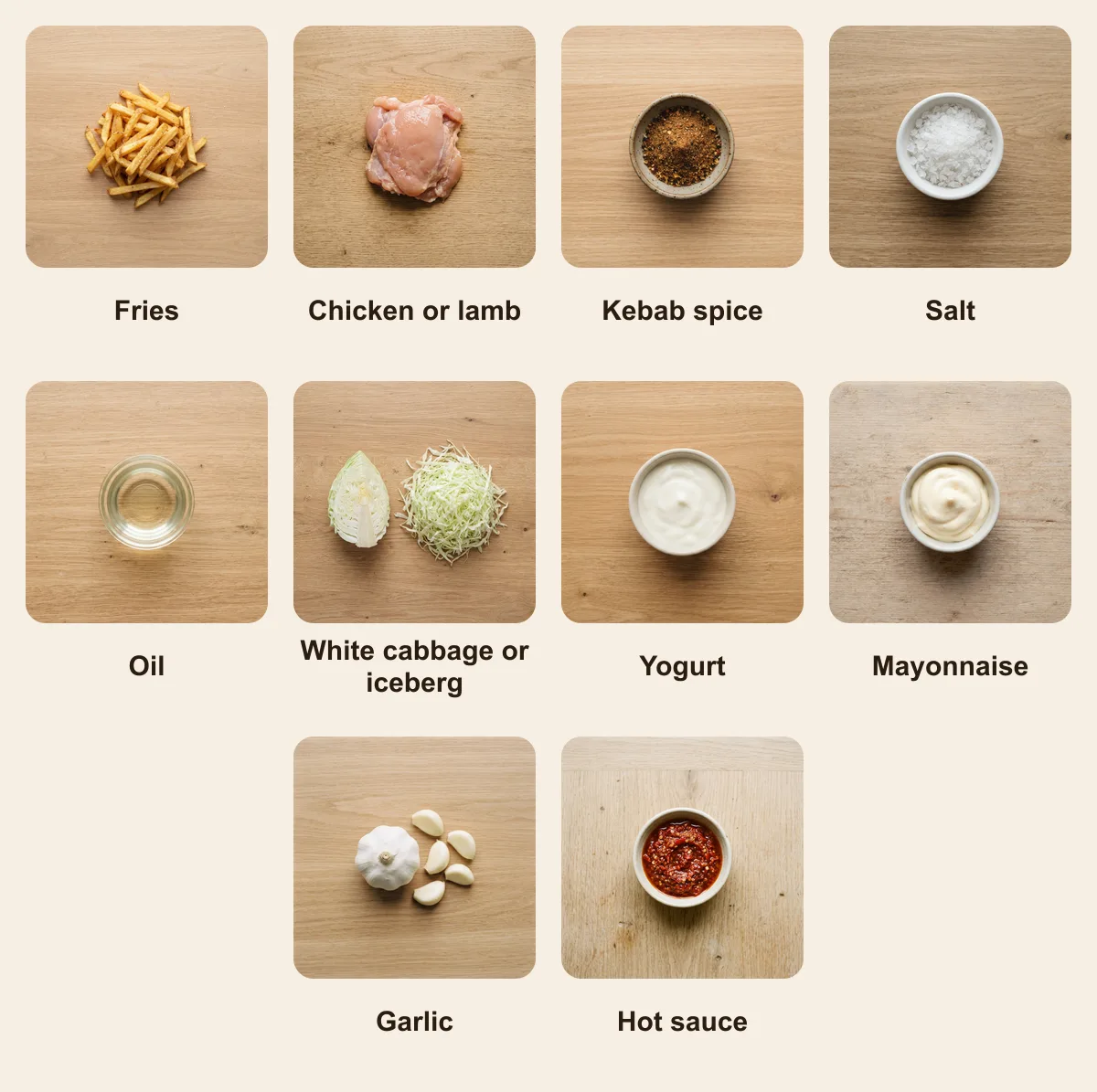
- 800 g fries
- 500 g chicken or lamb, in thin strips
- 2 tsp kebab spice (paprika, cumin, coriander, garlic powder) and 1 tsp salt
- 1 tbsp oil
- 150 g white cabbage or iceberg, shredded fine
- 150 g yogurt, 3 tbsp mayonnaise and 1 crushed garlic clove, for the sauce
- hot sauce, to taste
- 4 takeaway boxes or deep bowls
How to make it
- 1
Get the fries crisp — 180°C oil for 4-5 minutes, or a hot oven at 220°C for 20-25 minutes — and salt them the moment they come out.
- 2
Toss the strips with the spice and salt, then fry them fast in oil, 3-4 minutes, until browned.
- 3
Half-fill each box with fries, keeping them dry, then stack meat and a little cabbage on top.
- 4
Add hot sauce to taste, then lattice the garlic sauce over the top rather than pouring it, lid on — fork through the flap, Vienna style.
Pro tip: Lattice the sauce over the top rather than pouring it — poured on, it pools at the bottom and turns the fries to sludge.
Where Kebap-Box comes from
Its lineage is specifically Viennese. The würstelstand — the street sausage stand — is an old and protected part of the city's food culture, and it established the format of a hot meal eaten standing at a counter with no seating. Turkish-run stands adopted that format wholesale and the box is the result: a plate that does not need a table.
How Kebap-Box is cooked
The box is the constraint that shapes everything. It has to be eaten one-handed while standing at a counter, which means the components must be small enough to spear with a plastic fork and the sauce must be applied so it does not pool at the bottom.
The practical solution used by Viennese stands is to build in layers with the fries at the bottom, meat and salad in the middle, and sauce applied in a lattice over the top rather than poured. That keeps the lower fries dry for long enough to matter, which is roughly the life expectancy of the box.
Ingredients and shopping
Fries or rice. Doner meat, shaved and crisped; at home, thin strips of spiced chicken or lamb fried hard stand in for it. Mixed salad cut fine, red cabbage, and often a chopped tomato-cucumber mix. Pepperoncini are common.
Austrian stands typically offer a garlic-yoghurt sauce, a herb sauce and a chilli sauce, in the German pattern rather than the Swedish two-sauce one. Some add a curry-style sauce, which is a würstelstand crossover.
How Kebap-Box is served
In the box with a plastic fork, standing at the stand, often late. A can of something cold. It is the Viennese street-food format applied to a Turkish product, and both traditions are visible in it.
Common mistakes
Pouring sauce over everything
It pools at the bottom and turns the fries to sludge. Lattice it over the top.
Coarse salad
It has to be eaten with a plastic fork standing up. Cut everything fine.
Too much salad relative to the box
It overflows and cannot be eaten cleanly. The box sets the portion.
Cold meat
The heat of the meat is what keeps the whole box appealing. Shave and crisp it to order.
Kebap-Box: questions and answers
What is a Kebap-Box?
An Austrian street-food box of fries or rice topped with shaved doner meat, salad and sauce, eaten standing at a kebab stand.
How is it different from a Swedish kebabtallrik?
The box is designed to be eaten standing with one hand and a plastic fork; the Swedish plate is a composed sit-down meal eaten with cutlery.
Why lattice the sauce?
Poured over, it pools at the bottom and ruins the fries. A lattice keeps the lower layer dry longer.
Sources and further reading
- Street food before it was cool: 6 of Vienna's real street food dishes — Vienna Würstelstand
- Würstelstand — Wikipedia