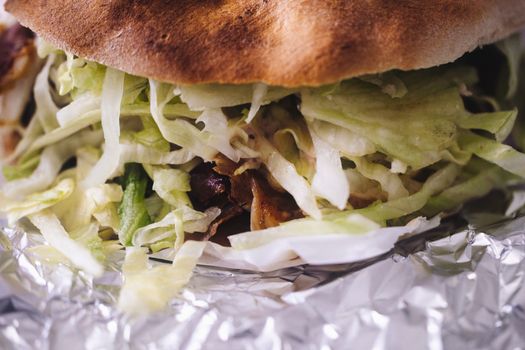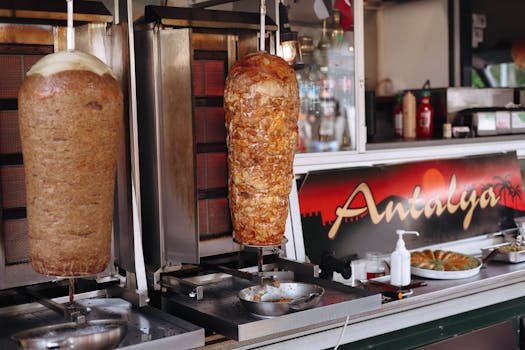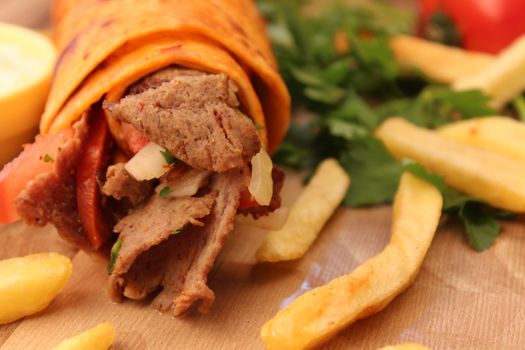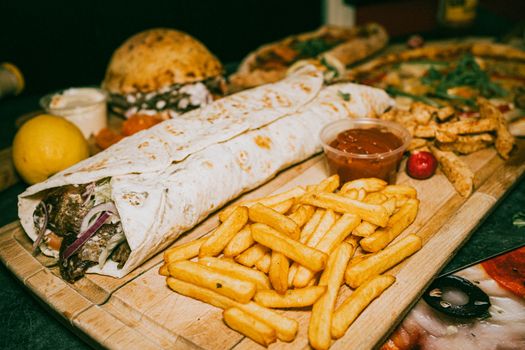
A Brussels friterie classic: a half baguette stuffed with meat, a full portion of frites, and sauce, with spit-carved doner as the dominant filling in kebab shops. The 'little machine gun' shows how Turkish doner was absorbed into Belgium's fry-shop format rather than displacing it.
Also known as: mitraillette, mitraillette kebab, machine gun sandwich, mitraillette durum
Watch it made
Ingredients
- 2 demi-baguettes, lightly warmed
- 400 g doner or gyros slices (or thin-cut marinated lamb or chicken)
- 800 g Bintje or Maris Piper potatoes, in 12 mm batons
- 1 kg beef dripping (blanc de boeuf) or 1.5 L frying oil
- 100 g mayonnaise, 20 g tomato paste, pinch of cayenne (quick sauce andalouse)
- Or samurai sauce: mayonnaise beaten with harissa
- Optional lettuce and tomato
How to make it
- 1
Rinse and dry the potato batons, then blanch them in dripping at 150 C for 6 minutes; rest at least 15 minutes.
- 2
Stir the andalouse together and keep it cold.
- 3
Sizzle the doner slices on a dry, hot pan until the edges frill and crisp.
- 4
Refry the frites at 180 C for 2-3 minutes to a deep gold; salt them in the air, not in the bread.
- 5
Split the demi-baguette, lay in the meat, cram a full portion of frites on top of it, and ribbon the sauce over everything.
Pro tip: Fry in beef dripping if you can find it; blanc de boeuf is what makes Belgian frites taste Belgian. And the frites go inside the bread, on top of the meat, never on the side; that is the entire legal definition of a mitraillette.
The story of Mitraillette with doner
The mitraillette — little machine gun — is a Brussels friterie classic: a half baguette stuffed with meat, a full portion of frites and sauce. In kebab shops the meat is spit-carved doner, and the resulting sandwich shows how Turkish doner was absorbed into Belgium's existing fry-shop format rather than displacing it.
That absorption is the interesting part. Belgium had a deeply established friterie culture, with its own baguette-and-frites sandwich formats, before doner arrived. Rather than opening separate kebab shops selling a Berlin-style wrap, the meat was slotted into the local sandwich, and the mitraillette au kebab is the result.
The technique that defines it
Belgian frites are the non-negotiable component and they are made a specific way: cut thick, blanched at a low temperature until soft but pale, rested, then fried hot until golden. That double cook is what gives them a fluffy interior and a crust firm enough to survive being packed into a baguette under sauce.
The baguette is split, filled with the meat first, then the frites piled on top, then the sauce over everything. The frites go in hot and directly from the fryer — a mitraillette assembled with fries that have been sitting is a poor thing, and the whole sandwich has a working life of about five minutes.
Choosing your ingredients
A demi-baguette, fresh and with a crust that will hold. Doner meat, shaved and crisped. Potatoes suited to frying — bintje is the Belgian standard — cut thick and double-fried in beef dripping if you are being authentic, oil otherwise.
The sauce is where Belgium gets specific: andalouse (mayonnaise, tomato and pepper), samouraï (mayonnaise and harissa), or brasil are the common kebab-shop choices, and there are dozens more. Salad is optional and often omitted.
Mistakes that ruin it
Single-fried chips
They collapse into paste under sauce inside a baguette. The blanch-rest-fry method is what makes them structural.
Assembling ahead
The sandwich has about five minutes. Fries go in straight from the fryer.
A soft baguette
It needs a crust to hold the weight. A soft roll disintegrates.
Sauce under the fries
It goes over the top so the fries stay crisp for as long as possible.
How it is served
Wrapped in paper, eaten standing at the friterie or walking. Extra sauce in a pot. A beer. It is late-night food and it is enormous — a full mitraillette is not a light meal by any measure.
Questions about Mitraillette with doner
What does mitraillette mean?
Little machine gun, in French — a reference to the shape of the loaded baguette.
Why are Belgian frites different?
They are cut thick and fried twice — first at a low temperature to cook them through, then hot to crisp. Traditionally in beef dripping.
What sauce goes on a mitraillette?
Andalouse, samouraï or brasil are the common kebab-shop choices. Belgian friteries carry dozens of options.
Why are the fries inside?
Belgium had an established friterie sandwich culture before doner arrived. The meat was slotted into the existing format rather than replacing it.