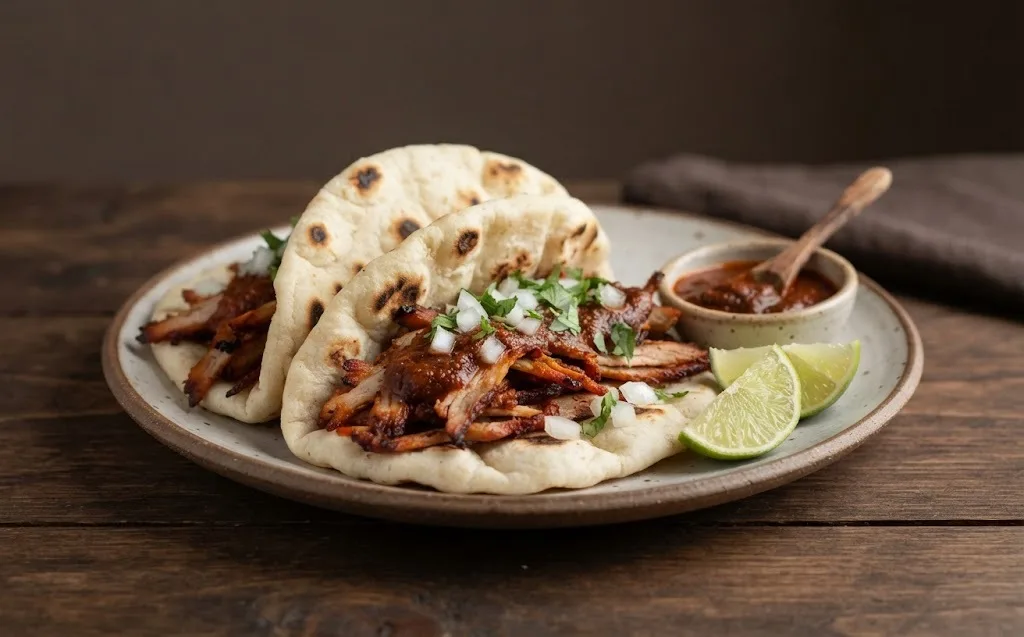
Puebla's direct doner descendant, created in the 1930s by Iraqi and Lebanese immigrants who stacked marinated pork on a vertical spit and shaved it into a soft wheat 'pan árabe' instead of pita. It is the missing link between the Ottoman doner and tacos al pastor, which evolved from it decades later.
Also known as taco árabe, taco arabe poblano, pan árabe tacos.
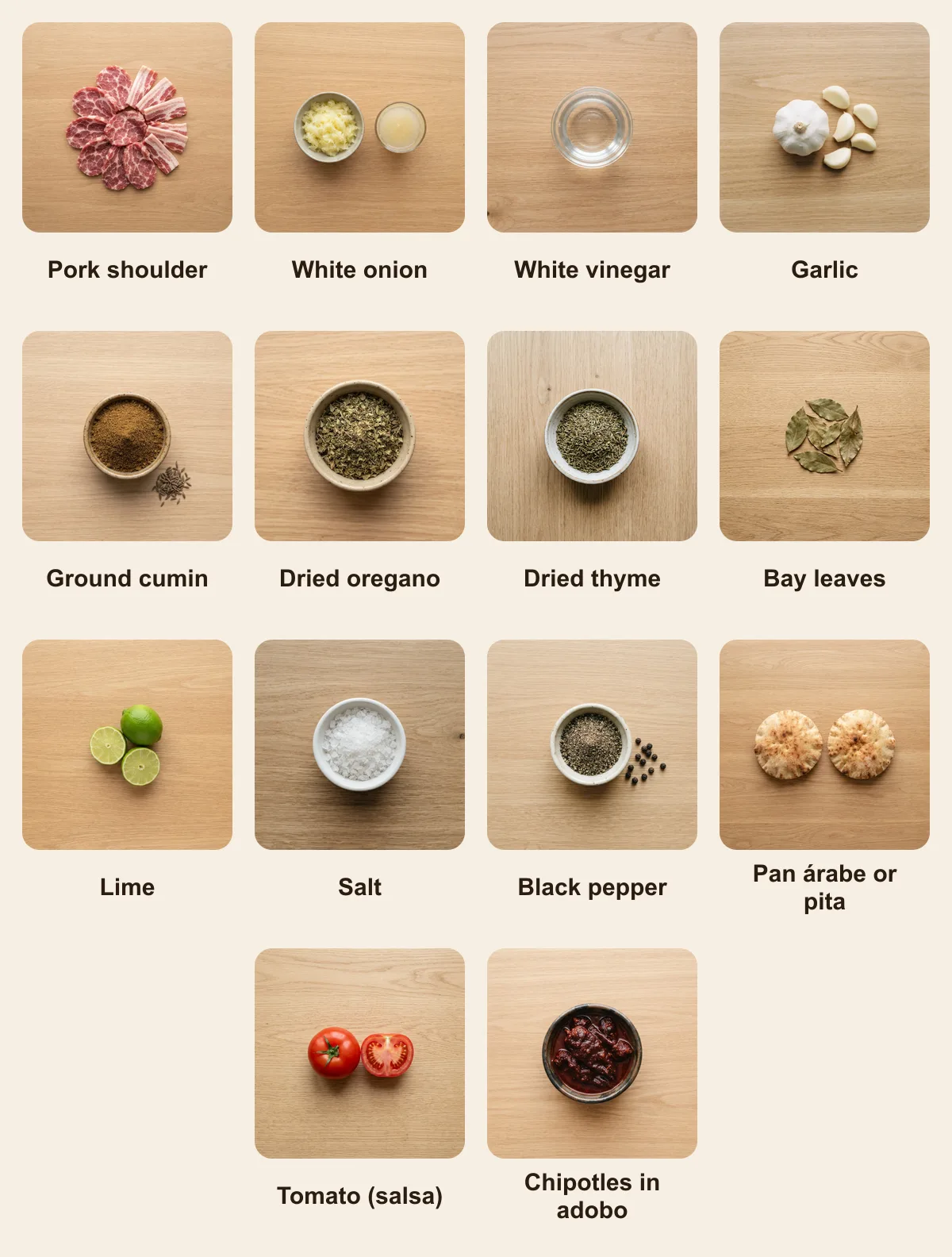
Ingredients
- 800 g pork shoulder, in thin 5 mm slices
- 1 white onion, grated
- 60 ml white vinegar
- 3 garlic cloves, crushed
- 1 tsp ground cumin
- 2 tsp dried oregano and 1 tsp dried thyme
- 2 bay leaves, crumbled
- juice of 1 lime, plus wedges to serve
- 1.5 tsp salt and 1/2 tsp black pepper
- pan árabe, thick flour tortillas or small pitas
- 4 chipotles in adobo, 1 small tomato, 1 garlic clove and 1 tbsp vinegar, for the salsa
How to make it
- 1
Marinate the pork overnight in the onion, vinegar, garlic, cumin, oregano, thyme, bay, lime, salt and pepper — the Levantine-meets-Puebla adobo that defines the dish.
- 2
Blend the chipotles with the tomato, garlic, vinegar and a pinch of salt into a smooth salsa de chipotle.
- 3
Stack the drained slices onto two vertical skewers and roast at 200°C about 50 minutes, or sear the slices flat on a screaming plancha 2 minutes a side.
- 4
Sliver the meat thinly and re-crisp the shavings briefly on the hot surface.
- 5
Warm the pan árabe on a dry pan, fill with pork and finish only with chipotle salsa and lime.
Pro tip: No onion-and-coriander here: árabes are eaten pita-style with chipotle salsa alone — its vinegary smoke does the job salsa verde does elsewhere.
Where Tacos árabes come from
Al pastor evolved from this dish decades later in Mexico City, adding achiote, guajillo and pineapple and switching to a corn tortilla. Tacos árabes remain closer to the origin: the marinade is herb-and-cumin rather than chilli-and-achiote, the bread is wheat, and the sauce is a chipotle-based one rather than a salsa verde.
How Tacos árabes are cooked
The trompo is the same as al pastor's but the marinade is not. Pork is seasoned with cumin, oregano, thyme, garlic, black pepper and a little vinegar — a recognisably Levantine profile that has picked up Mexican herbs rather than Mexican chillies. It is stacked, roasted and shaved the same way.
The bread is the visible difference. Pan árabe is a soft, thin, unleavened or lightly leavened wheat flatbread, closer to a pita than to a tortilla, and it is warmed on the plancha before filling. Its softness and its size mean the taco is folded rather than doubled, which changes how it eats.
Ingredients and shopping
Pork shoulder or leg, sliced thin. A marinade of cumin, dried oregano, thyme, garlic, black pepper, salt and vinegar. For a home version, stack the slices on two vertical skewers and roast, or sear them flat on a very hot plancha, then shave and re-crisp.
Pan árabe from a Mexican bakery, or a thin pita or a Lebanese flatbread as the substitute. The salsa is chipotle-based — chipotles in adobo blended with a little tomato, garlic and vinegar into a smooth, smoky, moderately hot sauce. Lime wedges on the side.
How Tacos árabes are served
Folded in warm pan árabe with chipotle salsa and lime, in Puebla, usually in the evening. Nothing else. The taquerías that make them have been in the same families for generations and the format has barely changed.
Common mistakes
Using an al pastor marinade
Tacos árabes predate al pastor and are seasoned with cumin, oregano and thyme rather than achiote and guajillo. The two are distinct dishes.
Corn tortillas
The bread is a soft wheat pan árabe. Corn tortillas pull it toward al pastor, the descendant, and away from the original.
Skipping the crisping
As with all spit meat cooked at home, the shaved slices need a hot dry pan to reproduce the spit's browned edges.
A salsa verde
The traditional sauce is chipotle-based and smoky. Salsa verde belongs to al pastor.
Tacos árabes: questions and answers
Are tacos árabes the same as al pastor?
No — they are its ancestor. Tacos árabes came first, in 1930s Puebla, with a cumin-and-oregano marinade and wheat pan árabe. Al pastor evolved from it later with achiote, guajillo, pineapple and corn tortillas.
What is pan árabe?
A soft, thin wheat flatbread used in Puebla, closer to a pita than to a tortilla — a direct inheritance from the Lebanese and Iraqi immigrants who created the dish.
What sauce is served with them?
A chipotle-based salsa — smoky and moderately hot — rather than the salsa verde usual with al pastor.
Who invented them?
Iraqi and Lebanese immigrants in Puebla in the 1930s, adapting the vertical spit of their homelands to pork and to local bread.
Sources and further reading
- Taco árabe — Wikipedia (ES)
- Mexico's favorite taco has immigrant roots, and was first called taco árabe — Mexico News Daily