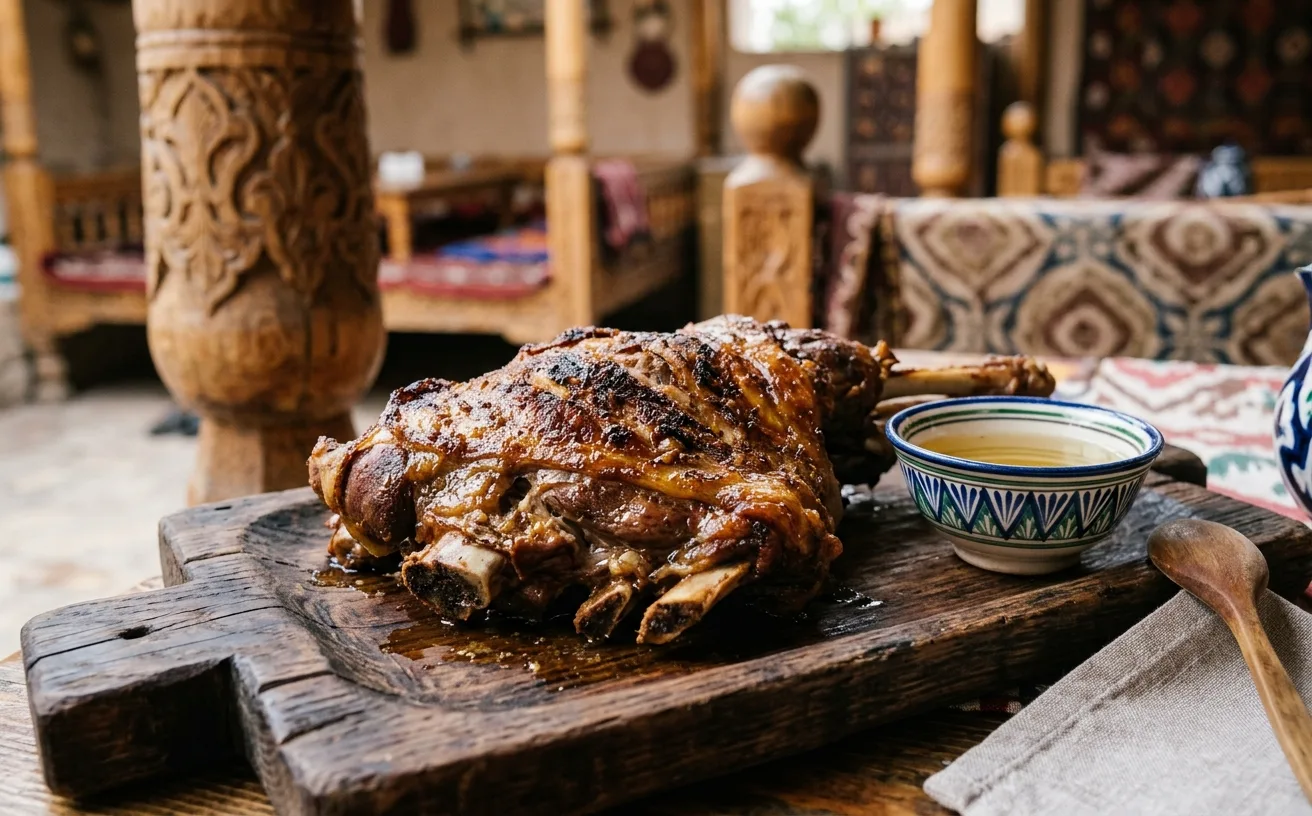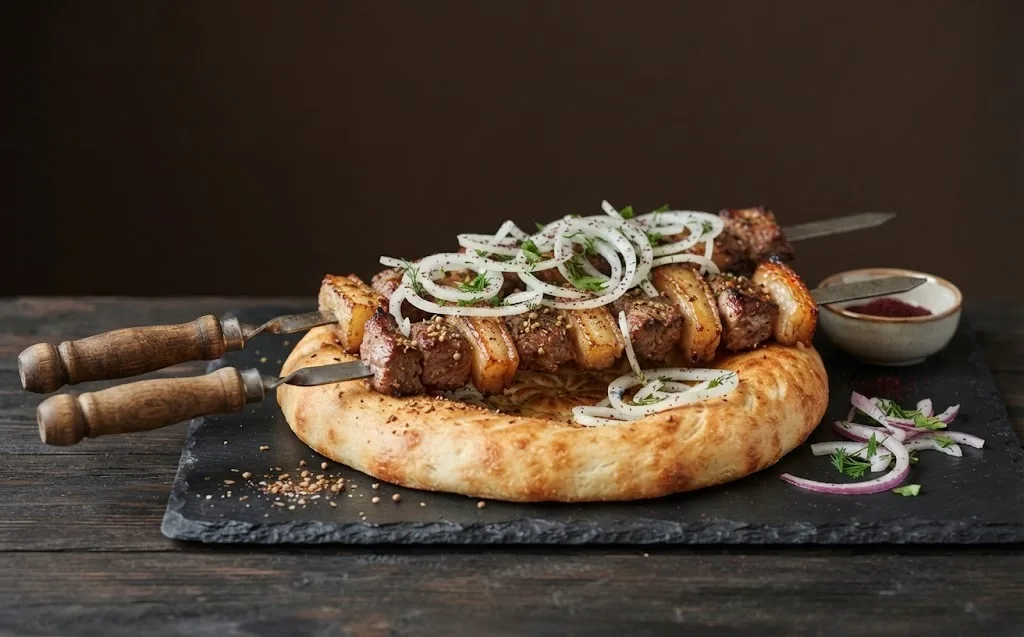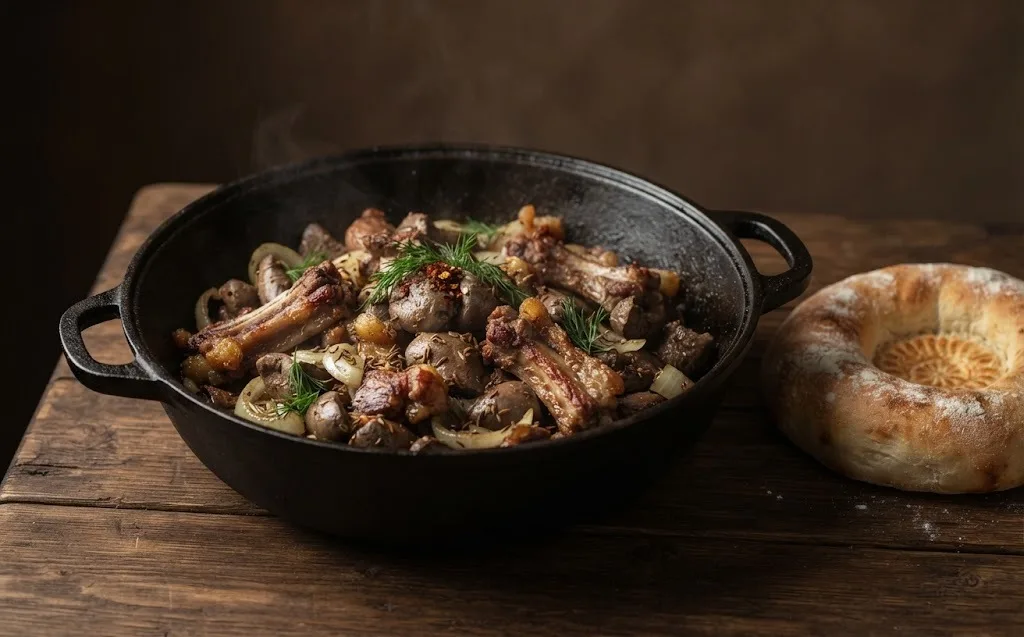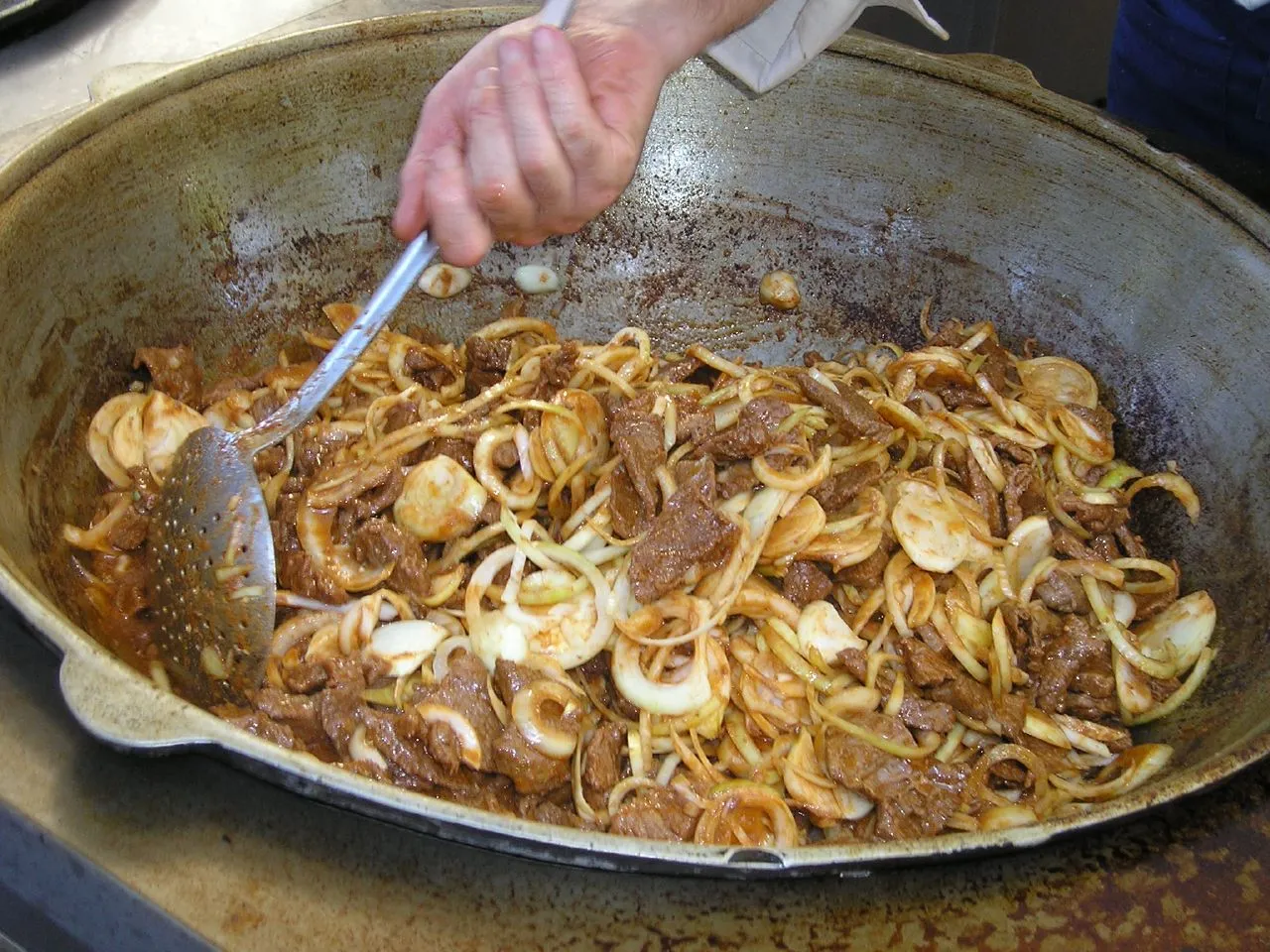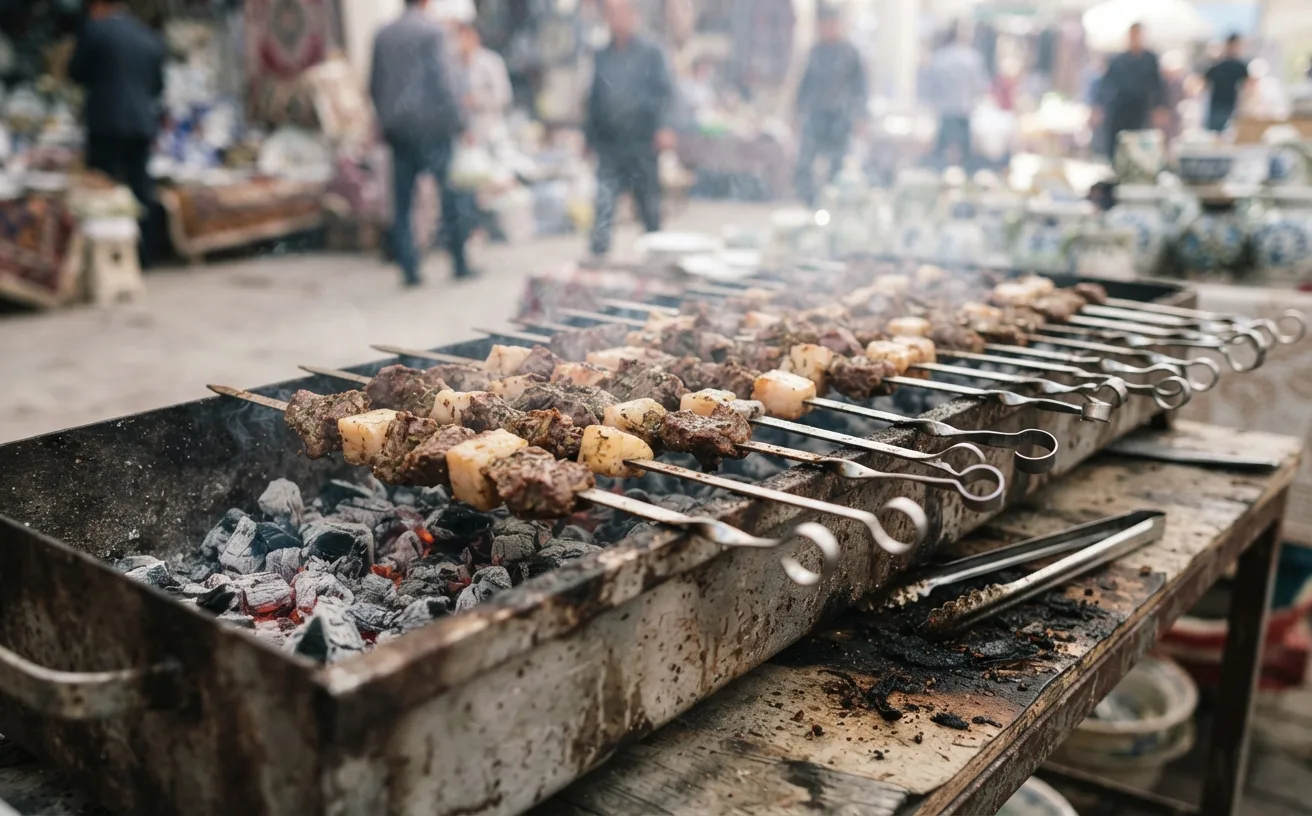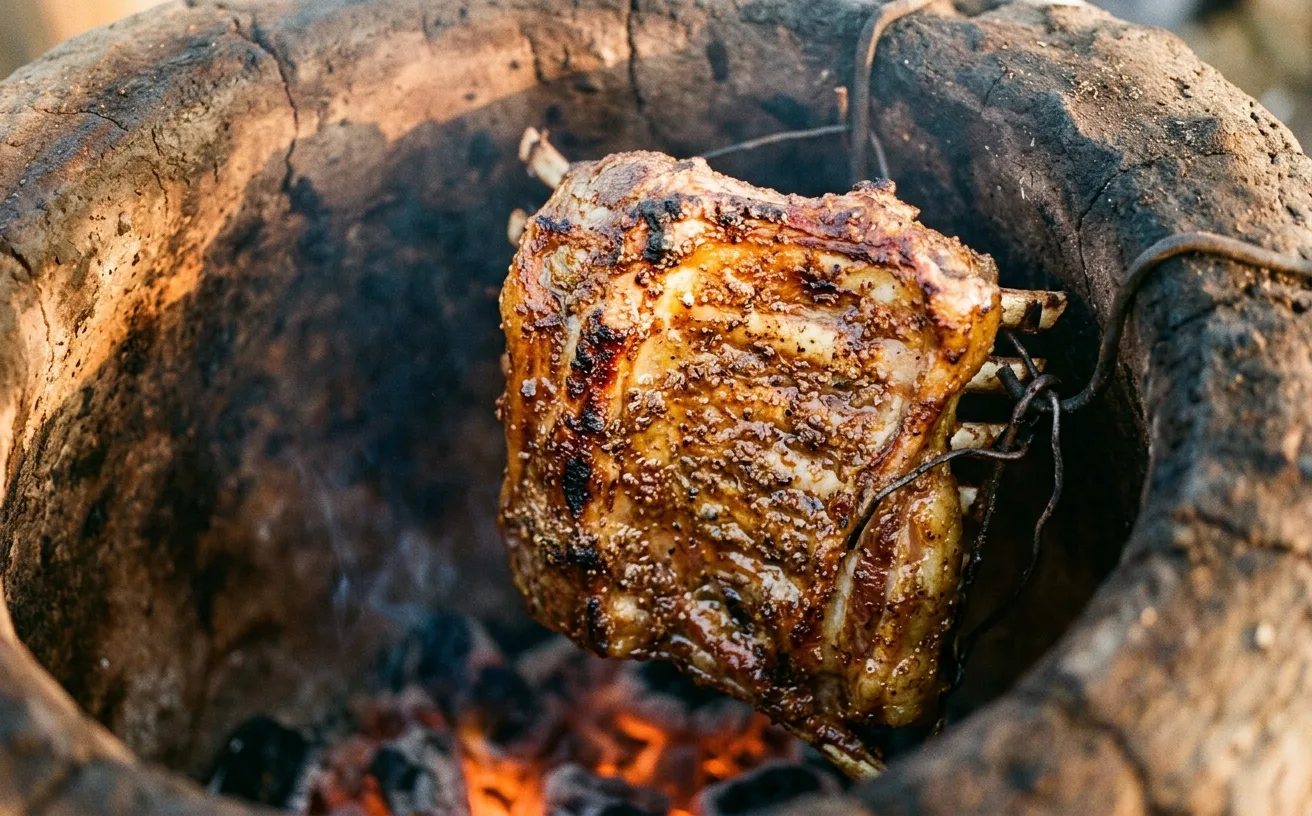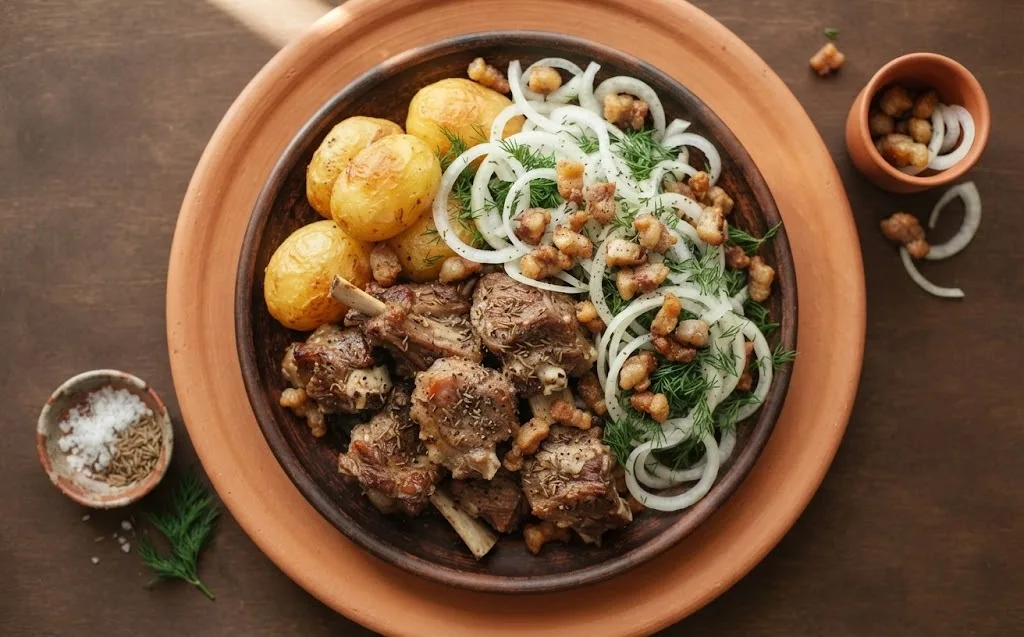
An Uzbek 'kebab' with no skewer at all: lamb on the bone and potatoes fried in stages in deep fat, then finished together under the lid of a cast-iron kazan until the potatoes turn dense and savoury. It shows how broadly Central Asia applies the word kabob to roasted meat.
Also known as kazan kebab, qozon kabob, Uzbek kazan kabob.
Ingredients
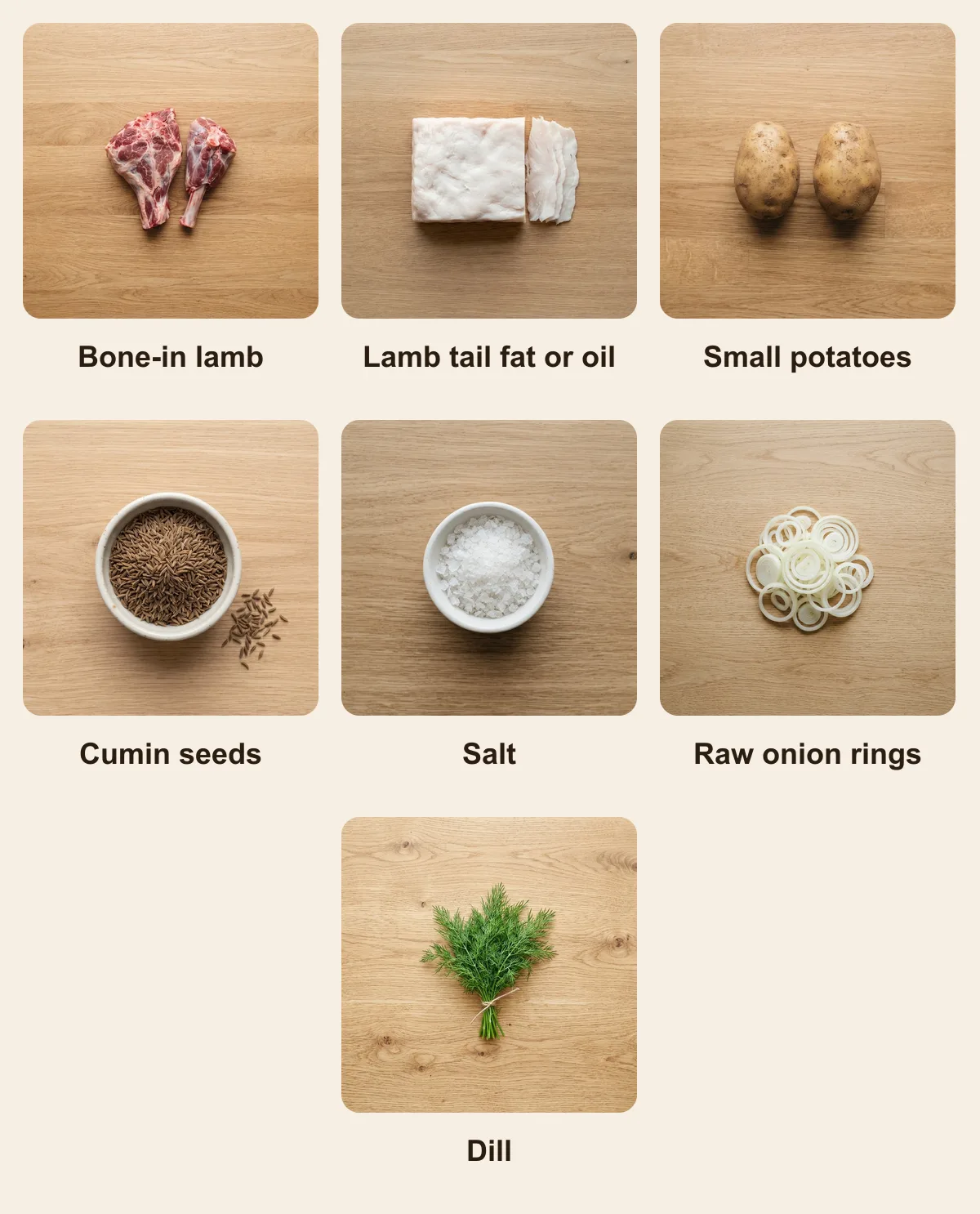
- 800 g fatty bone-in lamb (ribs or shoulder), in large chunks
- 150 g lamb tail fat, diced (or, as a fallback, enough sunflower or cottonseed oil to deep-fry the potatoes, strained and reused afterwards)
- 600 g small waxy potatoes (e.g. Charlotte), peeled and left whole
- 1 tsp cumin seeds
- 2 tsp salt
- 2 onions, in raw rings, to serve
- small bunch of dill, to serve
How to make it
- 1
Render the tail fat in a kazan or heavy Dutch oven until crisp cracklings float; lift the cracklings out.
- 2
Fry the whole potatoes in that fat, rolling them until they wear a golden shell, and set aside.
- 3
Brown the lamb chunks hard in the same fat.
- 4
Return the potatoes, season with salt and cumin, clamp on a tight lid and cook on the lowest flame 60-75 min without adding a drop of water.
- 5
Pile onto a platter with raw onion rings, dill and the reserved cracklings.
Pro tip: Fried first, then steamed under the lid in fat alone: one splash of added water and the potatoes' crust dissolves, turning fried kabob into boiled stew.
Where Kazan Kabob comes from
Kazan kabob is Uzbek, and despite the shared word it is not a relative of Turkish kazan kebabı. Here the kazan is the same broad cast cauldron used for plov, and the dish is what it produces when the occasion is smaller than a wedding: lamb and potatoes cooked in sequence in a single pot of hot oil, served on one platter.
It belongs to the teahouse and the courtyard rather than the restaurant. In Tashkent and the Fergana Valley the same kazan that makes plov on a Sunday makes kazan kabob on a weekday, and the appeal is precisely that it is quicker and less ceremonial than plov while using the same fire, the same pot and the same instincts about oil temperature.
Uzbek lamb and potatoes, not Turkey's stuffed eggplant
Uzbek cooks make Kazan Kabob in the same cast cauldron used for plov, and it has nothing to do with eggplant: that is Kazan Kebab, a Turkish dish from Şanlıurfa filed under vegetables. Here whole waxy potatoes fry first in hot fat, bone-in lamb ribs or shoulder brown hard in the same kazan, then the potatoes go back on top and everything finishes under a tight lid without water. Kazan Kebab stuffs lean mince into eggplants and simmers them in a thin tomato liquid instead. Only the pot links the two names. A single platter carries the lamb and potatoes, with raw onion rings, dill and torn non.
Compare: Kazan Kebab
How Kazan Kabob is cooked
The order is the whole recipe. Potatoes go in first, into deep, genuinely hot fat, and are fried whole or in large pieces until the outside is set and golden and the inside is still short of done. They come out and wait. Then the lamb — ribs, or shoulder on the bone — goes into the same fat, now carrying potato flavour, and browns hard on all sides before the heat drops and the lid goes on.
The potatoes go back in just before the lid, laid on top of the meat for the whole covered stretch so they finish in steam and rendered lamb fat rather than in oil. That final pass is what separates kazan kabob from a plate of chips with meat next to them: the potato absorbs lamb fat at the moment its interior is still open, and comes out dense and savoury rather than crisp and hollow.
Ingredients and shopping
Lamb on the bone is strongly preferred — ribs above all, because the bone and the strip of fat along it feed the pot. Bone-in shoulder in large chunks is the workable substitute. Waxy potatoes hold their shape through two cooking stages; floury ones collapse in the second and give you a mash under the meat.
Cottonseed oil is traditional and gives a specific, slightly grassy note that Uzbek cooks recognise instantly. Sunflower is the ordinary substitute and perfectly acceptable. What matters more than the variety is the volume: at its most traditional this is a true deep-fry, so if you cook in oil rather than rendered tail fat, be prepared to commit a genuine amount of it to the pot, most of which you will strain and reuse.
How Kazan Kabob is served
It is turned out onto one large communal platter, meat under, potatoes over, with a heap of raw onion rings piled alongside — their bite is not optional against this much fat. Fresh dill goes over the top, non bread comes to the table torn rather than cut, and green tea rather than anything cold is what is actually drunk with it.
Common mistakes
Oil that is not hot enough for the potatoes
Cool oil soaks in and the potatoes turn greasy and grey. Get it properly shimmering before the first potato goes in, and fry in batches so the temperature never crashes.
Cooking the potatoes all the way through in the first pass
They still have a second cooking stage on top of the lamb. Fully cooked potatoes go to mush there. Pull them while the centres are firm.
Using boneless lean lamb
The dish depends on rendered fat and gelatine from bone and rib. Lean cubes give you dry meat sitting in oil that never became a sauce.
Stirring after the lid goes on
Once the potatoes are back on top, leave the pot alone. Stirring breaks them and turns the layers into a hash.
Kazan Kabob: questions and answers
Is kazan kabob the same as Turkish kazan kebab?
No. They share only the word for the pot. Uzbek kazan kabob is lamb and potatoes cooked in deep oil in stages; Turkish kazan kebabı is a Şanlıurfa pan dish of long eggplants stuffed with seasoned minced meat and cooked covered in a little tomato water.
Can I make it in a wok or a Dutch oven?
A Dutch oven is the better stand-in because it holds heat the way a kazan does. A wok will work for the frying stages but loses too much heat once the lid goes on.
Do I have to use that much oil?
Traditionally, yes — the potatoes are deep-fried, not roasted, and the oil is strained and reused afterwards, which is what is done at home in Uzbekistan. Rendering lamb tail fat and frying in that instead is a shallower route to the same crust.
What cut of lamb is best?
Ribs, if you can get them. Otherwise bone-in shoulder cut into large pieces. The bone matters as much as the meat here.
Sources and further reading
- Uzbek Meat Dishes — Advantour (Uzbekistan travel guide)
- A Guide to Kazan Kebab — AZ Cuisines