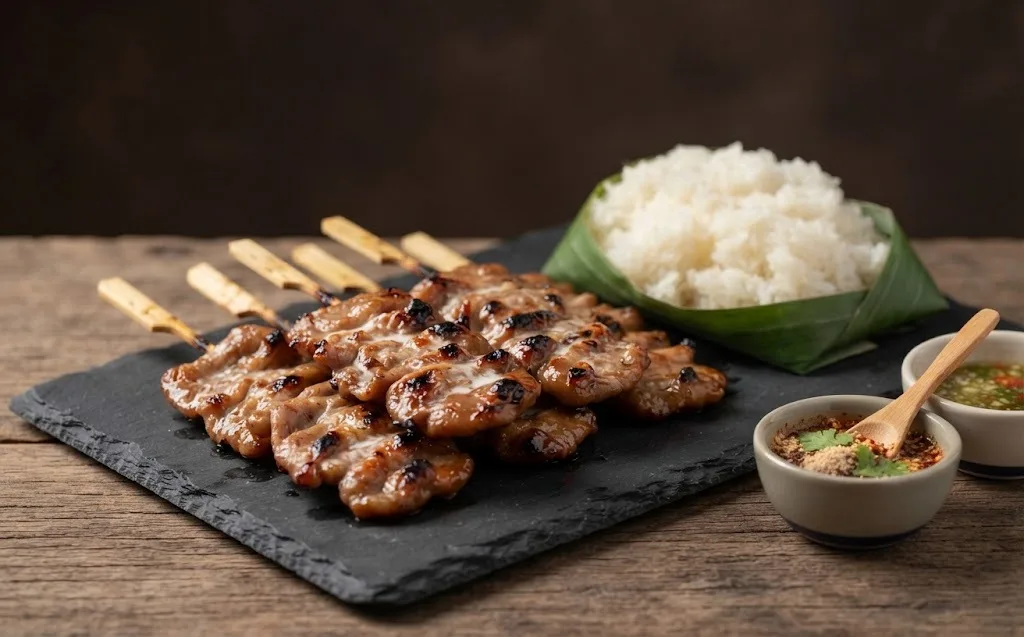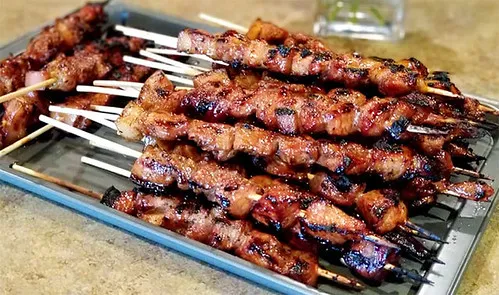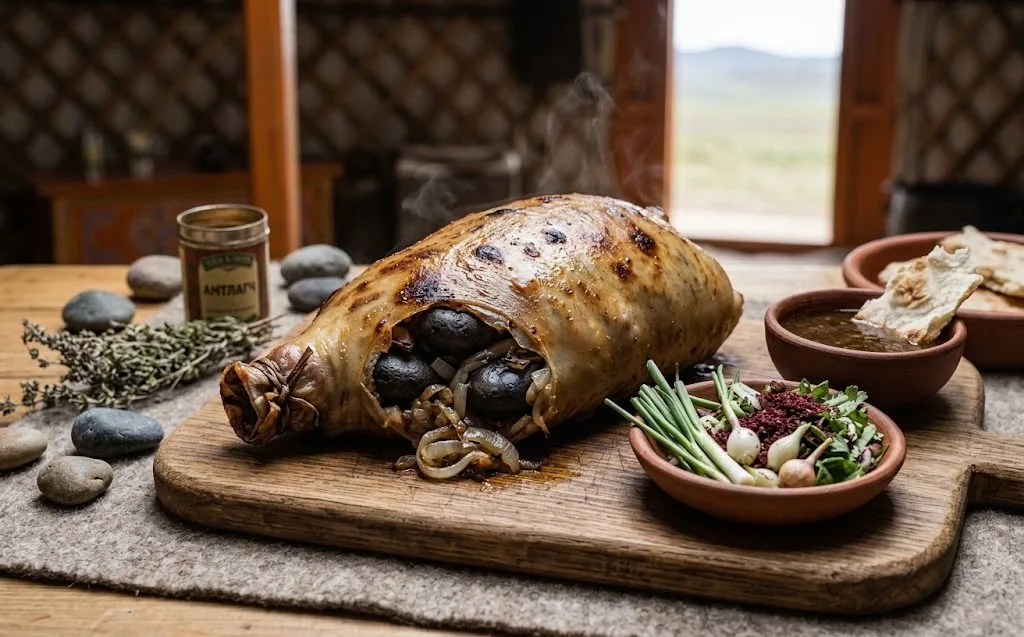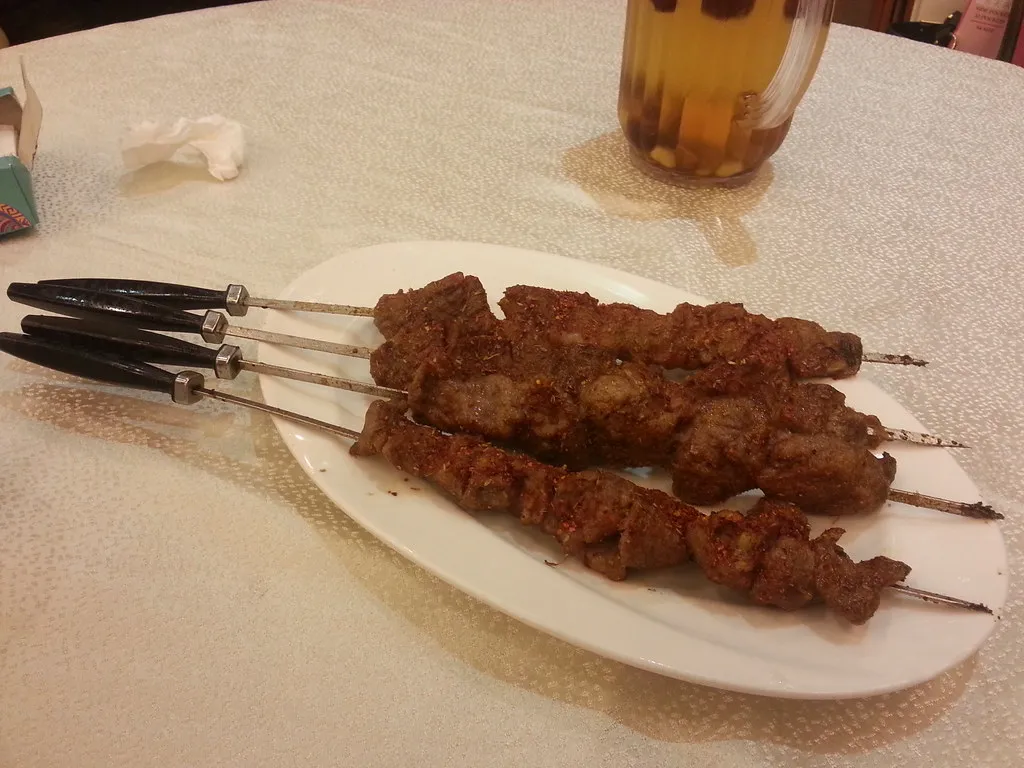
Lamb skewers from Uyghur cooks of Xinjiang — small pieces of mutton interleaved with fat, dusted with cumin, chile flakes, and salt over open coals — that conquered every Chinese city as late-night shaokao street food. The character for the dish (串) is a pictogram of meat on a stick.
Also known as 串, 羊肉串, yang rou chuan.
Reference video
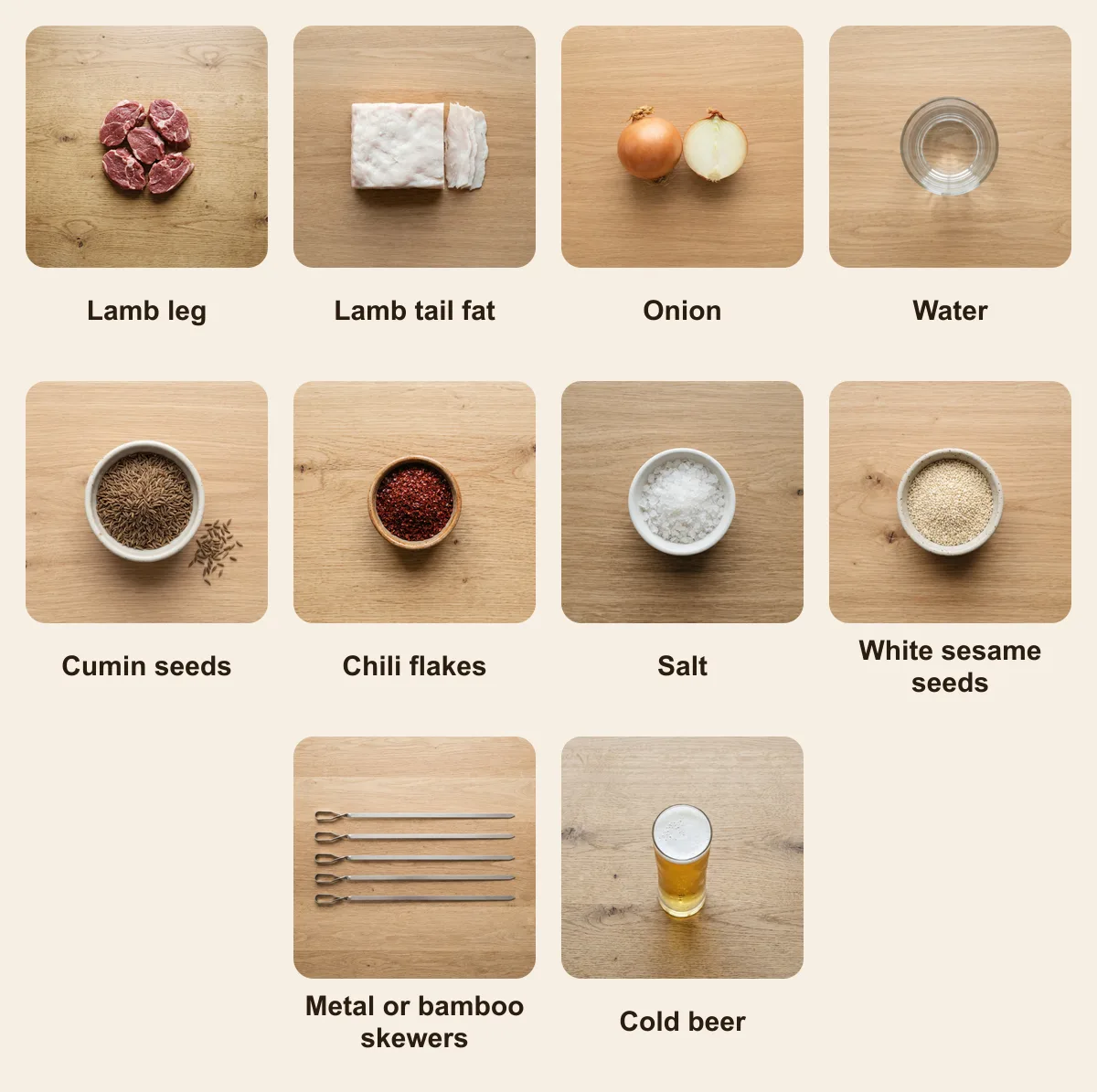
Ingredients
- 600 g lamb leg, in 1.5 cm pieces, plus 100 g lamb tail fat, cut into similar-sized cubes to alternate
- Half an onion, blitzed with 100 ml water
- 2 tbsp cumin seeds, half of them coarsely crushed
- 1 tbsp coarse chili flakes
- 1.5 tsp salt
- 1 tbsp white sesame seeds
- Thin metal or bamboo skewers
- Cold beer (treat it as an ingredient)
How to make it
- 1
Steep the lamb in the onion water half an hour, drain well and blot dry.
- 2
Skewer small pieces snugly, alternating in a cube of lamb tail fat every third spot.
- 3
Line the skewers in a tight row over narrow, fierce coals and roll the whole rank in unison every 20-30 seconds, street-vendor style.
- 4
Midway, pinch the cumin-chili-salt mix over both sides and keep rolling until the spices toast and the fat blisters, 6-8 minutes total.
- 5
Flick sesame seeds over at the end and eat straight off the metal, beer in the other hand.
Pro tip: Use cumin two ways, half coarsely crushed and half whole seed: the crushed seed clings to the rendering fat while the whole seeds stay on the surface and pop between your teeth.
Where Chuanr comes from
The migration from Xinjiang to the rest of China happened largely in the 1980s and 1990s, and it is one of the most successful internal food migrations anywhere. Cumin, essentially absent from most Chinese regional cooking, arrived nationwide on the back of these skewers and is now a supermarket staple.
How Chuanr is cooked
Cumin is the whole flavour identity and it is applied as whole or coarsely crushed seed rather than fine powder, dusted on during grilling so it toasts directly on the fat. Fine ground cumin burns and turns bitter; coarse seed toasts and pops, which is the texture and aroma the dish is known for.
The pieces are small and alternate lean and fat — a piece of pure tail fat every second or third position, exactly as in Uzbek shashlik, since the tradition is the same Central Asian one. The grill is a long narrow trough so only the meat sits over the coals and the skewer handles stay cool.
Ingredients and shopping
Mutton or lamb shoulder in one-and-a-half-centimetre cubes, with lamb tail fat cut into squares to alternate. The fat is not optional and its absence is the most common reason home chuanr are disappointing.
Whole cumin seed, coarsely crushed. Coarse chilli flakes. Salt, and white sesame seeds to finish. Ground Sichuan peppercorn is an optional extra for a numbing note. Flat metal skewers or bamboo, and a narrow grill or a foil-lined tray arrangement that keeps the handles off the heat.
How Chuanr is served
By the handful — ten or twenty skewers is a normal order — with beer, at a street table late at night. Grilled flatbread, aubergine or leeks from the same grill. In summer the tables spill onto the pavement, and shaokao is as much a season as a meal in northern China.
Common mistakes
Ground cumin instead of seed
Fine powder burns and turns bitter. Coarsely crushed whole seed toasts on the fat and is what the dish smells of.
Skipping the fat cubes
They render and baste the lean meat. Without them the skewers dry out in minutes.
Seasoning before grilling only
The spice is dusted on during and after grilling, in layers, so some of it stays fresh and pungent.
A wide grill
The skewer handles burn. Use a narrow trough or arrange foil so only the meat sits over the coals.
Chuanr: questions and answers
What does the character 串 mean?
It is a pictogram of pieces of meat threaded on a stick — one of the most visually literal characters in Chinese.
Why whole cumin seed rather than powder?
Powder burns and turns bitter over coals. Coarsely crushed whole seed toasts on the rendering fat and gives the dish its signature aroma.
Where is chuanr from?
Uyghur Xinjiang, in far western China. It spread nationwide in the 1980s and 1990s and brought cumin into mainstream Chinese cooking with it.
Do I need the fat cubes?
Yes. Alternating lean meat with lamb tail fat is what keeps the small pieces moist over a hot fire.
Sources and further reading
- Chuan (food) — Wikipedia
- Xinjiang Lamb Skewers — Omnivore's Cookbook (Maggie Zhu)