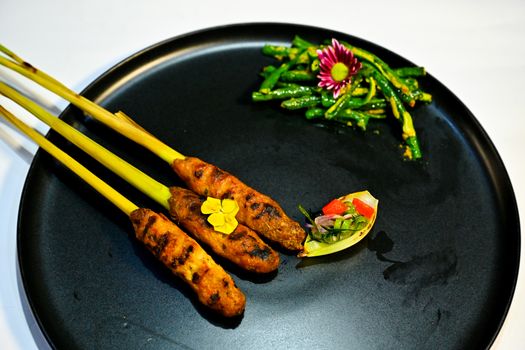
Bali's signature satay: minced fish or pork blended with grated coconut and basa genep spice paste, then wrapped ('lilit') around flat lemongrass stalks that flavor the meat as it grills. Unlike most satay it needs no dipping sauce — the seasoning is inside.
Also known as: satay lilit, sate lilit Bali, Balinese minced satay
Watch it made
Ingredients
- 500 g Spanish mackerel or firm white fish, minced to a paste
- 100 g freshly grated coconut
- 5 shallots and 3 garlic cloves
- 2 cm each galangal and fresh turmeric, plus 2 candlenuts
- 2 red chilies and 1 tsp toasted shrimp paste
- 15 g palm sugar and salt
- 2 kaffir lime leaves, minced to threads
- 12 fat lemongrass stalks, to use as skewers
- 30 ml coconut oil
How to make it
- 1
Pound shallots, garlic, galangal, turmeric, candlenuts, chilies and shrimp paste into basa genep, then fry the paste in coconut oil until it darkens and smells cooked. Cool fully.
- 2
Knead the cooled paste into the fish with grated coconut, palm sugar, lime leaf and salt until springy.
- 3
With a wet palm, squeeze a handful of the mixture around the fat end of each lemongrass stalk, tapering it like a teardrop.
- 4
Grill over medium coals, turning every couple of minutes, 8-10 minutes until scorched in spots and set through.
- 5
Serve with sambal matah and steamed rice.
Pro tip: Fry the spice paste and cool it before it meets the fish. Raw basa genep tastes green and harsh, and a warm paste half-cooks the mince so it loses its grip and slides off the lemongrass over the fire.
The story of Sate Lilit
Sate lilit is Bali's signature satay and it inverts the format: minced fish or pork is blended with grated coconut and basa genep spice paste, then wrapped — lilit means to wrap — around flat lemongrass stalks that flavour the meat as it grills. Unlike most satay it needs no dipping sauce, because the seasoning is inside.
It belongs to Balinese ceremonial cooking as much as to street food. Basa genep, the island's complete spice paste, is made in quantity for temple offerings and family ceremonies, and sate lilit is one of the dishes it produces. Pork is used in Bali where the rest of Indonesia would not, which is a Hindu-Muslim dividing line visible on a skewer.
The technique that defines it
The lemongrass stalk is both handle and ingredient. Flattened at one end with the back of a knife so the mince adheres, it releases its oils into the meat from the inside as it heats — which is why the dish needs no sauce and why substituting a bamboo skewer produces something notably flatter.
Grated coconut in the mixture does two jobs: it binds, replacing the egg or flour a Western meatball would use, and it toasts on the outside of the skewer into a fragrant crust. It must be fresh or freshly rehydrated; dry desiccated coconut absorbs moisture from the mince and makes it crumbly.
Choosing your ingredients
Minced fish — mackerel or snapper — or minced pork, or a mixture. The fish version is the more celebrated. Fresh grated coconut, or desiccated rehydrated in a little coconut milk. Thick lemongrass stalks, flattened.
Basa genep is the complete Balinese spice paste: shallot, garlic, galangal, ginger, turmeric, candlenut, chilli, coriander, shrimp paste and more, fried down. Making it is a project and it freezes well, so make more than you need.
Mistakes that ruin it
Bamboo skewers instead of lemongrass
The stalk flavours the meat from inside and is why the dish needs no sauce. Bamboo gives a much flatter result.
Dry desiccated coconut
It absorbs moisture from the mince and makes it crumbly. Use fresh, or rehydrate desiccated in coconut milk.
Not flattening the lemongrass
The mince will not adhere to a round stalk. Crush one end with the back of a knife first.
Serving it with peanut sauce
Sate lilit is seasoned throughout and needs no sauce. Adding one buries the basa genep.
How it is served
As part of a Balinese spread with rice, lawar, sambal matah and vegetables, or on its own as a snack. No dipping sauce. Sambal matah — raw shallot, lemongrass, chilli and lime — is the one accompaniment that improves it rather than covering it.
Questions about Sate Lilit
What does lilit mean?
To wrap. The minced mixture is wrapped around a lemongrass stalk rather than threaded onto a skewer.
Why does it not need dipping sauce?
The seasoning is inside the mince — basa genep spice paste and grated coconut — and the lemongrass flavours it from within as it cooks.
What is basa genep?
Bali's complete spice paste, made from shallot, garlic, galangal, ginger, turmeric, candlenut, chilli, coriander and shrimp paste. It underpins most Balinese cooking.
Fish or pork?
Both are traditional. The fish version — usually mackerel or snapper — is the more celebrated.


