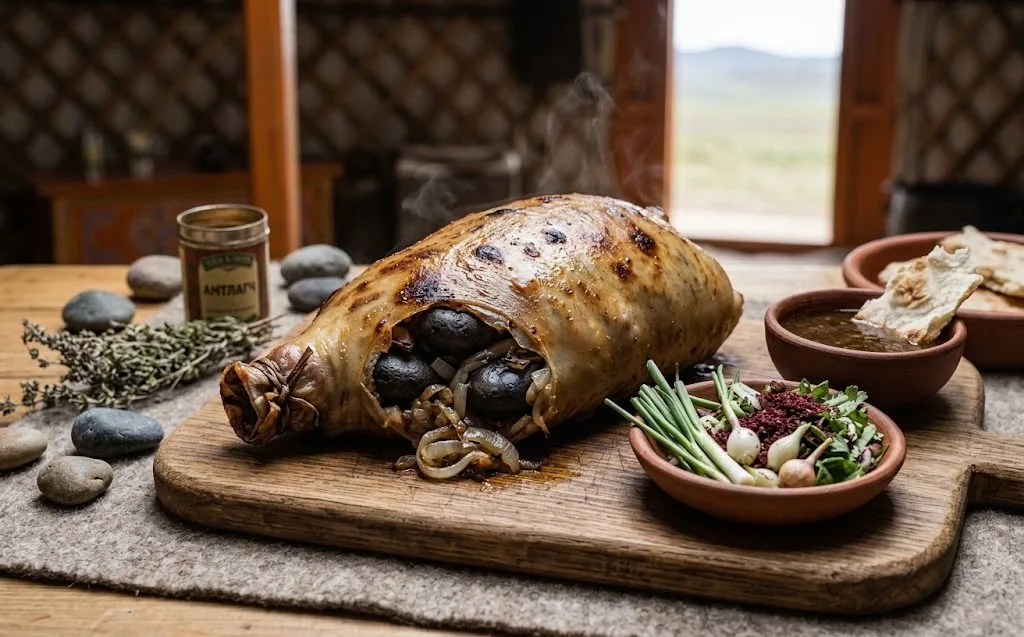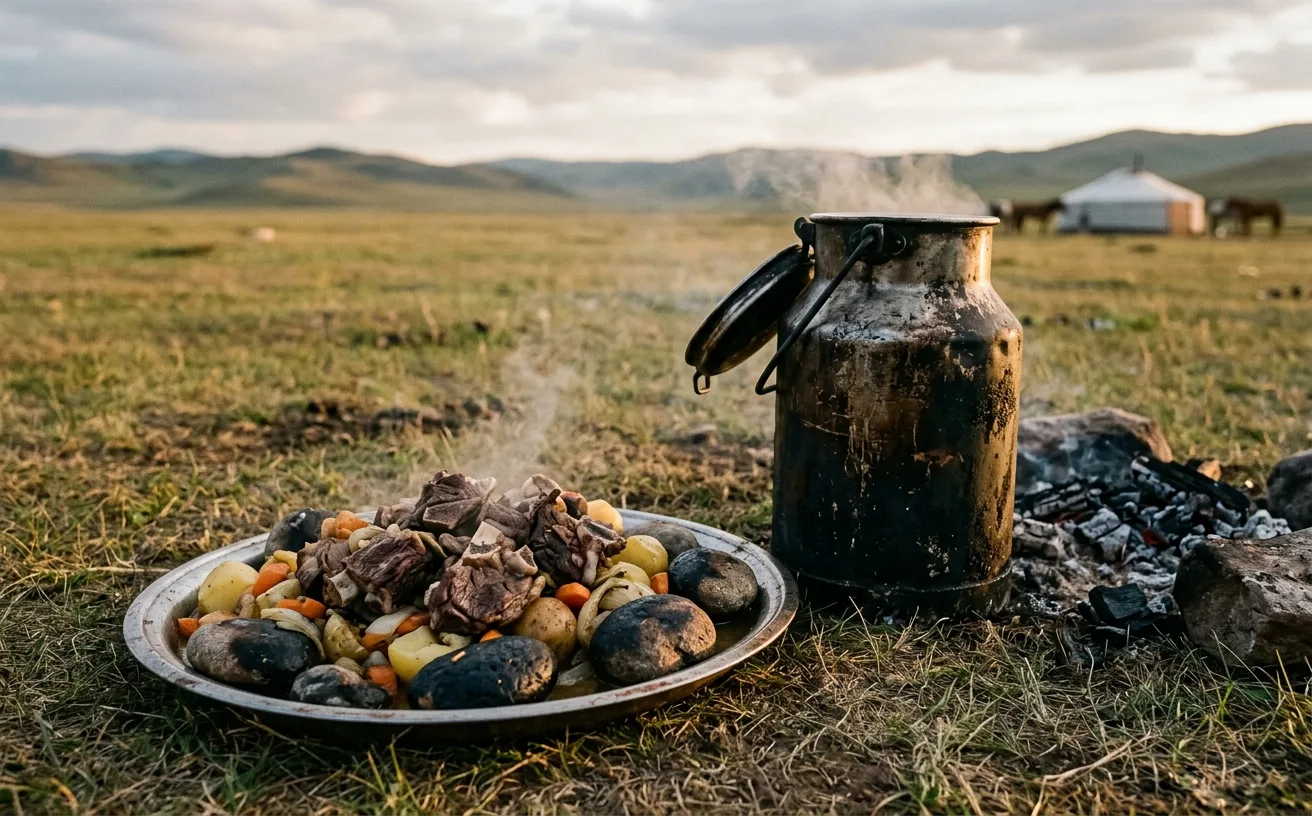
The true Mongolian barbecue (unrelated to the stir-fry restaurants): mutton on the bone sealed in a milk churn or pot with fire-heated river stones, which cook the meat from the inside while it steams. Diners toss the greasy hot stones between their hands afterward — folklore says it is good for circulation.
Also known as horhog, Mongolian barbecue authentic, khorkhog Mongolian.
Reference video
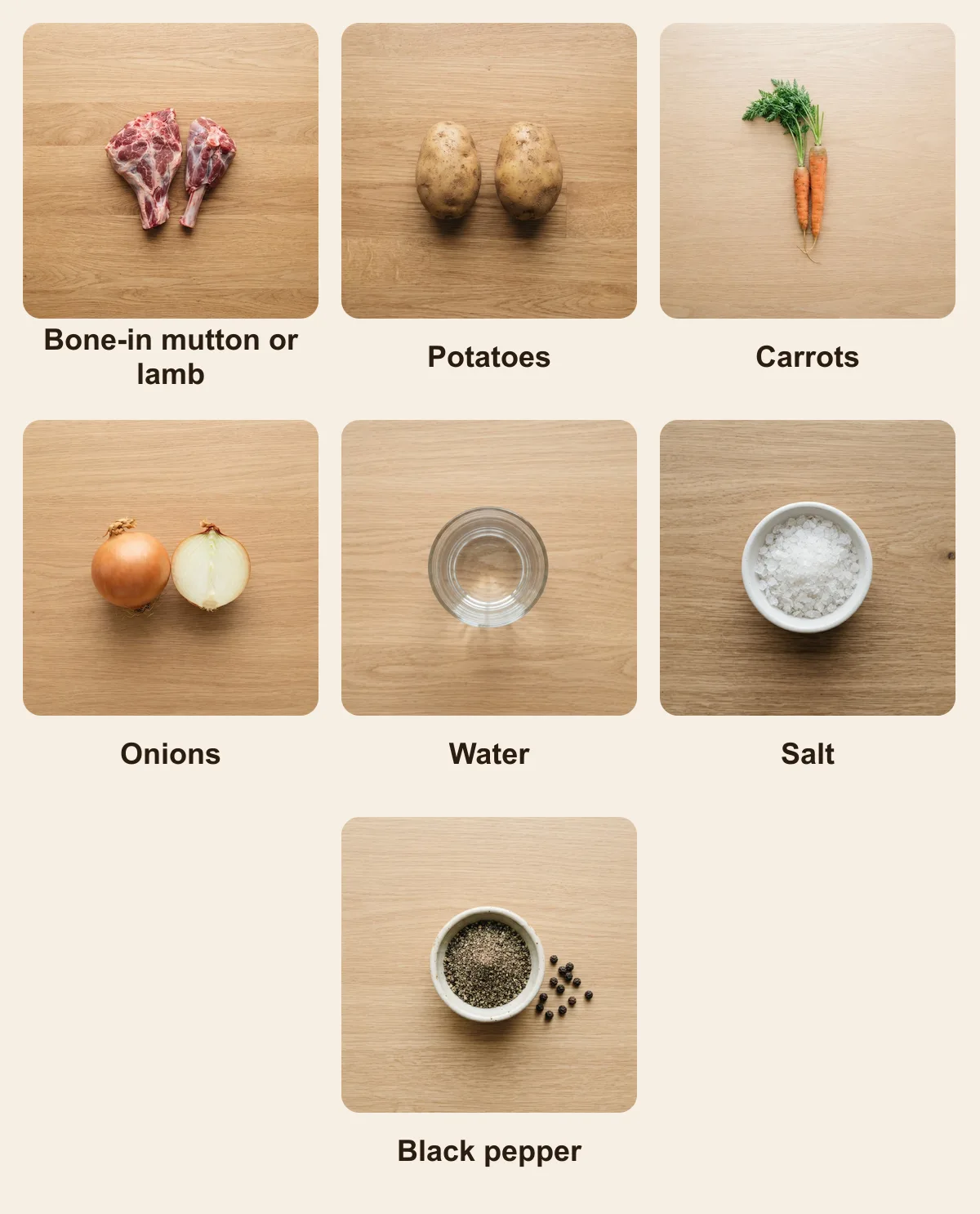
Ingredients
- 1.5 kg bone-in mutton or lamb (ribs, neck, shoulder), in big chunks
- 8-10 smooth, dense fist-size river stones, scrubbed and completely dry
- 4 potatoes, halved
- 3 carrots, in long pieces
- 2 onions, quartered
- 300 ml water
- 2 tsp salt
- 1 tsp black pepper
How to make it
- 1
Heat the stones in a wood fire or a 250°C oven for 40-45 minutes, until too hot to approach.
- 2
Using tongs, build layers in a large lidded pot: stones, meat, vegetables, more stones, seasoning as you go.
- 3
Pour in the water, lock the lid on tight and set over medium-low heat 60-75 minutes, giving the sealed pot a careful shake now and then.
- 4
Open the lid away from your face — steam rushes out — and lift meat and vegetables onto a platter, spooning over the peppery broth.
Pro tip: Only dense, smooth river stones survive the fire; porous rock can split violently. Mongolians pass the hot, greasy stones palm to palm for good health — at least use them to warm the bowls.
Where Khorkhog comes from
It is a herder's dish and a summer one, made when a sheep is slaughtered and there is a group to feed. The equipment is deliberately minimal: a metal churn, a fire, and stones from a riverbed. Nothing about it requires an oven, a grill or a kitchen, which is precisely the point in a pastoral culture.
How Khorkhog is cooked
The stones are the cooking element and their selection matters for safety as much as for cooking. Smooth river stones are used because they are dense and non-porous; porous stones can hold water, which turns to steam and can crack them violently. They are heated in a fire until glowing, then layered between pieces of mutton in the churn.
The churn is sealed and set over or beside the fire, and the meat cooks from two directions at once — radiant heat from the stones inside and conducted heat from the fire outside — in an atmosphere of its own steam. Onion, carrot and potato go in with it, and a little water is added, which flashes to steam immediately.
Ingredients and shopping
Mutton on the bone, cut into large pieces — ribs, shoulder, leg. Fat is left entirely intact. Smooth dense river stones the size of a fist, and enough of them to layer through the meat. Never use porous or damp stone.
Onion, carrot and potato. Salt, and traditionally little else. A heavy metal container with a sealable lid — a milk churn is traditional, a large stockpot with a tight lid is the practical substitute. Tongs for handling the stones, which are dangerously hot.
How Khorkhog is served
Straight from the churn onto a communal platter, with the vegetables and the broth that has collected at the bottom. Bread, salt, and airag (fermented mare's milk) or vodka. It is eaten outdoors with the hands and the stones are passed around afterwards as part of the ritual.
Common mistakes
Porous or damp stones
Trapped moisture flashes to steam and can crack them violently. Use dense, dry, smooth river stones only.
Not sealing the container
The steam is the cooking medium. A loose lid lets it escape and the meat roasts unevenly.
Too much water
A little flashes to steam immediately. More and you are boiling the mutton.
Handling the stones without tongs
They come out of a fire glowing. The traditional post-meal stone-tossing happens after they have cooled considerably.
Khorkhog: questions and answers
Is khorkhog related to Mongolian barbecue restaurants?
No. Those are a Taiwanese invention of the 1950s. Khorkhog is the genuine Mongolian dish — mutton cooked with fire-heated stones in a sealed churn.
What kind of stones are used?
Smooth, dense river stones. Porous or damp stones can crack violently when heated, which is a real hazard.
Why do diners toss the stones?
Folklore holds that handling the hot greasy stones is good for circulation. They are passed around after the meal once they have cooled somewhat.
Can I make it in a pot?
Yes — a large stockpot with a tight lid substitutes for a milk churn. The stones and the seal are the essential elements.
Sources and further reading
- Khorkhog — Wikipedia
- Mongolian cuisine — Wikipedia
- The Real Mongolian Barbecue — KQED