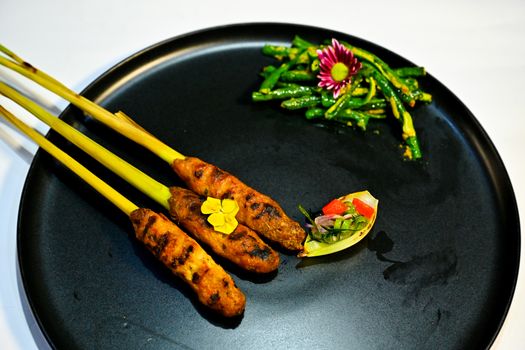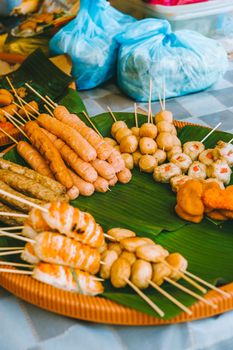
A mobile Malaysian night-market ritual, strongest in Penang: color-coded skewers of fish balls, cockles, quail eggs, meat, and vegetables that customers dunk ('lok' means dip in Cantonese) into a communal vat of boiling broth on the back of a van, then coat in satay peanut, chili, or sweet sauces. It is the skewer format migrated from the grill into the hotpot.
Also known as: lok-lok, lok lok, loklok, lok lok truck, lok lok steamboat skewers, penang lok lok
Watch it made
Ingredients
- 1.5 l clear chicken stock with 2 smashed garlic cloves and a slice of ginger
- 300 g fish balls and 200 g cockles or shelled prawns
- 300 g chicken breast or pork, thin bite-size slices
- 200 g firm tofu, cubes
- 150 g quail eggs, boiled and peeled
- 1 bunch water spinach or lettuce leaves
- bamboo skewers (about 30)
- satay peanut sauce, sweet dark sauce and chili-garlic sauce, for dipping
How to make it
- 1
Thread every ingredient onto its own skewers, a few pieces each, and arrange them by type on a platter — Penang vans color-code by price; you just need them findable.
- 2
Bring the stock to a steady rolling boil in a pot at the center of the table (a fondue or hotpot burner works).
- 3
Give each diner the three dips and let them dunk-and-cook: fish balls and tofu 1-2 minutes, raw meat slices 2-3, greens 20 seconds.
- 4
Top up the pot with hot water as it reduces and skim once or twice.
- 5
Finish by drinking small cups of the now-fortified broth.
Pro tip: Slice the raw meats thin enough to cook in a two-minute dunk — lok-lok fails the moment anything needs longer than a conversation pause.
The story of Lok-Lok
Lok-lok is a mobile Malaysian night-market ritual, strongest in Penang: colour-coded skewers of fish balls, cockles, quail eggs, meat and vegetables that customers dunk into a communal vat of boiling broth on the back of a van, then coat in satay peanut, chilli or sweet sauces.
Lok means dip in Cantonese, and the format is the skewer migrated from the grill into the hotpot. The van itself is the venue — sides open out, stools appear, and the vat sits in the middle. The colour coding on the skewer handles is the pricing system, which is elegant and entirely necessary when a customer has eaten thirty of them.
The technique that defines it
Everything on offer is chosen to cook in seconds to a couple of minutes in boiling broth, which is the real constraint on the menu. Fish balls, processed seafood, thin meat slices, leafy vegetables and pre-cooked items dominate; nothing that needs sustained cooking appears.
The dipping is done by the customer and the timing is theirs, which means the format tolerates a wide range of preferences. The sauces are applied after cooking, from communal pots — satay peanut, sweet chilli, a chilli-lime — and the double-dipping question is handled by ladling rather than by dunking a second time.
Choosing your ingredients
Fish balls, fish cake, cockles, prawns, quail eggs, sliced pork or beef, tofu puffs, enoki mushrooms, leafy greens, sausages, crab sticks — anything that cooks fast. All on skewers with colour-coded handles.
For the broth, a light stock — the vat at a lok-lok van is usually a simple pork or anchovy broth. Satay peanut sauce, sweet chilli sauce and a chilli-lime sauce for coating. It is a format more than a recipe.
Mistakes that ruin it
Items that need long cooking
Everything on a lok-lok skewer must cook in seconds to a couple of minutes. Anything slower blocks the vat and comes out wrong.
Leaving things in too long
Cockles and prawns toughen quickly; leafy greens collapse. The customer's judgement is the timer.
Dipping cooked items back into the broth
Sauces are ladled or poured after cooking. The broth stays for cooking only.
A heavy broth
It is a cooking medium, not a soup. A light stock lets the sauces do the flavouring.
How it is served
Standing or on stools around the van, dipping and eating continuously, paying at the end by counting the coloured handles. Beer or a soft drink. It is late-night, social, and the counting-up at the end is part of the ritual.
Questions about Lok-Lok
What does lok-lok mean?
Dip, in Cantonese — describing the action of dunking the skewers into the communal boiling broth.
How is it priced?
By the colour of the skewer handle. You keep your used skewers and the vendor counts them up at the end.
What goes on the skewers?
Fish balls, cockles, prawns, quail eggs, sliced meat, tofu puffs, mushrooms and leafy greens — anything that cooks in a couple of minutes.
Where is it most common?
Penang, where the mobile van format is strongest, though it is found across Malaysia.