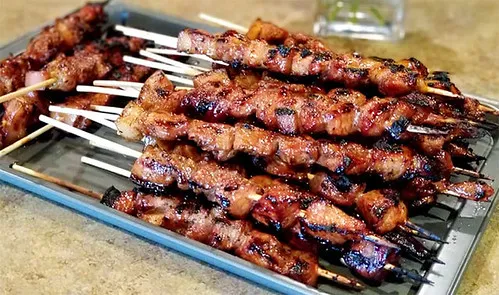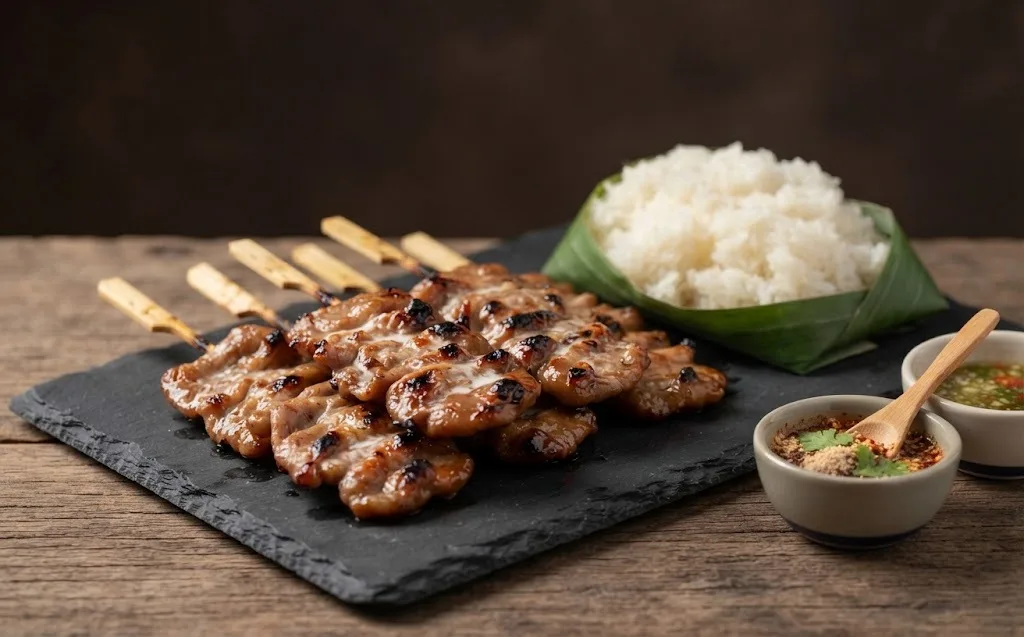
Bangkok's breakfast kebab: thin slices of pork marinated in coconut milk, palm sugar, fish sauce, and coriander root, grilled over charcoal until caramelized at the edges. Sold from morning street carts with a bag of sticky rice for eating on the go.
Also known as mu ping, muu bing, หมูปิ้ง.
Reference video
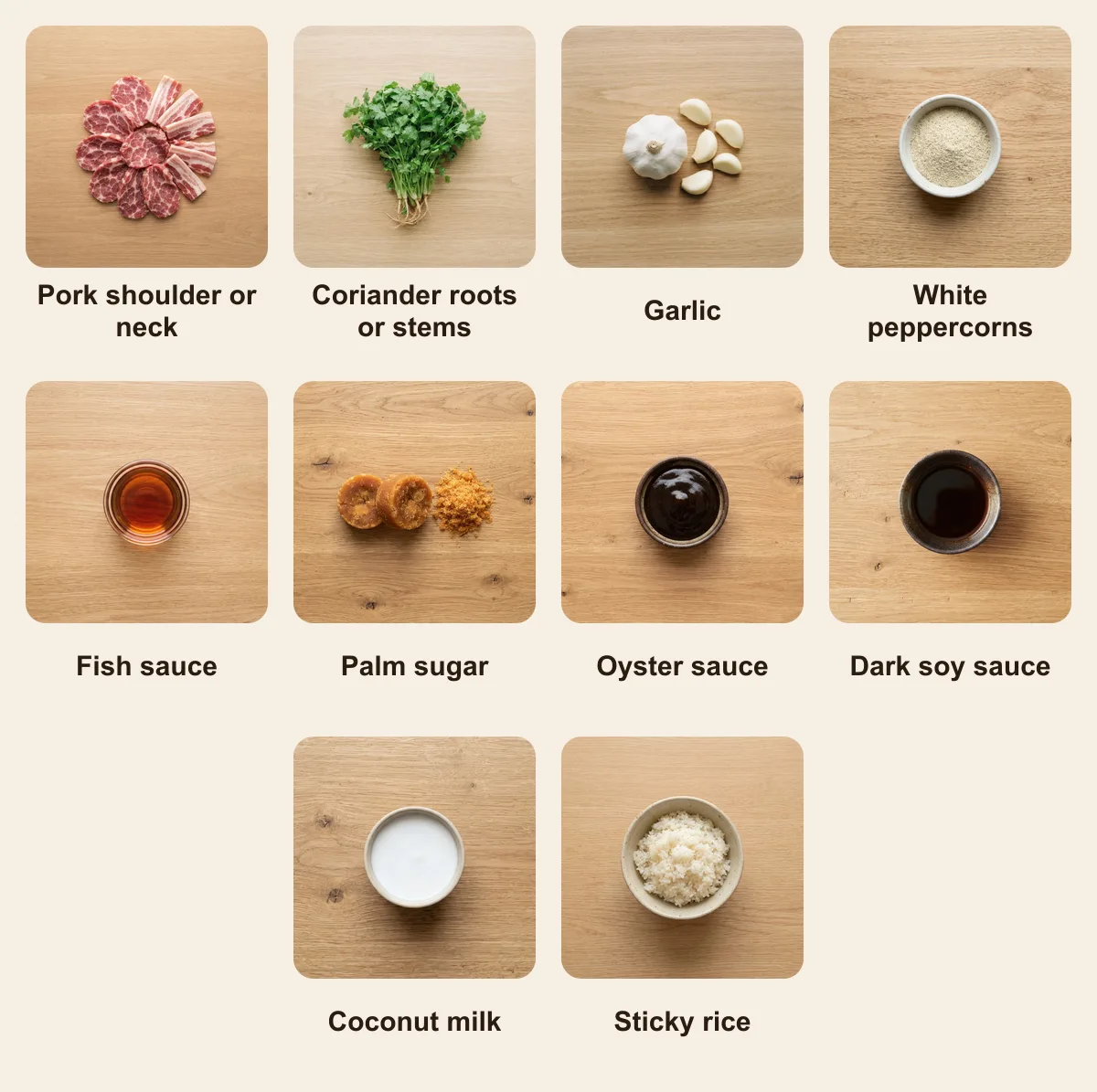
Ingredients
- 700 g pork shoulder or neck, sliced 5 mm thin
- 4 coriander roots, scraped
- 4 garlic cloves
- 1 tsp white peppercorns
- 45 ml fish sauce
- 40 g palm sugar
- 15 ml oyster sauce
- 10 ml dark soy sauce
- 100 ml coconut milk for the marinade, plus 60 ml coconut cream for basting
- sticky rice, to serve
How to make it
- 1
Pound the coriander roots, garlic and peppercorns to a rough paste.
- 2
Dissolve the palm sugar into the fish sauce, oyster sauce, dark soy and the coconut milk, then massage everything into the pork overnight.
- 3
Ribbon-fold the slices onto soaked bamboo skewers.
- 4
Grill over medium coals 8-10 min, brushing with coconut cream at every turn, until the edges caramelise with scattered char spots.
- 5
Serve with hot sticky rice, Bangkok breakfast style.
Pro tip: The coconut-cream baste works double: it keeps 5 mm pork from drying and its sugars build that burnished mahogany glaze, so brush at literally every turn.
Where Moo Ping comes from
Moo ping is a breakfast food, and the morning timing is not incidental. Bangkok's street food operates on shifts, and moo ping carts appear before dawn near office buildings, markets and BTS stations, then disappear by mid-morning. It is commuter food and its packaging — skewers and a bag of sticky rice — is designed for walking.
How Moo Ping is cooked
Coconut milk in the marinade is the Thai signature and it does something specific: its fat carries the fat-soluble aromatics of the coriander root and white pepper into the meat, and its sugars help the surface caramelise. It also makes the marinade cling, which matters for thin slices.
Coriander root — not leaf, not stem — is the other essential and it is the ingredient most often substituted wrongly. It is earthier and more intense than the leaf and it is pounded with garlic and white pepper into the classic Thai aromatic paste. The pork is basted with coconut cream during grilling, which is what produces the characteristic charred-and-glossy surface.
Ingredients and shopping
Pork shoulder or neck, sliced thin — around half a centimetre — and threaded so the slices wave along the skewer rather than lying flat. Fat should be visible in the slices; lean pork gives a dry moo ping.
Coconut milk and separately some coconut cream for basting. Palm sugar, fish sauce, coriander root, garlic, white pepper. Bamboo skewers, soaked. Sticky rice, soaked and steamed, is the fixed accompaniment.
How Moo Ping is served
Two or three skewers with a small bag of sticky rice, eaten walking, in the morning. Nam jim jaew — the toasted rice and chilli dipping sauce — is available at some carts but plenty of Bangkok office workers eat it plain with the rice.
Common mistakes
Coriander leaf instead of root
The root is earthier and far more intense. Leaf gives a completely different and much weaker flavour.
Lean pork
Shoulder or neck with visible fat. Lean pork dries out over charcoal in minutes.
A fierce fire
Coconut milk and palm sugar caramelise fast and burn faster. Moderate coals, frequent turning.
Skipping the coconut cream basting
It is what gives the glossy charred surface. Brushing it on during grilling is the finishing technique.
Moo Ping: questions and answers
Why coriander root and not leaf?
The root is earthier and much more intense, and it is the base of the classic Thai aromatic paste with garlic and white pepper. Leaf is not a substitute.
Why is coconut milk in the marinade?
Its fat carries the fat-soluble aromatics into the meat and its sugars help the surface caramelise. It also makes the marinade cling to thin slices.
Sources and further reading
- Mu Ping — Wikipedia
- Thai BBQ Pork Skewers - The Ultimate Street Food (moo ping) — Hot Thai Kitchen (Pailin Chongchitnant)