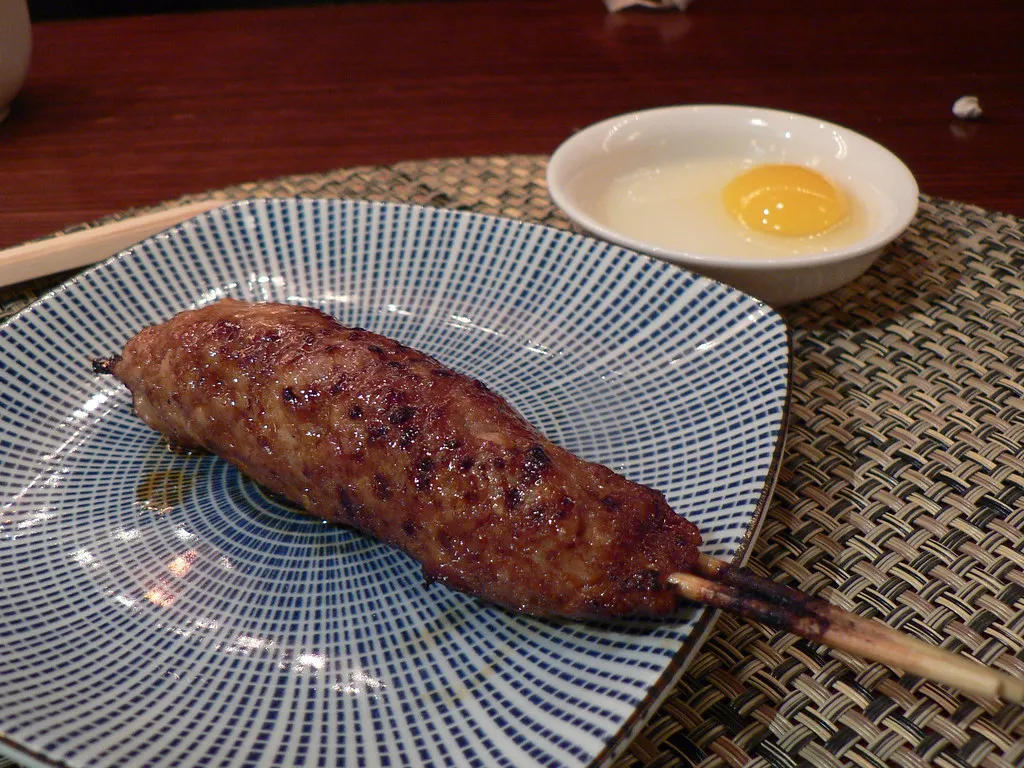
The minced-meat star of the yakitori canon: ground chicken kneaded with ginger, egg and sometimes crunchy cartilage, formed onto skewers and grilled with repeated dips in sweet soy tare glaze. The classic izakaya move is dipping each bite in raw egg yolk.
Also known as tsukune skewers, Japanese chicken meatball skewers, yakitori tsukune.
Reference video
Ingredients
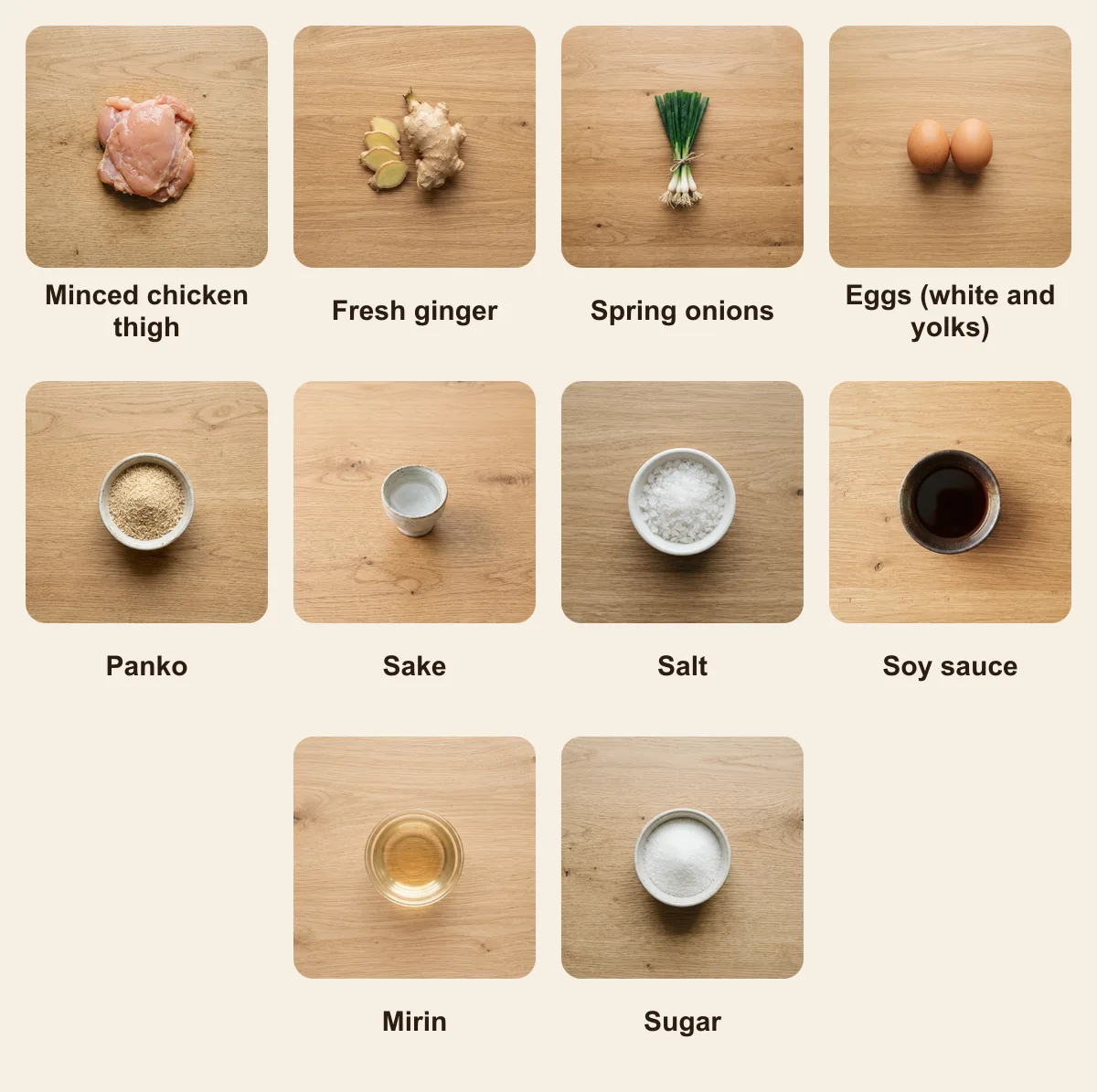
- 500 g minced chicken thigh
- 1 tbsp grated fresh ginger
- 2 spring onions, minced
- 1 egg white
- 2 tbsp panko
- 1 tsp sake
- 1/2 tsp salt
- 60 ml soy sauce, 60 ml mirin, 2 tbsp sake and 1 tbsp sugar, for the tare
- 4 raw egg yolks, to serve
How to make it
- 1
Beat the chicken with ginger, spring onion, egg white, panko, sake and salt until it turns pale and clings to the spoon.
- 2
Chill the mixture 30 minutes, then with wet hands press it into flattened ovals along skewers, two per stick.
- 3
Simmer the tare ingredients down by a third, until the glaze coats a spoon.
- 4
Grill or broil the skewers 4 minutes per side, then lacquer with tare and flash back over the heat twice more until glossy mahogany.
- 5
Serve each pair with a raw egg yolk for dipping, a spoonful of tare stirred through it.
Pro tip: The izakaya bounce comes from deliberate over-mixing: work the mince a good 3-4 minutes so the proteins spring rather than crumble.
Where Tsukune comes from
It is the one yakitori skewer that is a construction rather than a cut, and it is where a shop shows whether it grinds its own meat. The cartilage version — nankotsu iri — is a texture play that Japanese diners actively seek and that visitors sometimes find startling.
How Tsukune is cooked
The bind comes from working the mince until it turns sticky, exactly as in koobideh and lülə, but Japanese practice adds a small amount of egg and often a little cornflour or grated yam, which gives the characteristic springy bounce rather than a crumbly meatball texture.
Tare is applied by repeated dipping: the skewer is grilled, dipped, returned to the fire so the glaze sets, dipped again, and so on for three or four cycles. Each layer caramelises before the next goes on, which is how the deep glossy lacquer is built. Applying it all at once simply burns.
Ingredients and shopping
Chicken thigh mince, ideally ground at home so it stays coarse and keeps its fat. Add finely chopped chicken skin or a little fat if using lean mince. Grated ginger, spring onion, egg white and a little panko; cornflour or grated nagaimo yam does the same job.
For nankotsu iri, chopped chicken breast cartilage. Tare: soy sauce, mirin, sake and sugar, reduced. A raw egg yolk in a small dish for dipping — use very fresh eggs, and be aware this is a raw-egg preparation.
How Tsukune is served
One or two skewers at a counter, with a small dish of raw egg yolk to dip each bite. Shichimi togarashi on the counter. Beer or sake. It is ordered within a longer sequence of yakitori rather than alone.
Common mistakes
Under-kneading
The mixture must be worked until sticky or it falls off the skewer and has a crumbly texture.
Applying all the tare at once
It burns. Dip, return to the fire, repeat three or four times to build layers.
Very lean mince
Add chopped skin or fat. Lean chicken mince makes a dry, dense tsukune.
Shaping at room temperature
Chill the mixture. Cold fat holds the shape while warm fat makes it slack.
Tsukune: questions and answers
What is nankotsu iri tsukune?
The version with chopped chicken cartilage worked into the mince, giving a crunchy texture that Japanese diners actively seek out.
Why dip it in raw egg yolk?
It is a classic izakaya practice — the yolk coats the glazed skewer and softens the sweetness of the tare. Use very fresh eggs.
Why is my tsukune crumbly?
The mince was not kneaded to stickiness, or it was too lean. Work it until tacky and add chopped chicken skin or fat.
How is the tare applied?
By repeated dipping — grill, dip, return to the fire so it sets, and repeat three or four times to build the glaze in layers.
Sources and further reading
- Tsukune — Wikipedia
- Yakitori — Wikipedia
- Tsukune (Japanese Chicken Meatball Skewers) — Just One Cookbook (Namiko Hirasawa Chen)
- Tsukune Recipe Japanese Yakitori — No Recipes (Marc Matsumoto)