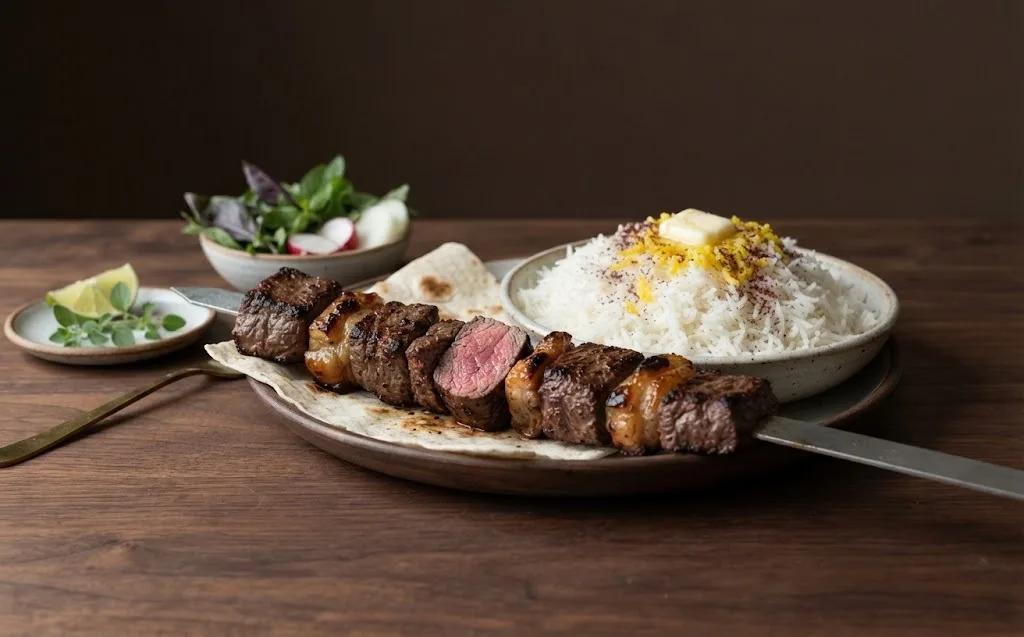
If barg is Persia's carpaccio-thin showpiece and koobideh its ground-meat workhorse, chenjeh is the steakhouse order: fat cubes of lamb or beef sirloin threaded snugly on a skewer and grilled until the outside crusts while the centre stays blushing. The name is plain Persian for a chunk of meat — where koobideh describes a technique (pounding) and barg a shape (leaf-thin slices), chenjeh just names the cut. It is arguably the oldest form of kebab there is — meat, fire, metal — and Iranian cooks treat it with matching restraint. The marinade here is little more than yogurt, onion juice, a glug of oil and a pinch of saffron, with salt held back until the skewer goes over the fire. Because the cubes are thick, the cut matters more than the recipe: a well-marbled beef sirloin or a good lamb leg rewards you; lean stewing meat punishes you. Served with grilled tomatoes, raw onion wedges and sangak or rice, it is the kebab for people who order steak medium-rare.
Also known as: Chenjeh Kabob, Persian Steak Kebab, Lamb Tikka
Reference video
Reference video, embedded from YouTube: filmed by Kooroush, not by How To Make A Kebab, and not owned, relicensed or distributed by this site.
View Original Video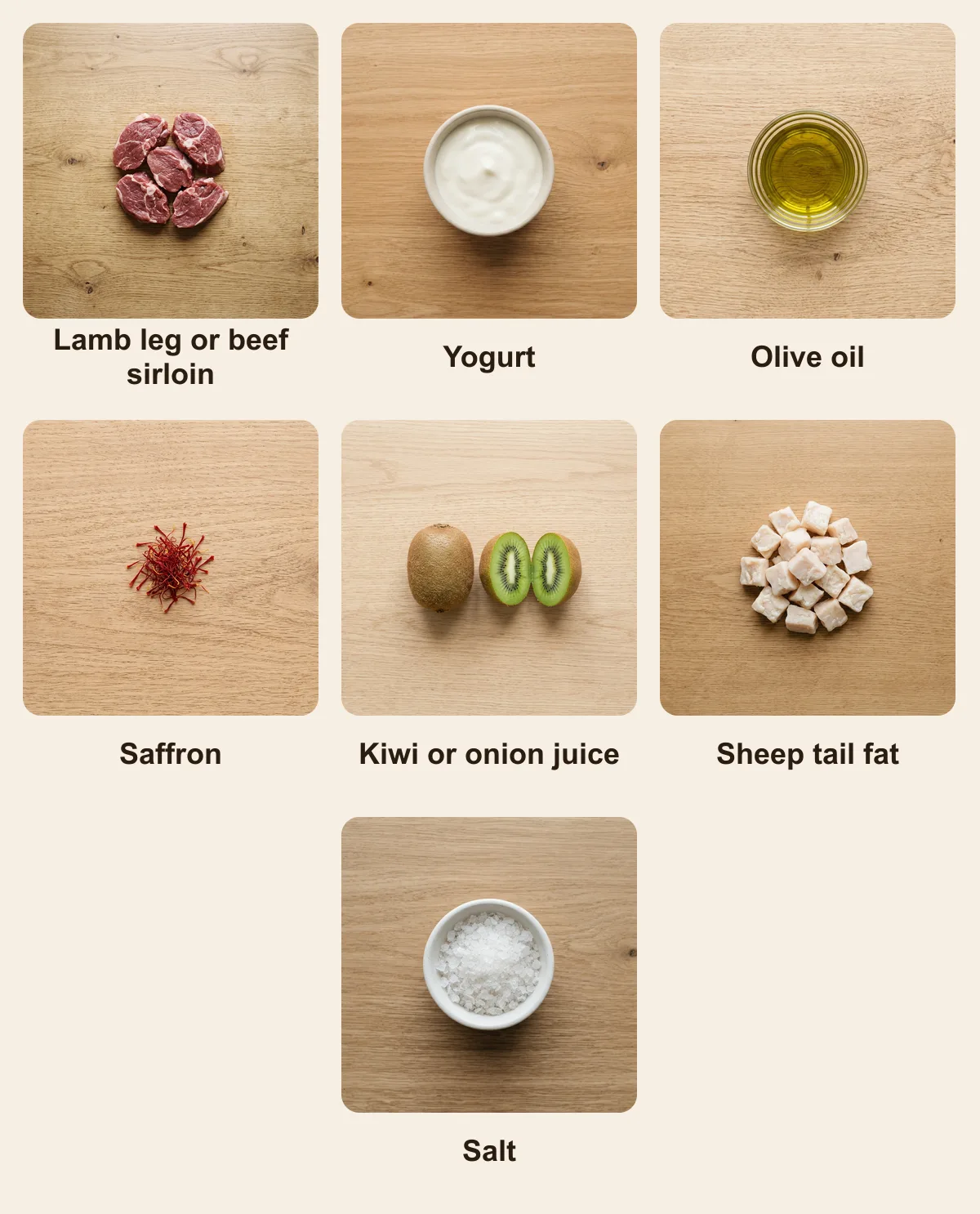
Ingredients
- 1kg Lamb Leg or Beef Sirloin (Cubed)
- Marinade: 1 cup Yogurt, 3 tbsp Olive Oil, Pinch of Saffron
- Tenderizer: Kiwi (Optional - use sparingly) or Onion Juice (from 2 onions, grated and strained)
- 150-200 g Sheep Tail Fat, in 2 cm chunks (to thread between meat)
- 2 tsp (about 10 g) Salt (added just before grilling, not in the marinade)
How To Make Kabab Chenjeh
-
1
Cut the lamb leg or beef sirloin into even 3-4cm cubes, no smaller, so every piece cooks at the same pace and the outside has time to sear before the centre passes medium-rare.
-
2
In a large bowl, stir together the yogurt, olive oil, onion juice and the saffron (ground and steeped in a little hot water), add the cubes and turn until every piece is coated, then cover and refrigerate for 24 hours. If you use kiwi instead of onion juice, add it only for the last hour.
-
3
Thread the cubes snugly onto flat metal skewers, slipping a small chunk of sheep fat between every 2-3 pieces of meat so it melts and bastes them from inside as they grill.
-
4
Season the skewered cubes with salt now rather than in the marinade, then grill over high-heat charcoal for 8-10 minutes in total, turning every 2 minutes, until the outside is seared and an instant-read thermometer in the centre of a cube reads 63°C (145°F), with the middle still pink.
-
5
Serve hot over chelo rice with a knob of butter, sliding the fat pieces off the skewer together with the meat.
Note: Don't leave kiwi in marinade for more than 1 hour or meat turns to mush. Onion juice is safer for overnight. On the coals, chenjeh cooks faster than it looks — turn often over full heat and pull the skewer as soon as the fat pieces between the cubes blister and drip; the centre should still be pink.
Go Deeper · the full story
About this recipe
Chenjeh strips Persian kebab down to its rawest form: fat cubes of lamb or beef sirloin, salt, fire. Where koobideh depends on technique (pounding and shaping mince) and joojeh depends on a marinade doing most of the flavor work, chenjeh depends almost entirely on the cut of meat you start with.
This recipe cuts the meat into thick, even cubes so the outside sears before the center overcooks, threads a piece of sheep fat between every couple of chunks to baste them from the inside as they grill, and keeps the marinade to yogurt, oil, onion juice and a pinch of saffron — nothing acidic enough to toughen the surface over a full day in the fridge.
Why this recipe works
Why This Recipe Works
- Cutting the cubes to a uniform 3-4cm, not smaller, gives them enough mass to sear hard on the outside before the centre passes medium-rare.
- Threading sheep fat between every two or three chunks bastes the meat from inside the skewer as it renders, instead of relying on brushing from outside.
- Turning the skewer often over full heat and pulling it the moment the threaded fat blisters and drips keeps the crust seared while the centre stays pink — chenjeh cooks faster than its thickness suggests.
How to serve it
Serving Notes
Chelo rice and butter are the traditional plate; the cubes are rich enough that a plain starch does more for the dish than another sauce would.
Pull the fat pieces off the skewer along with the meat — they're meant to be eaten, not discarded, and carry most of the basting flavor.
Serve straight off the fire: chenjeh's whole appeal is the contrast between a charred crust and a still-pink centre, and that fades fast once it cools.
Common mistakes to avoid
Common Mistakes
- Cutting the cubes too small: thin cubes cook through before they get any real char, so the crust that defines the dish never develops.
- Skipping the fat between the meat: without it the lean cubes dry out on high heat instead of basting themselves as they cook.
- Salting the meat at the start of the marinade: salt draws moisture out early and the cubes lose juiciness long before they hit the fire.
- Using lean stewing meat instead of a well-marbled cut: chenjeh has almost nowhere to hide a poor cut, since there's no long braise to tenderize it.
Frequently Asked Questions
Can I use beef instead of lamb, or mix them?
Either works — lamb leg and beef sirloin are interchangeable here, since a well-marbled cut matters more than the exact species.
Do I really need the sheep fat, or can I skip it?
You can skip it, but the cubes will dry out faster without something basting them from inside the skewer; beef fat trimmed from the sirloin is a reasonable substitute.
Can I use lemon juice in the marinade like other Persian kebabs?
Better not — chenjeh's marinade leans on yogurt and onion juice specifically because the cubes sit in it for 24 hours, and an acidic marinade that long would turn the surface mushy.
What's the difference between chenjeh and joojeh?
Chenjeh is red meat cut into cubes; joojeh is chicken pieces in a saffron-lemon marinade — different proteins and a completely different marinade logic.
Sources and further reading
- Chenjeh Kebab — Wikipedia
- Kebab — Wikipedia
Keep Cooking
Build The Full Plate
Technique And Support Guides
Shashlik vs Shish Kebab: Meat, Marinade, Cut and Fire Compared
How shashlik differs from shish kebab: the shared şiş root, 4-5 cm pieces vs 3 cm cubes, vinegar or kefir marinades, the mangal fire, and which one to cook.
Best Meat For Kebab
Choose the best meat for kebab by fat ratio, cut, grind, and cooking style, whether it ends up on a skewer, in a wrap, or on a plate.
How To Keep Kebab On The Skewer
Learn how to keep kebab on the skewer with the right fat level, onion handling, kneading, skewer shape, and grill timing.
Metal Vs Wooden Skewers For Kebab
Understand when to use metal or wooden skewers for kebab, plus why flat skewers matter for minced kebab and how oven use changes the choice.
Related Recipes
Kabab Koobideh
The national dish of Iran. Ground meat with onion, grilled on wide skewers.
Kabab Barg
The "Leaf" kebab. Thinly pounded filet mignon marinated in aromatic onion juice.
Joojeh Kabab
Classic Persian saffron chicken. Golden, citrusy, and tender.
Kabab Torsh
The "Sour" Kebab from Northern Iran. Marinated in pomegranate molasses and crushed walnuts.