A skewer is not a serving stick. It is a structural component of the kebab and, in the case of metal, an active cooking surface that conducts heat into the centre of the meat while the fire works on the outside. Choose the wrong one and you get the two classic failures: minced kebab sliding off into the coals, and cubes spinning uselessly every time you try to turn them.
Equipment guide
Metal Vs Wooden Skewers For Kebab
By Ali Ocak
Updated 2026-11-03
Quick answer
Are metal or wooden skewers better for kebabs?
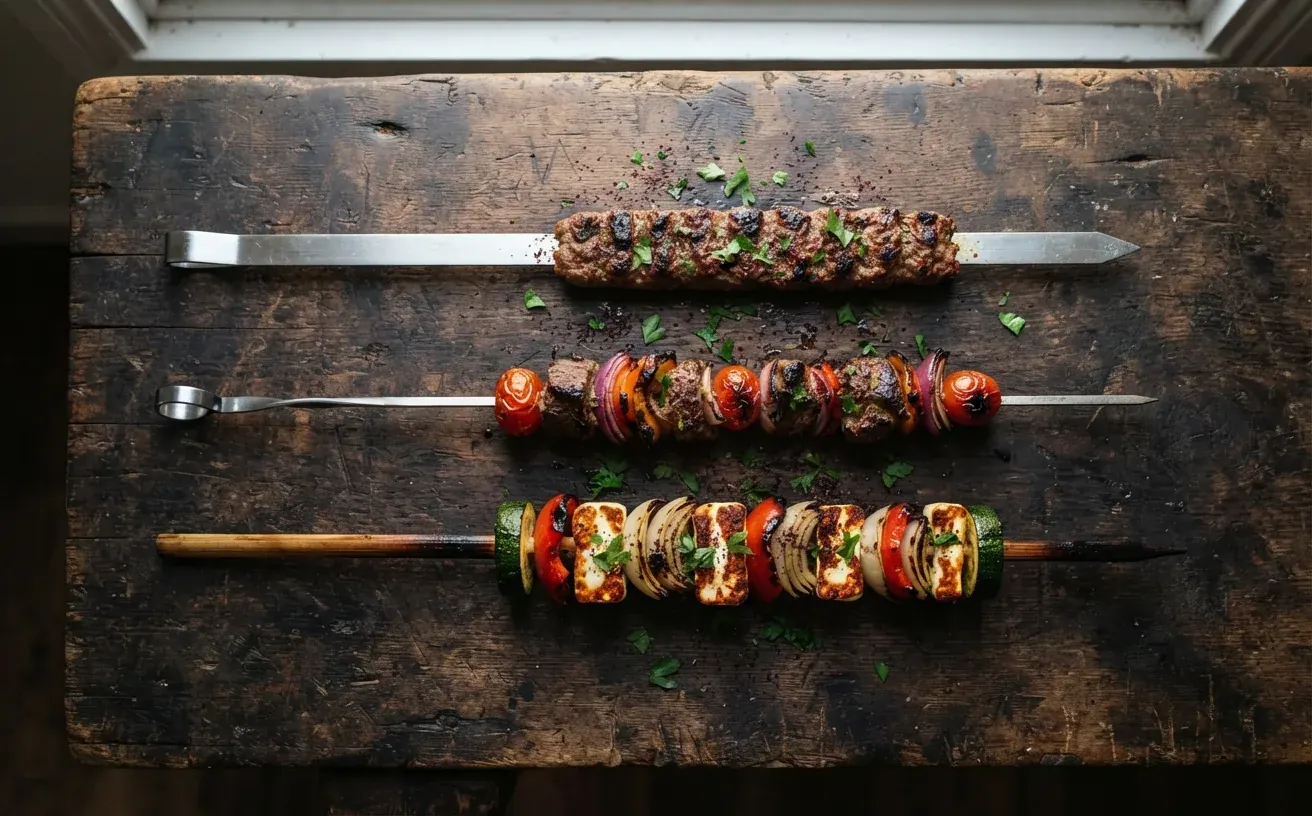
Flat metal skewers are best for minced kebabs like adana, koobideh and seekh and over live charcoal, because steel conducts heat into the meat; soaked bamboo works fine for cubed chicken, vegetables and oven cooking.
Key takeaways
- Stainless steel conducts heat roughly a hundred times better than dry wood.
- A proper metal kebab skewer is flat, not round: a stainless steel blade 1.5 to 3 mm thick, anywhere from 12 mm wide for cubes up to 20 to 25 mm wide for adana and koobideh, and 40 to 60 cm long so the handle stays clear of the fire.
- Bamboo skewers — typically round, 3 to 4 mm across, 20 to 30 cm long — are the right tool more often than metal loyalists admit.
- The most consequential line in this whole comparison is not the material — it is the cross-section.
- Minced kebabs — adana, koobideh, seekh: flat metal, no substitute.
- Over live charcoal, the argument tilts hard toward metal.
The metal versus wood question is really three questions stacked together: what material, what shape, and what dish. A flat 2 cm stainless blade and a round 3 mm bamboo stick are not two versions of the same tool — they solve completely different problems, and each is genuinely the wrong answer for the other's job.
This guide gives you a clear verdict for every situation: minced kebabs like adana and koobideh, cubed kebabs like souvlaki and shish tawook, oven versus live fire, and the buying decision if you only want to own one set.
The physics: a skewer is either a heat pipe or an insulator
Stainless steel conducts heat roughly a hundred times better than dry wood. Over a grill, a metal skewer becomes a rod of hot metal running through the core of the meat, cooking it from the inside while the coals cook it from the outside. That is why kebab on metal cooks noticeably faster and more evenly than the same meat on bamboo — the centre is not waiting for heat to migrate through 3 to 4 centimetres of protein.
Wood does the opposite: it insulates. The meat on a bamboo skewer cooks entirely from the outside in, which is slower but also gentler — useful for delicate items like chicken breast or vegetables that you do not want overcooked at the core before the surface colours.
This single difference drives most of the practical rules. Metal suits thick minced kebabs and dense cubes of lamb that need the interior to keep pace with a fierce fire. Wood suits thin, quick-cooking pieces where the surface is the whole story.
Metal skewers: what you are actually buying
A proper metal kebab skewer is flat, not round: a stainless steel blade 1.5 to 3 mm thick, anywhere from 12 mm wide for cubes up to 20 to 25 mm wide for adana and koobideh, and 40 to 60 cm long so the handle stays clear of the fire. The width is the point — minced meat grips a broad flat blade, and the flat profile means the kebab turns when you turn it instead of rotating around the axis.
Metal takes any temperature a home cook can produce. Charcoal grills run 250 to 350°C at grate level and a broiler element sits around 260 to 290°C; steel shrugs at all of it, where wooden ends char and eventually burn through. Metal is also effectively a lifetime purchase: one wash and it is ready again, against bamboo that goes in the bin after a single cook.
The two real costs are heat and handling. A skewer that has spent ten minutes over coals will hold scalding heat for several minutes after it comes off, so it never goes to the table bare — slide the meat off onto bread, the way adana and koobideh are actually served, with the bread catching the juices.
Wooden skewers: cheap, single-use, and fine within limits
Bamboo skewers — typically round, 3 to 4 mm across, 20 to 30 cm long — are the right tool more often than metal loyalists admit. For cubed chicken, thin marinated pieces, prawns, halloumi, and vegetables, especially in a 180 to 200°C oven or under a moderate grill, they do the job for pennies and skip the washing-up.
The soak is not optional folklore: 30 minutes in cold water is the minimum, and an hour is better for live fire. A soaked skewer survives a normal cook; a dry one starts charring within a couple of minutes over direct coals and can snap mid-turn, dropping the whole line of meat. Even soaked, the exposed ends will blacken over a hot grill — shield them with a strip of foil or park them over the cooler edge.
The hard limit is minced kebab. A round 3 mm stick gives a soft spiced mince almost nothing to grip: too little surface area, no flat face, and no conducted heat to set the interior quickly. If a recipe like adana or seekh kebab is the goal and you only have bamboo, shape the mixture into caseless fingers instead — that is exactly what cevapi are, and they grill beautifully with no skewer at all.
Flat versus round matters more than metal versus wood
The most consequential line in this whole comparison is not the material — it is the cross-section. Round skewers, metal or wood, let food rotate freely around the axis. You turn the skewer 90 degrees, the meat sags back to where gravity wants it, and one face burns while the other stays pale. Flat skewers lock the food to the turn.
For minced kebabs the flat blade is doing even more: the mixture is pressed onto the metal by hand, gripping a wide warm surface, and the classic dimpled finger-marks of koobideh and adana increase that grip while helping the kebab cook evenly. This is why every serious kebab culture that skewers mince — Turkish adana, Persian koobideh, Pakistani and Indian seekh — settled on wide flat blades, not sticks.
If you are stuck with round skewers for cubed meat, the fix is simple: thread each piece onto two parallel skewers about 1 cm apart. The second skewer kills the rotation. It doubles your skewer count but rescues the cook.
Match the skewer to the dish
Minced kebabs — adana, koobideh, seekh: flat metal, no substitute. Use a blade at least 15 mm wide, chill the seasoned mince 1 to 2 hours first, and press it on in an even layer about 2 cm thick. Verdict: if you make these more than twice a year, the flat set pays for itself immediately.
Cubed kebabs — souvlaki, shish tawook, lamb shish, boti: either material works, so decide by fire and frequency. Over hot charcoal or for regular cooking, thin metal skewers win on durability and even cooking of 2.5 to 3 cm cubes. For an occasional oven or grill-pan batch, soaked bamboo is completely adequate — souvlaki has been sold on disposable wooden sticks for a century.
Doner and gyros are the special case: they are vertical-spit dishes, and neither a flat blade nor a bamboo stick recreates a rotisserie. The honest home versions are either a stacked roast on a single sturdy vertical skewer standing in a tray in the oven, or thin-sliced marinated meat blasted under a very hot broiler — a different technique, covered by the doner and gyros recipes rather than the skewer drawer.
Vegetables, halloumi, fruit, and anything for a crowd of kids: bamboo, no debate. Cool ends, no metal at the table, nothing to collect and wash afterwards.
How the cooking method changes the answer
Over live charcoal, the argument tilts hard toward metal. The fire is hottest exactly where wooden skewers are most exposed, and long 50 to 60 cm flat skewers let you bridge the meat across the coals with nothing touching a grate — the traditional mangal setup, which is why adana and koobideh develop crust on all faces instead of grate stripes on two.
Under a broiler, either material works if you manage the ends: keep bamboo tips away from the element or wrap them in foil, and expect metal skewers to come out too hot to touch. Suspending skewers across the rim of a deep roasting tray mimics the mangal indoors — the meat hangs in the air, fat drips into the tray instead of smoking on a pan surface, and the kebab browns all round.
In a 180 to 200°C oven, wood's disadvantages nearly vanish — no open flame, moderate temperature — while metal keeps its inside-out cooking bonus, shaving several minutes off thicker pieces. For oven kebab, use whichever you own; for a first purchase aimed at oven cooking, bamboo is the cheaper rational choice.
Buying guide: the two-item skewer drawer
If you buy one serious set, make it six to eight flat stainless steel skewers, 2 mm thick, 15 to 20 mm wide, 45 cm or longer, ideally with a hanging loop or wooden handle. That single set covers adana, koobideh, seekh, and every cubed kebab on the site, and it will outlive the grill it cooks on. Avoid chrome-plated bargain sets — plating flakes with repeated high heat — and avoid anything shorter than 35 cm, which puts your hand over the fire.
Then keep a 100-pack of 25 cm bamboo skewers in the drawer for a euro or two. They cover vegetables, kids' portions, party quantities, and any day you do not feel like washing steel. Between those two purchases there is no kebab in the Turkish, Persian, Greek, or Indian repertoire you cannot skewer correctly.
Skip the gimmicks: rotating motorised skewer racks, square-section novelty sticks, and double-prong plastic-handled sets solve problems the flat blade already solved centuries ago.
Why kebabs fall off, spin, and burn: the real failure mechanisms
Mince slides off the skewer because the fat melted before the protein set. Warm hands, warm meat, or a long delay between shaping and cooking softens the fat, the mixture loses its grip, and the kebab sags and drops. The fixes are mechanical: chill the mince 1 to 2 hours, knead it until it turns tacky and paste-like so the proteins bind, work with a bowl of cold water for your hands, and get the shaped skewers over high heat within minutes so the surface sets fast.
Cubes burn on one side because they are spinning on a round skewer — the same face keeps falling back toward the heat. The fix is flat skewers or the two-parallel-skewer trick, not more careful turning.
Wooden skewers catch fire because dry bamboo above roughly 250°C direct heat chars in minutes; an unsoaked skewer over coals is kindling with dinner attached. Soak 30 minutes minimum, shield the bare ends, and never use wood to bridge directly over open flame with nothing supporting the middle — soaked bamboo also loses stiffness and will bow under a heavy load of meat.
Finally, crowding: pieces jammed tight against each other steam at the contact points and never brown there. Leave a few millimetres between cubes so hot air reaches every face — the small gap is the difference between grilled and half-boiled.
Sources and further reading
- Thermal Conductivity of Common Materials - Solids, Liquids and Gases — The Engineering ToolBox
- All Your Questions About Grilling Skewers, Answered — Cuisine at Home
- Kabab koobideh — Wikipedia
- Grilled Adana-Style Kebabs — America's Test Kitchen
Cook These Next

Lamb / 1h
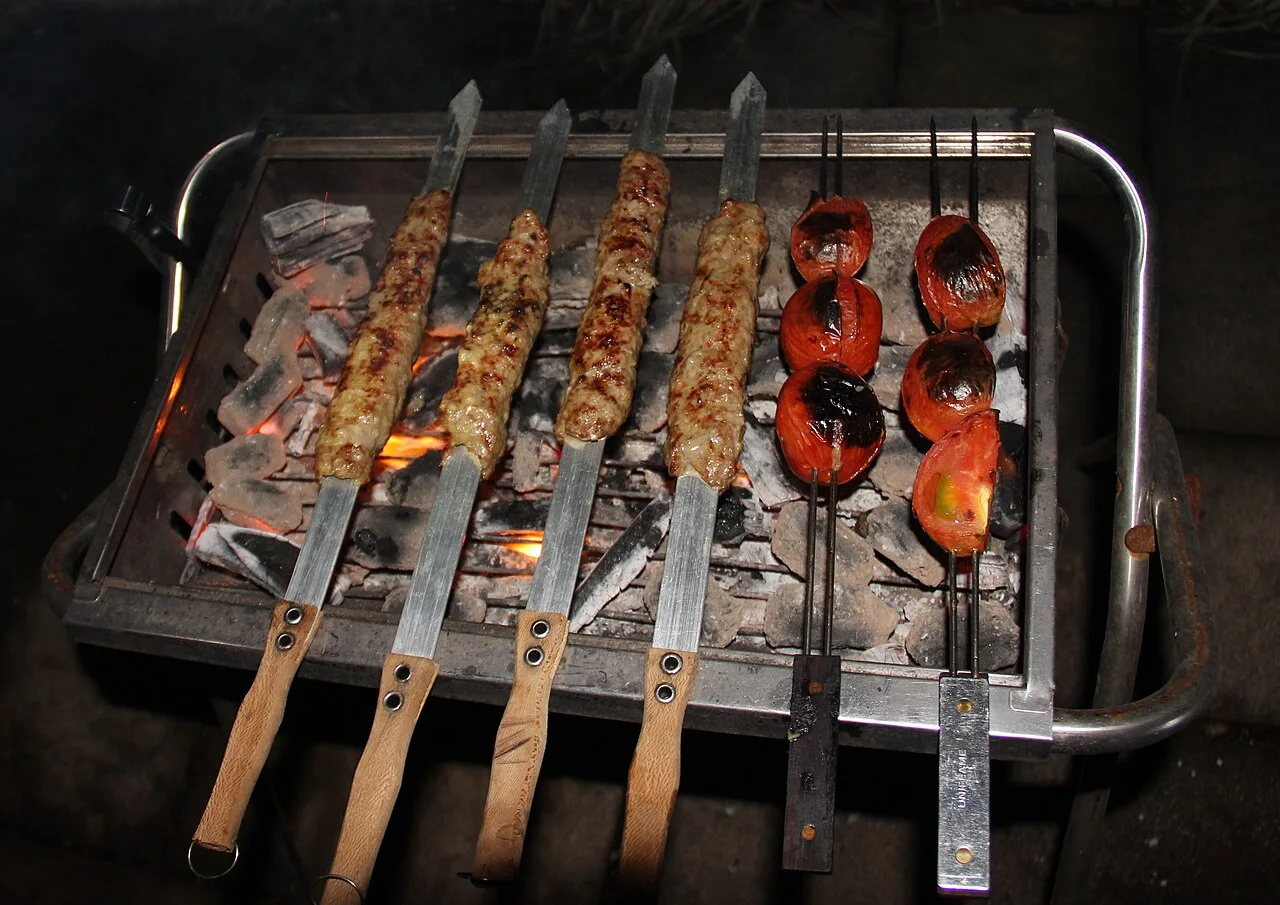
Adana Kebab
The spicy gold standard of Turkish BBQ. Hand-minced lamb with tail fat.
Beef / 2h 40m
Kabab Koobideh
Often called the national dish of Iran: ground meat and grated onion, pressed onto wide flat skewers and grilled.
Beef / 1h 40m
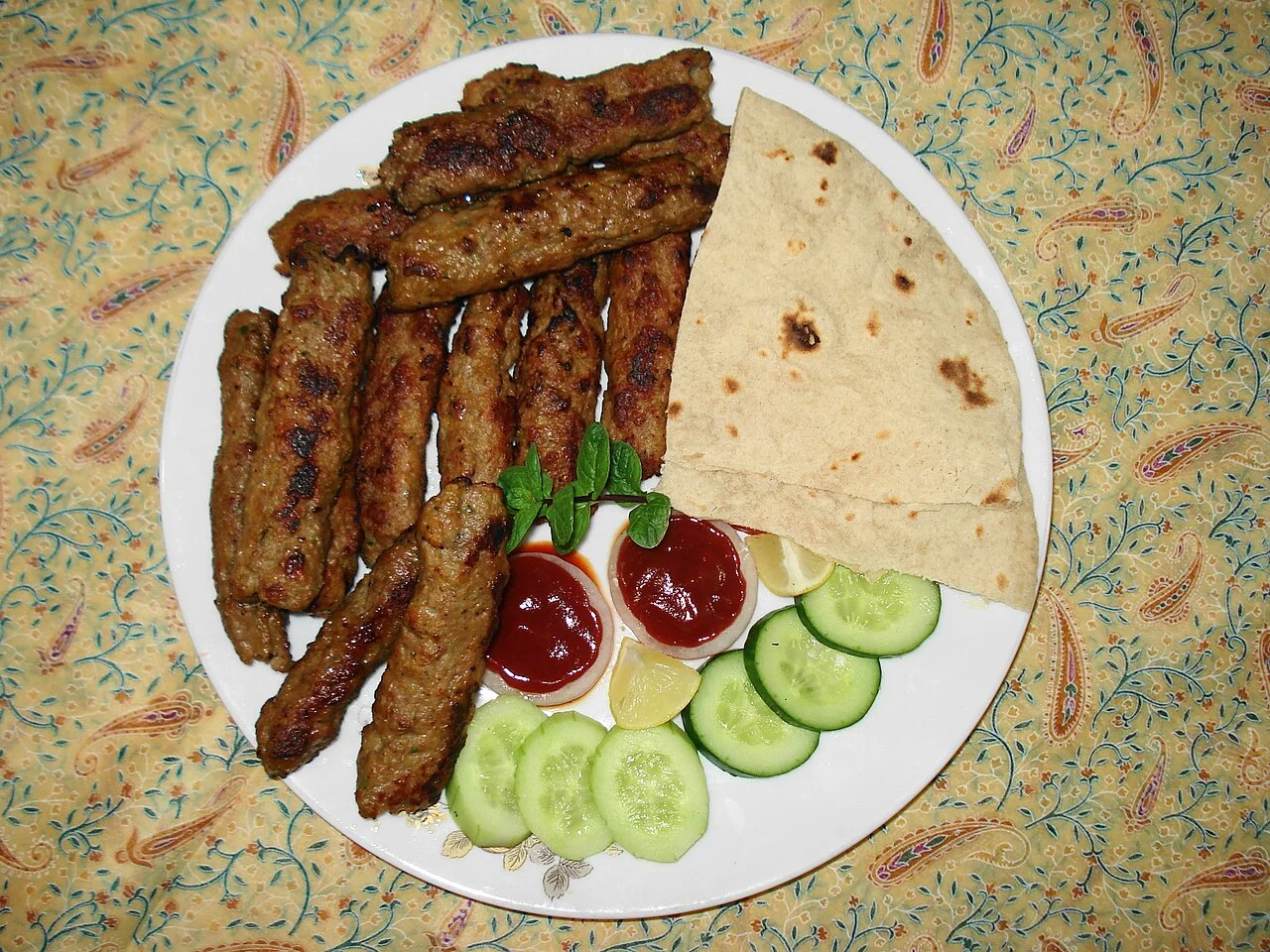
Seekh Kebab
Spiced minced meat cylinders cooked in a Tandoor.
Pork / 2h 30m
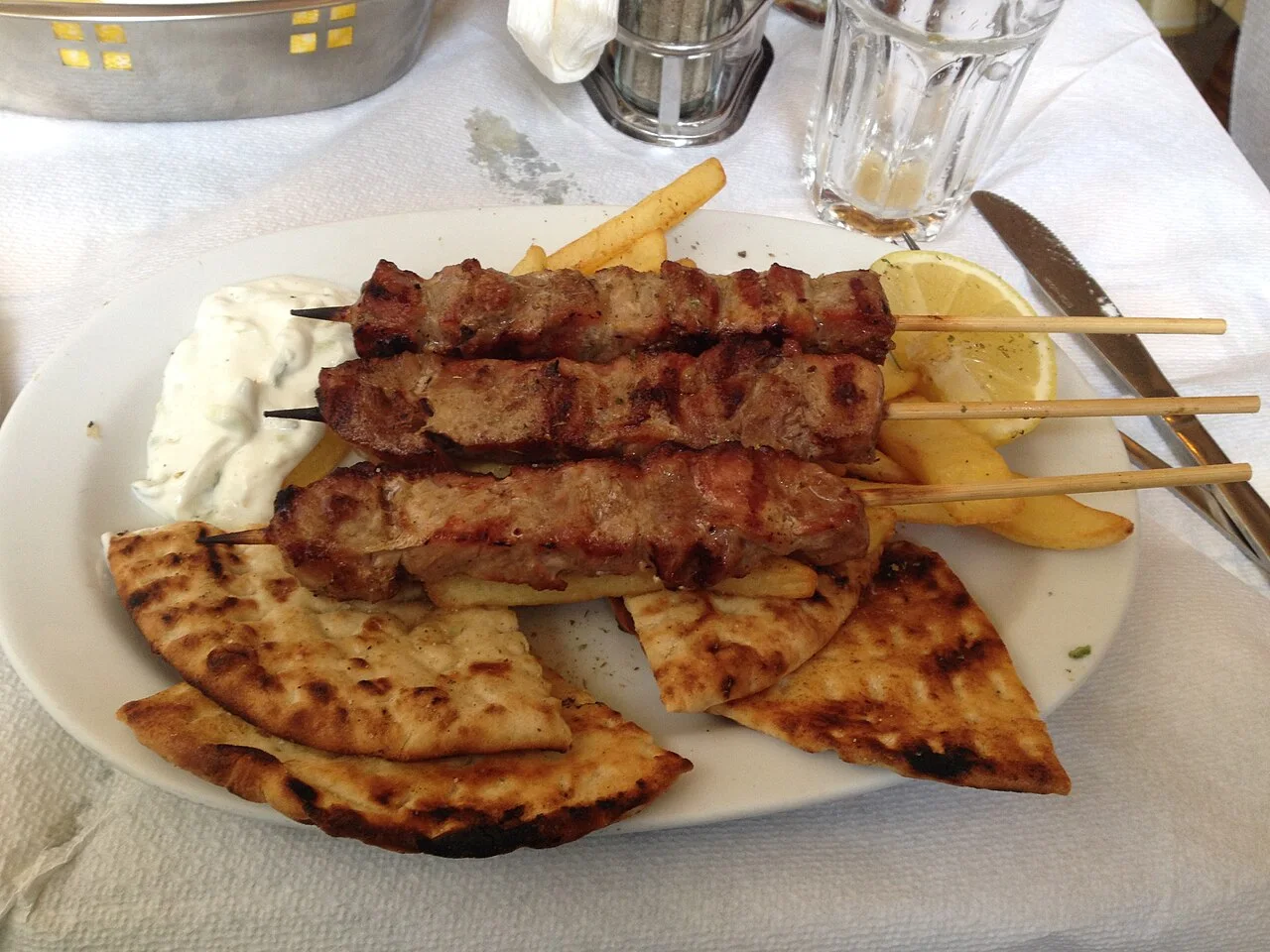
Souvlaki
Classic Greek skewers. Traditionally Pork, marinated in lemon and oregano.
Related Collections
Turkish Kebab Guides
A focused collection for Turkish kebab styles including Adana, Urfa, Cag, Iskender, and supporting bread pages.
Persian Kebab Recipes
A collection of Persian grilling styles, from koobideh and barg to joojeh and other skewer traditions.
Indian Kebab Recipes
A collection of Indian kebab styles, from seekh and galouti to boti, reshmi, and green-marinated skewers.
More Guides
Sauce guide
Best Sauce For Kebab
Find the best sauce for kebab, gyros, shawarma, and cevapi with a practical guide to yogurt sauces, garlic sauces, tahini, and chili styles.
Comparison
Adana Vs Urfa Kebab
Compare Adana and Urfa kebab by heat level, fat feel, pepper use, texture, and serving style so you know which one to cook.
Serving guide
What To Serve With Cevapi
Serve cevapi properly with somun, onion, ajvar, kajmak, and practical Balkan plate-building advice for home cooks.
Meat guide
Best Cut For Shish Kebab
Choose the best cut for shish kebab with a practical guide to lamb, beef, and chicken options, cube size, fat balance, and what actually stays juicy on skewers.
Technique guide
How To Marinate Kebab Properly
Learn how to marinate kebab without making the meat mushy, watery, or flat, with clear guidance for chicken, lamb, beef, and yogurt-based marinades.
Heat guide
What Temperature to Cook Kebab
The heat each method needs, from charcoal to oven, and the internal temperature that makes chicken, minced and cubed kebabs safe: 74 °C, 71 °C and 63 °C with a rest.
Keep cooking
New to kebab? Start with how to make kebab at home, then read about gemüse kebab, yaprak döner or shishlik.
How People Search for This
Readers find this page on Google with these searches:
flat metal skewers for kebabs
Comments
Cooked it, changed something, or spotted a mistake? Say so here. Every comment is read before it is published.