The short version first. Donair versus shawarma is ground against whole muscle and sweet against savory: a spiced beef loaf under a sweet condensed-milk sauce, against long-marinated stacked meat under garlicky toum or nutty tahini. Donair versus gyro is a family dispute, Halifax rebuilt the gyros with a spiced ground-beef cone and a sweet sauce in place of tzatziki, so the divide is the sauce and the cayenne, not the machine. The rest of the page is what those differences mean at the cutting board.
Comparison
Gyros Vs Shawarma Vs Donair
By Ali Ocak
Updated 2026-11-03
Quick answer
What is the difference between donair and shawarma?
Donair is a spiced ground-beef loaf served under a sweet condensed-milk sauce, while shawarma is long-marinated stacked whole-muscle meat served with garlicky toum or nutty tahini.
What is the difference between donair and gyro?
Donair is Halifax's rebuild of the gyro: a spiced ground-beef cone with a sweet sauce in place of tzatziki, so the real divide is the sauce and the cayenne, not the machine.
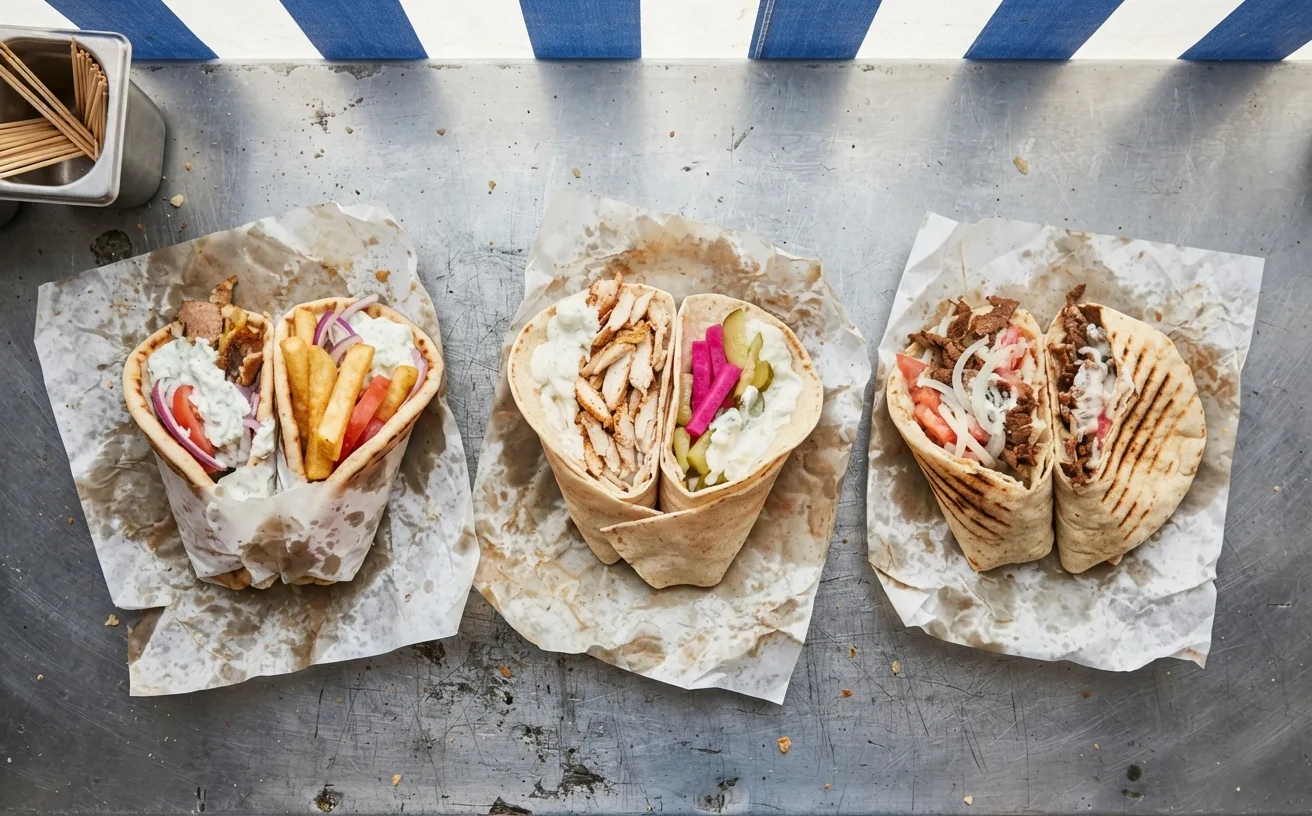
Key takeaways
- The vertical rotisserie is a 19th-century Ottoman invention: turning the spit upright let fat baste the meat as it dripped down instead of feeding the fire, and it let a cook carve a paper-thin crust to order while the interior kept roasting.
- This is the first genuine fork in the road.
- Greek gyros seasoning is deliberately short: oregano, garlic, salt, black pepper, lemon, olive oil, sometimes thyme or a touch of paprika.
- Bread is where most home cooks accidentally make the wrong dish.
- Strip away the bread and the spices and you could still identify each dish blind by its sauce.
- If you want the fastest path to a great wrap with the fewest ingredients: gyros.
Gyros, shawarma, and donair are three answers to the same question: what do you do with a vertical spit of rotating meat once it leaves the Ottoman Empire? All three descend from Turkish doner kebab, and all three ended up somewhere completely different. Gyros went to Greece and got lemon, oregano, and tzatziki. Shawarma went to the Levant and got cardamom, toum, and pickled turnips. Donair went to Halifax, Nova Scotia in the early 1970s and got a sweet condensed-milk sauce that horrifies purists and converts everyone who actually eats it.
If you are standing in your kitchen deciding which one to cook, the name of the meat matters far less than three concrete choices: how the meat is seasoned and stacked, which bread carries it, and what the sauce is doing. Those three decisions are where the dishes genuinely diverge, and they are what this page compares. The wrap structure, the garnish logic, even the temperature you serve at all follow from them.
One honest note before the comparison: at home, nobody has a vertical rotisserie. Every one of these dishes translates to a home method, stacked meat on a vertical skewer roasted at around 200 degrees C, a loaf baked to 71 degrees C internal, or marinated thighs under a hot broiler, and each translation favors a different dish. That practicality is part of the verdict, not a footnote.
One rotating cone, three descendants
The vertical rotisserie is a 19th-century Ottoman invention: turning the spit upright let fat baste the meat as it dripped down instead of feeding the fire, and it let a cook carve a paper-thin crust to order while the interior kept roasting. That single idea is the common ancestor. Doner kebab is the Turkish original, and if you want the source dish itself, the doner pages on this site are the reference point for the whole family.
Gyros is what happened when Anatolian Greek refugees brought the technique to Greece after 1922. The name simply means turn. In Greece the cone is usually pork or chicken, seasoned with oregano, and served in thick pocketless pita, often with fries tucked inside the wrap. The Greek-American gyro cone, the one on most North American spits, is a different animal: a ground beef and lamb emulsion, pressed and steamed into a dense loaf before it ever meets the rotisserie.
Shawarma is the Levantine branch, the Arabic name is a rendering of the Turkish word for turning, and it kept the stacked whole-muscle construction but rebuilt the flavor around long acidic marinades and warm spices. Donair is the youngest and strangest branch: created in Halifax around 1972 by a Greek immigrant who found locals lukewarm on classic gyros, so he sweetened the sauce and spiced a ground-beef cone to match. In 2015 Halifax made donair its official food. Three names, three real dishes, one machine.
Which gyro you mean decides the donair versus gyro question. Against a Greek pork gyros the contrast is total: whole muscle against ground loaf, tzatziki against sweet sauce. Against the North American food-court gyro the two cones are near-twins, both ground, pressed, and shaved, and the real differences shrink to three: the gyro cone carries lamb alongside the beef, the donair loaf carries cayenne, and the sauces sit at opposite ends of the sweet-savory line.
The meat: whole muscle, marinated stacks, or a seasoned loaf
This is the first genuine fork in the road. Greek gyros and Levantine shawarma are stacked whole-muscle dishes: thin slabs of pork shoulder, chicken thigh, or beef, threaded onto the spit in layers with fat interleaved between them. Cut the slabs thin before stacking so the marinade penetrates, about 5 mm for pork gyros and 8 to 10 mm for chicken thigh or beef shawarma, and the finished carve off the cone should land at 2 to 3 mm, thin enough to crisp, thick enough to stay juicy.
Donair and the Greek-American gyro cone are ground-meat dishes. A proper donair loaf is beef at roughly 20 to 25 percent fat, kneaded hard with its spices until the myosin binds and the paste turns sticky and smooth, the same protein logic that holds an adana kebab or koobideh on its skewer. That kneading is not optional: an unbound loaf crumbles when you slice it. The loaf bakes to 71 degrees C internal, rests, then gets sliced thin and crisped on a hot griddle or under a broiler.
Fat placement is the tell. Whole-muscle builds rely on interleaved fat and marinade oil basting downward on the spit; ground builds carry their fat internally, which is why donair meat re-crisps so well from cold, the fat renders again on the griddle. If you love the springy, uniform chew of cevapi or adana, the donair loaf will feel familiar. If you want distinct, ragged, crusty-edged slices, cook the whole-muscle route.
Decision rule: if you can get chicken thighs or pork shoulder and have 4 to 24 hours to marinate, make gyros or shawarma. If you have ground beef and two hours, make donair. Chicken must reach 74 degrees C; the sliced whole-muscle carve gets there instantly at the crust.
Spice logic: lemon and oregano versus the warm spice cabinet versus paprika
Greek gyros seasoning is deliberately short: oregano, garlic, salt, black pepper, lemon, olive oil, sometimes thyme or a touch of paprika. The marinade is bright and herbal because the sauce, tzatziki, is also cooling. Nothing in the Greek build fights anything else, which is why it reads as clean rather than complex.
Shawarma is the opposite philosophy: a long warm-spice list layered over an acidic base. A working chicken shawarma marinade runs yogurt or lemon juice plus vinegar, then cumin, coriander, cardamom, turmeric, cinnamon, allspice, black pepper, and garlic, comfortably 7 to 10 spices, at around 1.5 to 2 tablespoons of total ground spice per kilo of meat. The acid matters mechanically, not just for flavor: yogurt and lemon drop the surface pH and tenderize over an 8 to 24 hour marinade, which is why rushed 30-minute shawarma tastes like spiced grilled chicken instead of shawarma.
Donair seasoning is a third lane entirely: dried oregano, paprika, garlic and onion powder, cayenne, salt, and pepper worked into the ground beef itself, roughly 2 tablespoons of seasoning per kilo. It is closer to a spiced meatloaf than to either marinade, and it is calibrated to stand up to a sweet sauce. Season a donair loaf like a gyros marinade and the sweet sauce will flatten it completely.
Bread and wrap architecture
Bread is where most home cooks accidentally make the wrong dish. Greek gyros wants thick, soft, pocketless pita, 5 to 8 mm, oiled and warmed on a griddle for about 30 to 45 seconds per side. It folds around the filling like a taco rather than rolling shut, and the wrap stays open at the top. That open fold is why gyros can carry heavy, wet ingredients like tomato and tzatziki without collapsing.
Shawarma wants thin bread: saj or markouk at 1 to 2 mm, lavash, or thin pita. The wrap rolls fully closed, tight, with the ends tucked, and the best shops then press the finished roll on a hot flat-top or in a panini press for a minute until the seam seals and the outside crisps. A tight roll only works with thin bread; try it with 8 mm Greek pita and you get a bread log with a meat rumor inside. The lavash versus pita versus durum guide on this site covers this exact mechanics problem in more depth.
Donair uses a soft, thin North American pita, briefly steamed or dampened and heated so it turns pliable, then wrapped and rolled in foil. The foil is structural, not packaging: donair sauce and tomato make the sloppiest filling of the three, and the foil-wrapped service is the only reason it is eatable by hand at all. Verdict by bread on hand: thick pita means gyros, lavash or saj means shawarma, soft supermarket pita plus foil means donair.
The sauce is the real dividing line
Strip away the bread and the spices and you could still identify each dish blind by its sauce. Gyros takes tzatziki: strained yogurt, grated cucumber squeezed hard in a towel, garlic, olive oil, lemon or vinegar, dill or mint. The non-negotiable numbers are thick yogurt (10 percent fat Greek-style) and cucumber wrung until it stops dripping, because cucumber is about 95 percent water and unsqueezed it turns the sauce to soup within 20 minutes.
Shawarma splits by protein. Chicken shawarma takes toum, a dense garlic emulsion of garlic, neutral oil, lemon, and salt, essentially a garlic mayonnaise with no egg, built by adding oil in a thin stream at roughly 4 parts oil to 1 part garlic. Beef and lamb shawarma lean toward tahini sauce: tahini let down with lemon juice and water at about 2 parts tahini to 1 part lemon, whisked through its seized stage until it loosens into cream. Pickled turnips and cucumbers supply the acid crunch that the rich sauces demand.
Donair sauce is the outlier and the whole point of the dish: one 300 ml can of sweetened condensed milk, about 60 ml of white vinegar, and half a teaspoon of garlic powder. Whisk the vinegar in gradually and the acid thickens the milk proteins into a glossy, spoon-coating sauce; it is sweet, garlicky, and completely unlike anything else in the kebab world. If the idea repels you, you want gyros. If you are curious, make the donair, the sauce is the experience.
Do not cross the sauces. Tzatziki on donair meat reads as sour against the paprika loaf; sweet sauce on shawarma buries the cardamom you spent a day marinating in. The sauce and the seasoning were designed as pairs.
Which one to cook tonight
If you want the fastest path to a great wrap with the fewest ingredients: gyros. Chicken thighs, oregano, lemon, garlic, yogurt for a quick tzatziki, thick pita, tomato, onion. Marinate 4 hours minimum, roast stacked on a vertical skewer at 200 degrees C for about 90 minutes or broil flat, carve thin. Add fries inside the wrap if you want the true Athens street version. If you would rather skewer than wrap, the same marinade logic runs the souvlaki pages.
If you want maximum flavor payoff and can plan a day ahead: shawarma. The 8 to 24 hour marinade is doing tenderizing work nothing else can replace, and the toum or tahini plus pickles gives you the sharpest, most layered bite of the three. It is the right choice for feeding a crowd too, since a big stacked roast carves progressively.
If you have ground beef, or you want something no one at the table has eaten before: donair. Two hours from mixing bowl to foil-wrapped wrap, no marinade window, and the loaf slices and re-crisps beautifully for days, which makes it the best make-ahead of the three. And if what you actually crave is grilled ground meat without the wrap ceremony at all, the adana, koobideh, and cevapi recipes on this site are the direct route, same minced-meat logic, open flame instead of a cone.
Where these builds actually fail
Watery tzatziki is failure number one, and the mechanism is always the same: unstrained yogurt or unsqueezed cucumber releasing water into the sauce. Salt pulls moisture out of cucumber cells by osmosis, so salt the grated cucumber, wait 10 minutes, then wring it. There is no fixing a wet tzatziki after assembly; the water has already soaked the pita.
Broken toum is failure number two. The emulsion holds only if the oil goes in slowly, a thin stream over 3 to 4 minutes for a full batch, and only if everything is cold-to-room temperature. Dump the oil in and the garlic cannot coat the droplets fast enough, and you get garlic oil instead of garlic cream. If it breaks, restart with a spoonful of the broken sauce and an ice cube and rebuild.
Thick carving kills whole-muscle builds. Slices over 4 to 5 mm taste like roast dinner in bread, because the crust-to-interior ratio is the entire texture argument of spit meat. Chill the cooked stack for 20 to 30 minutes before slicing if your knife skills are ordinary; firm meat slices at 2 to 3 mm where warm meat shreds. Then re-crisp the slices in a hot pan, that second sear is where shops get their edges.
The last failure is architectural: overloading. A wrap holds together at roughly 150 to 200 grams of filling; past that, the tightest roll splits at the seam. Gyros tolerates overload best because it is open-folded, shawarma worst because the roll depends on compression, and donair cheats with foil. If your wraps keep bursting, the answer is less filling, not bigger bread.
Sources and further reading
- Safe Minimum Internal Temperature Chart — USDA Food Safety and Inspection Service
- The story behind the doner kebab — National Geographic
- Bursa Kebab — Bursa Provincial Directorate of Culture and Tourism (Turkish Ministry of Culture and Tourism)
- Halifax Donair — The Canadian Encyclopedia (Historica Canada)
- History Of The Halifax Donair — Flavour Network (Corus Entertainment)
- Gyros — Wikipedia
Cook These Next
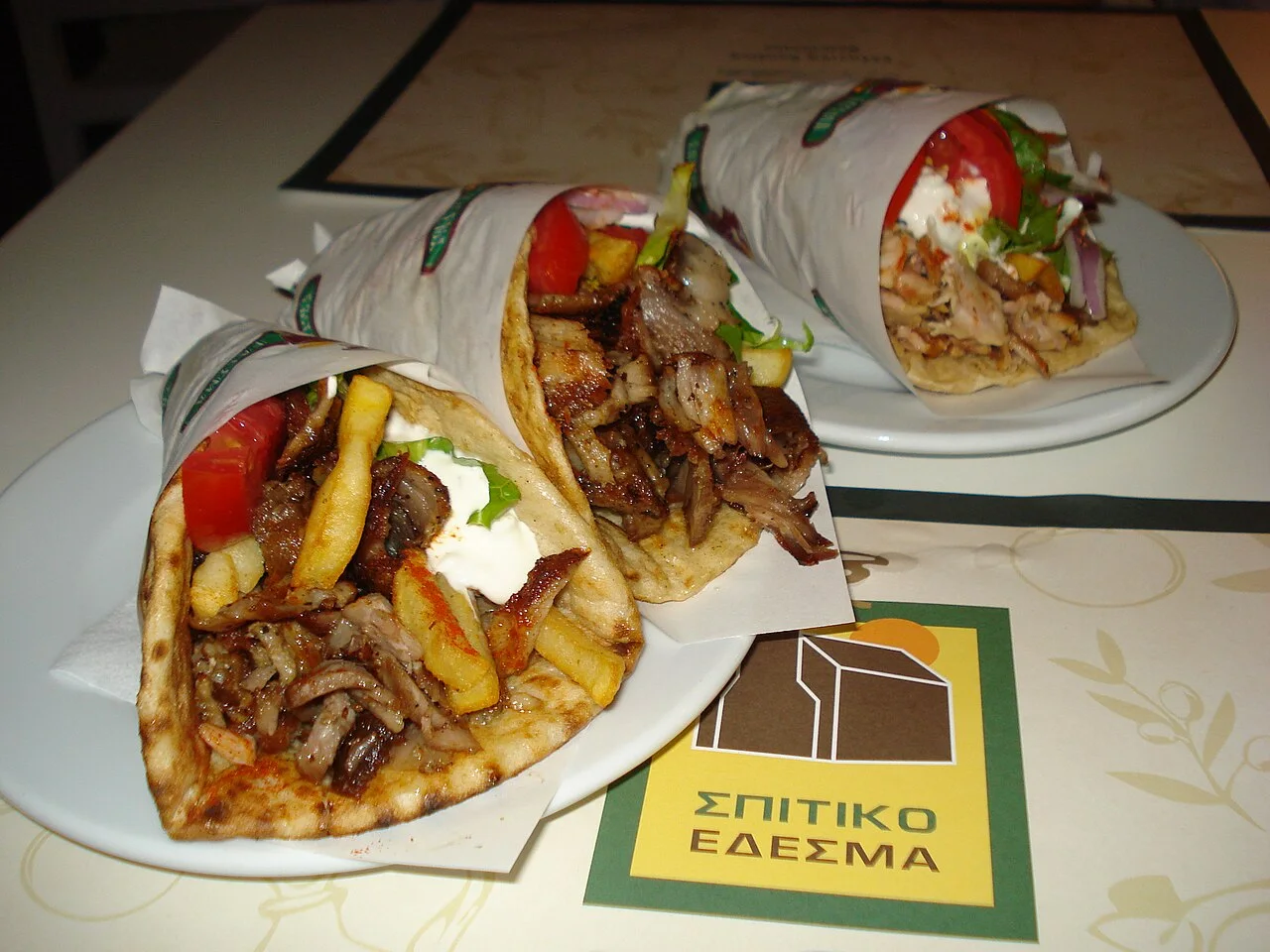
Pork / 9h 50m
Authentic Gyros
The Greek vertical rotisserie. Pork slices stacked and shaved.
 AI illustration
Beef / 1h 25m
Halifax Donair
Canada's spiced beef masterpiece with sweet condensed milk sauce.
 AI illustration
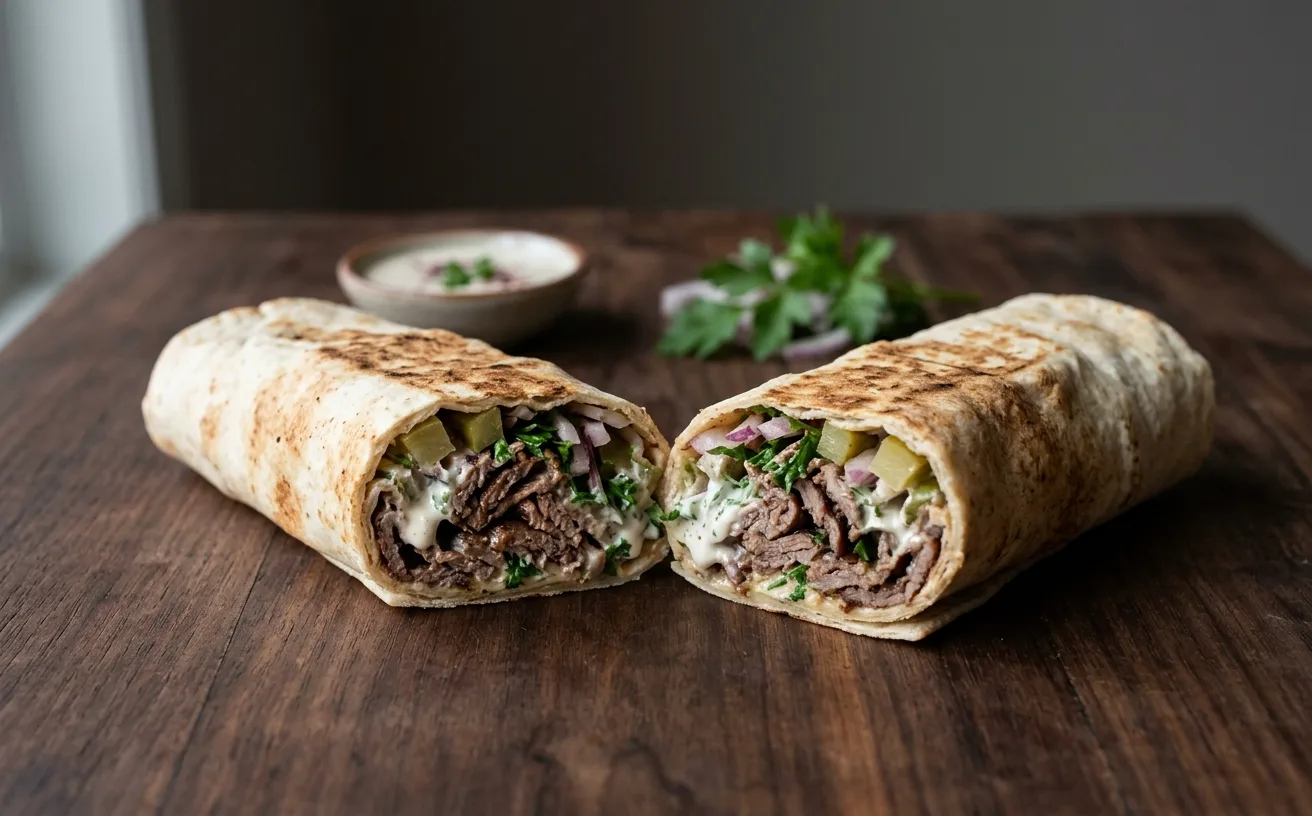
Beef / 25h 5m
Beef Shawarma
The Levantine cousin of Gyros. Distinct Arab spices (cardamom, cinnamon) and Tahini sauce.
 AI illustration
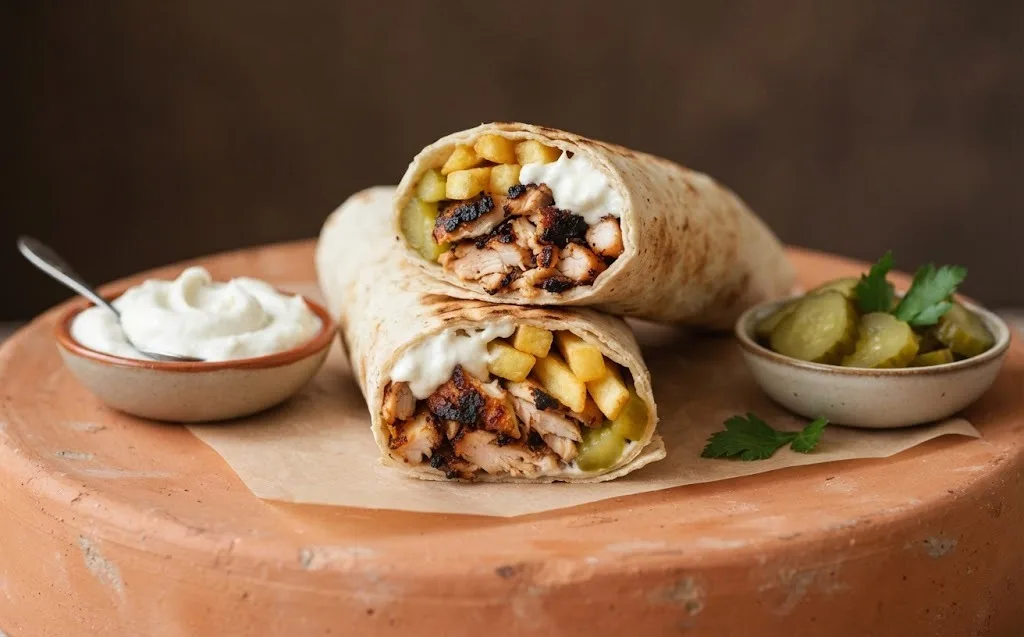
Chicken / 9h 5m
Chicken Shawarma
Garlic-lovers dream. Stacked chicken marinated in yogurt and lemon, served with Toum.
Related Collections
Gyros, Shawarma, and Donair Guide
Compare gyros, shawarma, donair, souvlaki, and tawook with bread pairings, sauce choices, wrap assembly, and serving ideas.
Best Bread for Kebab, Shawarma, and Gyros
Learn which bread to use for kebab wraps, gyros, shawarma, doner, and grilled meat plates, including lavash, pita, pide, somun, lepinja, and durum.
More Guides
Bread comparison
Lavash Vs Pita Vs Durum
Compare lavash, pita, and durum for kebab wraps so you know which bread to use for gyros, shawarma, Adana wraps, and sliced-meat rolls.
Oven guide
How to Cook Kebab in the Oven
Oven kebabs brown when the broiler is hot, the skewers sit on a rack over a tray and the meat is not crowded. Pan setup, timing and doneness for minced and chunked kebabs.
Equipment guide
Metal Vs Wooden Skewers For Kebab
Understand when to use metal or wooden skewers for kebab, plus why flat skewers matter for minced kebab and how oven use changes the choice.
Sauce guide
Best Sauce For Kebab
Find the best sauce for kebab, gyros, shawarma, and cevapi with a practical guide to yogurt sauces, garlic sauces, tahini, and chili styles.
Comparison
Adana Vs Urfa Kebab
Compare Adana and Urfa kebab by heat level, fat feel, pepper use, texture, and serving style so you know which one to cook.
Serving guide
What To Serve With Cevapi
Serve cevapi properly with somun, onion, ajvar, kajmak, and practical Balkan plate-building advice for home cooks.
Donair vs shawarma: what is the difference?
Donair vs shawarma is ground against whole muscle and sweet against savory: donair is a spiced beef loaf under a sweet condensed-milk sauce, shawarma is long-marinated stacked meat under garlicky toum or nutty tahini.
Keep cooking
Readers of this page also look up durum kebab, patlican kebab and kebapi. For the basics, see how to make kebab at home.
How People Search for This
Readers find this page on Google with these searches:
vs gyro · what's the difference between a gyro and a shawarma
Comments
Cooked it, changed something, or spotted a mistake? Say so here. Every comment is read before it is published.