Shaping minced kebab on a skewer is the single technique that separates a home cook who makes adana, koobideh, and seekh kebab from one who makes grilled meatloaf on a stick. The seasoning can be perfect and the charcoal can be perfect, and none of it matters if the meat lets go of the metal at minute three. The good news is that meat falling off a skewer is not bad luck. It is physics, and every part of it is controllable.
Technique guide
How To Shape Minced Kebab On Skewers
Shape Adana-style, koobideh, and seekh kebabs correctly with better hand pressure, skewer coverage, thumb patterning, and grill-ready thickness.
By Ali Ocak
Updated 2026-09-09
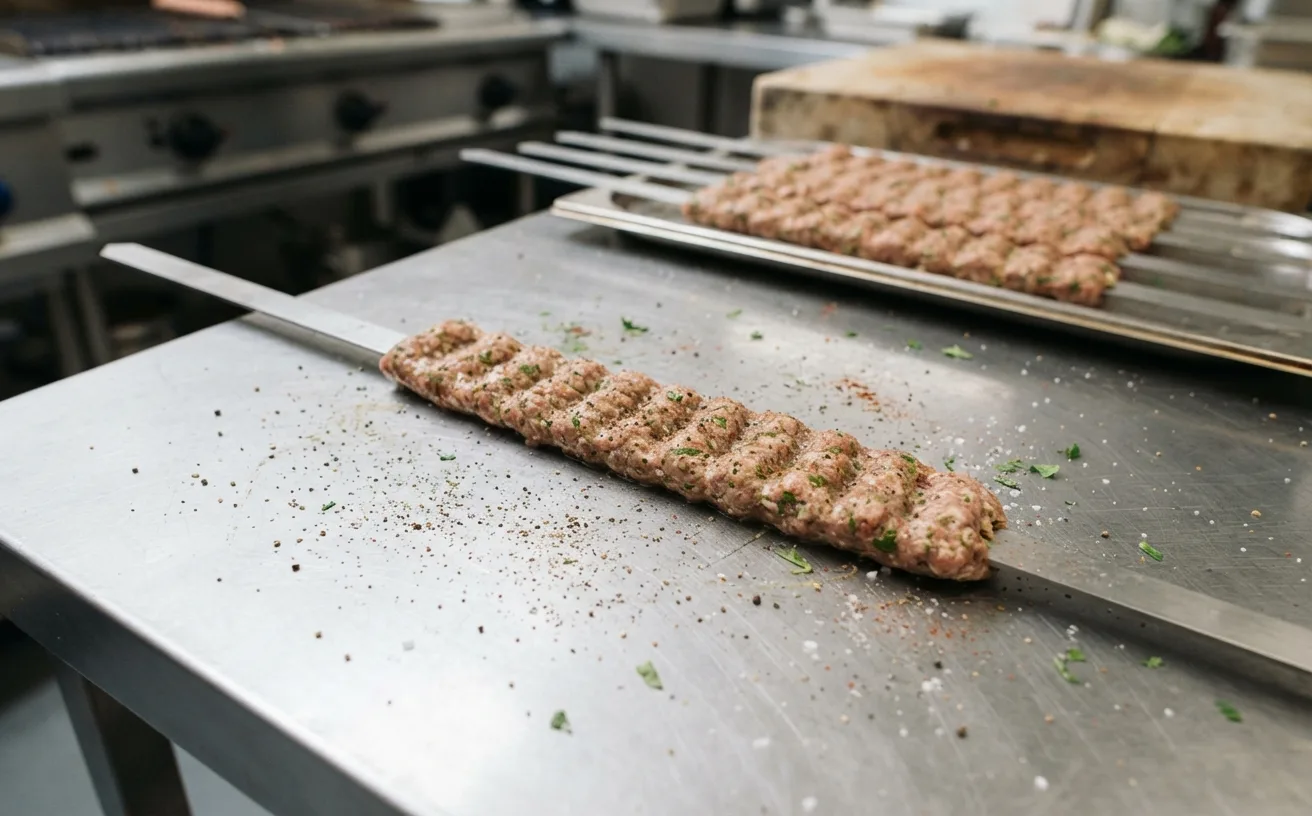
Three things decide whether your kebab holds: the fat and moisture content of the mixture, how much you kneaded it before shaping, and the temperature of everything at the moment your hands touch the meat. Get those right and the actual shaping motion takes fifteen seconds per skewer. Get them wrong and no amount of careful patting will save you, because the failure was baked in before the skewer entered the picture.
This guide covers the whole chain: building a mixture that grips, choosing a skewer that gives the meat something to hold, the hand motion itself, the thickness targets for each classic style, and the specific mechanisms that make kebabs crack, sag, and drop into the coals.
Source-backed support
Sources Worth Watching
Reference material this guide draws on — each link opens with its original publisher.
The mixture decides before your hands do
A skewer kebab needs 20 to 30 percent fat. Adana is traditionally lamb shoulder with tail fat at roughly 25 to 30 percent. Koobideh runs leaner, around 20 percent, usually as an 80/20 grind. Below 20 percent the cooked kebab is dry and crumbly and the raw mixture is stiff and reluctant to bond. Above 30 percent the fat renders so fast on the grill that the structure hollows out and the kebab sags off the skewer. If you are buying supermarket mince, standard 80/20 works; 90/10 lean mince does not, and no binder will fully rescue it.
Grind matters as much as fat, and it is not the same for every skewer. Koobideh and seekh want a fine grind: koobideh is usually ground twice through a medium plate, 4 to 5 millimeters, or once through a 3 millimeter plate. A single coarse chili-grind pass has too little exposed protein surface to bond into a cohesive sheath around metal, so if your butcher only does one coarse pass, ask for a second, or briefly work the mince in a food processor in two-second pulses. Koobideh needs that cohesion most, because it hangs suspended over coals; cevapi, shaped freehand and grilled on a grate, tolerate a coarser grind. Adana is the exception among skewer kebabs: its registered method chops lamb and tail fat by hand with a zırh, and the home stand-in is a coarse double grind, because a fine grind smears the fat and loses the open texture. Its hold on the skewer comes from the fat and the kneading.
Water is the enemy, and onion is the usual smuggler. Onion belongs in adana, koobideh, and seekh kebab, but it must go in grated and then squeezed hard in a clean towel or pressed through a sieve. A medium onion is about 89 percent water, and every gram of free onion juice in the bowl is steam waiting to blow the meat off the skewer. Grate, squeeze until the pulp is nearly dry, then mix. The flavor stays; the sabotage leaves.
Salt at 1.5 to 2 percent of the meat weight, and salt early, at the start of mixing rather than at the end. Salt is not just seasoning here. It dissolves myosin, the sticky muscle protein that acts as the glue of the whole operation, and salted meat that rests develops a tackiness that unsalted meat never reaches. This is the same principle that makes sausage bind, and a skewer kebab is, structurally, a skinless sausage wearing metal instead of casing.
Knead until the meat grips back
Once the salt is in, knead. Not fold, not stir: knead like bread dough, pressing and smearing the mixture against the side of the bowl for a solid 5 to 8 minutes. You are mechanically extracting myosin and turning a bowl of loose crumbles into a single elastic mass. The texture change is unmistakable. Loose mince looks grainy and matte; properly kneaded kebab meat turns paste-like, slightly glossy, and pulls away from the bowl in one piece.
The test is simple and it is pass-fail: press a golf-ball portion onto your open palm and turn your hand upside down. If it clings for a count of five, the bind is there. If it drops, keep kneading. Do not shape a single skewer until the mixture passes, because a mixture that cannot hold onto your hand at room temperature will certainly not hold onto hot metal over fire.
Then chill. Rest the kneaded mixture in the fridge for at least 30 minutes, ideally 1 to 2 hours, and shape while it is cold, below about 4 degrees Celsius. Cold fat is firm and behaves like structure; fat above roughly 15 degrees starts to smear, and smeared fat coats the protein and blocks the very bond you just kneaded into existence. If the kitchen is hot or you are shaping a large batch, work with half the mixture and keep the rest in the fridge. Warm hands are part of the problem too, which is the real reason the wet-hands trick in the next sections uses cold water and not just water.
The skewer is half the technique
Minced kebab needs a flat, wide metal skewer, full stop. Flatness stops the meat from spinning around the axis when you turn it, and width gives the mixture surface area to grip. For koobideh and seekh kebab, look for blades 1 to 2 centimeters wide. Adana is traditionally shaped on a broad sword-like skewer 2 to 3 centimeters wide and about 3 millimeters thick, and that width is why an adana can be a full 1.5 centimeters of meat and still hang confidently over open coals.
Round skewers are for chunks: souvlaki, shish, chicken thigh cubes. A round profile under minced meat is a bearing, and the first turn shears the bond. Thin round bamboo is the worst of all worlds, smooth, narrow, and combustible. The decision rule is clean: if the meat is minced, the skewer is flat; if the meat is cubed, round is fine.
If flat skewers are genuinely not available, change the dish rather than fight the tool. Shape the same mixture into free-form fingers about 2 centimeters thick and grill them on a grate or a cast-iron pan, which is exactly what cevapi and many kofta traditions do. You lose the theater of the skewer and keep the flavor. That trade is far better than watching koobideh divorce a bamboo stick over live fire.
The shaping motion, step by step
Set up a bowl of ice-cold water next to the meat and wet your hands before every single skewer. Wet, cold hands stop the paste from sticking to you instead of the metal, and they keep the surface fat firm while you work. Portion first: 100 to 130 grams per skewer for koobideh, 150 to 180 grams for a full-size adana, about 100 grams for seekh kebab. Weigh the first two portions and eyeball the rest; uneven portions cook unevenly, and the light skewer will be dry before the heavy one is safe.
Roll the portion into a smooth ball, then into a rough log. Pierce the log lengthwise with the skewer so the metal runs through the center, then squeeze the meat onto the blade with one hand while the other holds the skewer, working from the middle outward. The motion is squeeze-and-slide: gentle pulses of pressure that weld the meat to the metal and stretch it along the blade at the same time. You are aiming for an even sheath 1 to 1.5 centimeters thick over 15 to 20 centimeters of skewer, with no bare metal windows in the middle of the meat.
Seal both ends by pinching the meat firmly onto the skewer in a slight taper. The ends are where failure starts: an open, blunt end lets rendering fat and steam escape under the sheath and peels it forward like a sleeve. Finally, add the ridges. Lay two fingers across the meat and press gentle grooves every 2 to 3 centimeters along the length. The ridges are not decoration. They increase surface area for browning, they create thin points that cook in sync with the thick points, and they act as expansion joints so the kebab can contract on the fire without cracking through.
Total hands-on time per skewer, once the mixture is right, should be 15 to 30 seconds. If you are massaging one skewer for two minutes, your hands are warming the fat past its working range and making the next problem worse. Speed here is not showing off; it is temperature management.
Thickness targets by style: adana, koobideh, seekh
Adana is the wide, flat one. On its 2 to 3 centimeter blade the meat sits about 1 to 1.5 centimeters thick, pressed flatter than the other styles, with pronounced finger ridges. Because it is broad and flat it cooks fast, around 6 to 8 minutes over hot coals, and it presents maximum surface for char, which is the point of a kebab seasoned mainly with red pepper and fat. Its milder sibling urfa shapes identically; only the chili changes.
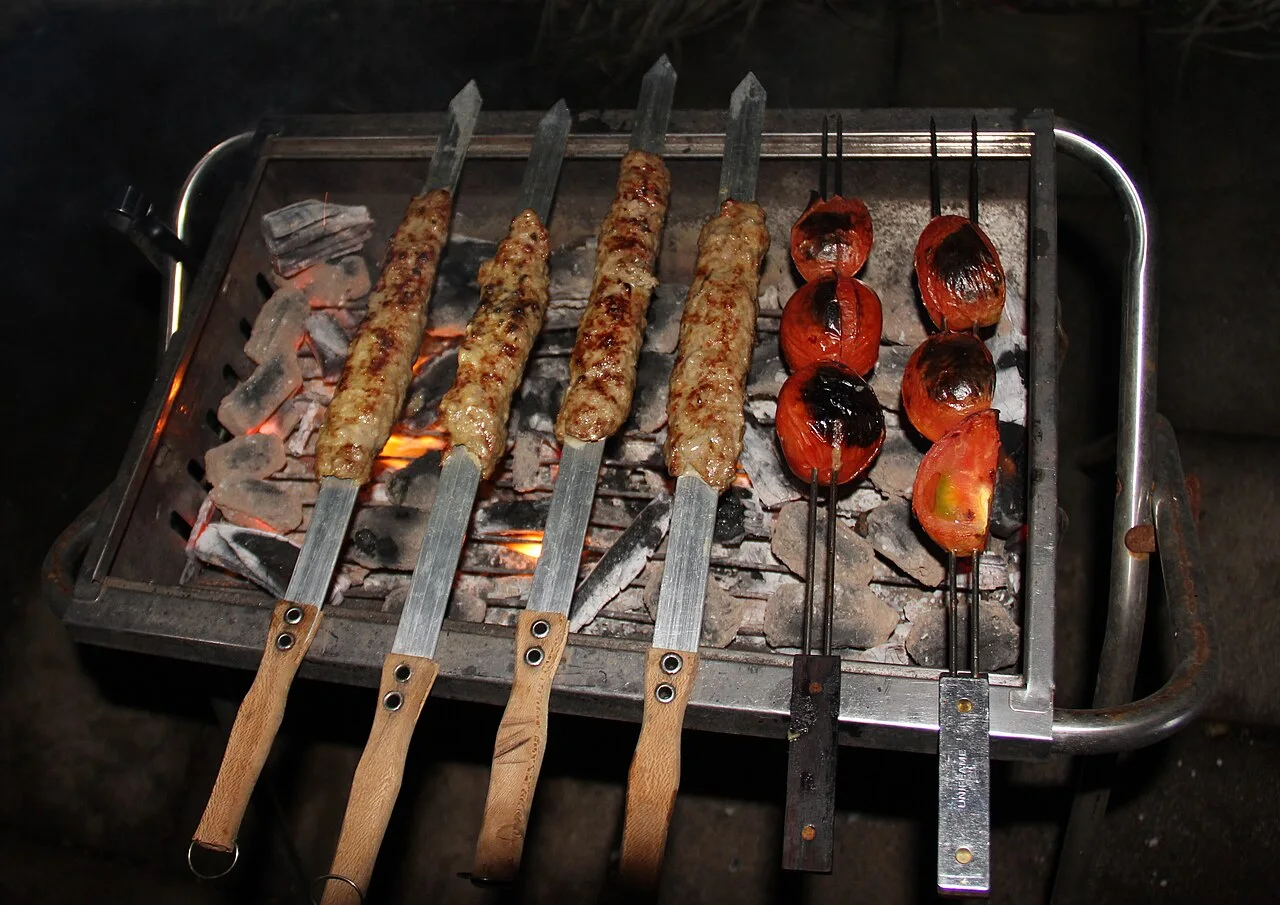
Koobideh is the long, delicate one. It runs thinner, around 1 centimeter of meat over a 1 to 2 centimeter blade, often 20 centimeters or more of length, with tight pinched ridges. It is traditionally suspended between two rails directly over coals with nothing beneath it, which is why koobideh is the least forgiving style of all: every rule in this guide applies at full strength, especially the knead and the chill. If your bind is marginal, make adana today and koobideh after more practice.
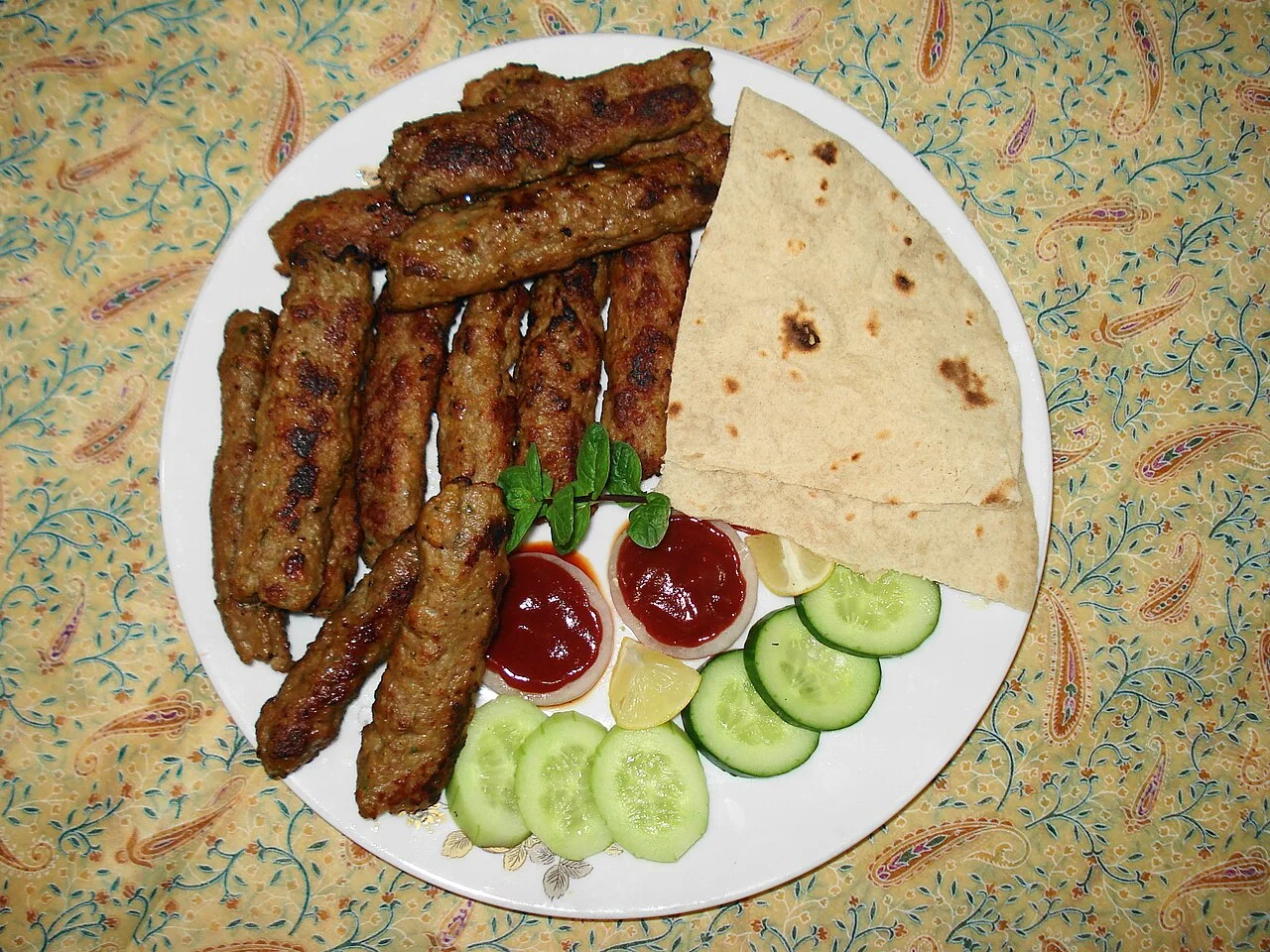
Seekh kebab is the cylinder. Shape it 2 to 2.5 centimeters in diameter around the skewer, rounder and slightly thicker than the Iranian and Turkish styles, which suits its warm-spice profile and its habit of finishing in a tandoor or under high grill heat for 10 to 12 minutes. The extra thickness keeps the interior juicy through the longer cook, and it is the most beginner-friendly of the three because a cylinder has no thin edges to dry out.
The decision logic: first skewer kebab ever, make seekh. Feeding a crowd fast with maximum char, make adana. Chasing the restaurant experience with bread that catches the drippings, make koobideh and serve it the Persian way with grilled tomato. And if the gathering includes people who fear the skewer entirely, cevapi and gyros-style plates deliver the same minced-meat satisfaction with zero suspension engineering.
The cold rest and the first two minutes of fire
Shaped skewers go back into the fridge for 15 to 30 minutes before grilling. This one step, skipped by almost everyone, refirms the fat your hands just warmed and lets the sheath relax onto the metal. A skewer that goes straight from warm hands to hot grate is starting the cook with its glue half melted.
The fire should be medium-hot charcoal, roughly 230 to 260 degrees Celsius at meat level, coals fully gray with no flame. Flames are fat fires waiting to happen under a dripping kebab. Position the skewers suspended over the coals resting on bricks, rails, or the grill frame, not lying on the grate. Grate bars stick to soft raw meat, and prying a raw kebab off steel bars is how clean shaping work gets destroyed at the last moment.
The first two minutes decide everything. Turn the skewers every 30 to 45 seconds at the start so all faces set an even crust before gravity gets a vote; once the surface is firm and lightly browned, slow down to a turn every couple of minutes. Total cook is about 6 to 10 minutes depending on thickness, and minced meat is done at 71 degrees Celsius internal, with no pink for ground mixtures. Rest the cooked skewers 3 to 5 minutes on warm flatbread, which is not just tradition: the bread catches the juices and becomes the best bite on the table, exactly as it does under a doner wrap.
Why kebabs fall off: the real failure mechanisms
Sagging and dropping mid-cook is warm fat. Either the mixture was shaped warm, the shaped skewers skipped the cold rest, or the fat content crept past 30 percent. The fat melts, the sheath loses its internal scaffolding, and the meat slides down the blade before letting go entirely. Fix: chill harder, shape faster, and check your fat ratio before blaming your hands.
Crumbling and cracking is an under-developed bind. The mixture was not kneaded to the sticky stage, was too lean, or was too coarsely ground, so there was never enough dissolved myosin to hold the mass together through contraction on the fire. The slap test catches this before the grill does. A mixture that fails it needs more kneading, and a mixture that still fails after 10 minutes of kneading needs more fat or, for koobideh and seekh, a finer grind, not more willpower.
Steam separation, where the kebab puffs and detaches in patches, is trapped water, and the culprit is almost always unsqueezed onion juice, with wet herbs and rinsed-but-undried meat as accomplices. Water turns to steam at the meat-metal boundary and physically jacks the sheath off the skewer. The fix costs thirty seconds: squeeze the onion until it stops dripping.
Spinning is the wrong skewer, a round profile under minced meat, and no shaping technique compensates for it. And the last failure is impatience in the first two minutes: turning too late lets one face overcook and contract while the underside is still soft, which cracks the kebab across the ridges; grinding the raw skewer against grate bars tears the sheath open. Suspend the skewers, turn early and often, and the kebab that was built correctly will hold exactly as it should.
Cook These Next

Related Collections
Turkish Kebab Guides
A focused collection for Turkish kebab styles including Adana, Urfa, Cag, Iskender, and supporting bread pages.
Persian Kebab Recipes
A collection of Persian grilling styles, from koobideh and barg to joojeh and other skewer traditions.
Indian Kebab Recipes
A collection of Indian kebab styles, from seekh and galouti to boti, reshmi, and green-marinated skewers.
More Guides
Sauce guide
Best Yogurt Sauce For Gyro And Kebab
Compare tzatziki-style, Turkish-style, and garlic-yogurt sauces for kebab wraps and plates so you know which cooling sauce fits each meat and bread style.
Terminology guide
Kebab Vs Kabob Vs Kabab
Understand the difference between kebab, kabob, and kabab spellings, what people usually mean by each, and which dishes fall under the broader kebab family.
Serving guide
Best Side Dishes For Kebab
Serve kebab better with the right sides, salads, rice, pickles, breads, and sauces for wraps, plates, Turkish grills, Balkan spreads, and shawarma-style meals.
Comparison
Shashlik vs Shish Kebab: Meat, Marinade, Cut and Fire Compared
How shashlik differs from shish kebab: the shared şiş root, 4-5 cm pieces vs 3 cm cubes, vinegar or kefir marinades, the mangal fire, and which one to cook.
Spice guide
Yaji Suya Spice: Kuli-Kuli, Ratios and How to Make It
Yaji, the Nigerian suya spice: why kuli-kuli beats whole peanuts, ginger level with the base, four working ratios, a step-by-step grind and the two coats.
Technique guide
Viral Parchment Paper Doner: Why It Works and How to Fix It
The viral parchment paper doner: why thin rolled mince imitates spit meat, what it misses (salt, fat, a dry crisp) and a step-by-step method to 71°C.