Adana and Urfa are the two great hand-minced kebabs of southern Turkey, and they are close enough cousins that menus outside Turkey routinely mix them up. Same lamb, same tail fat, same wide flat skewer, same charcoal. The difference lives almost entirely in one ingredient: the pepper. Adana is built on hot red pepper and wants to burn a little. Urfa is built on isot — the dark, smoky, almost raisin-like pepper of Sanliurfa — and wants to smolder instead.
Comparison
Adana Vs Urfa Kebab
By Ali Ocak
Updated 2026-11-03
Quick answer
What is the difference between Adana and Urfa kebab?
The difference is the pepper. Adana is built on hot red pepper and wants to burn a little; Urfa is built on isot, the dark, smoky pepper of Sanliurfa, and smolders instead. Lamb, tail fat and skewer are the same.
Key takeaways
- Adana kebab comes from Adana, the big city of the Cukurova plain near the Mediterranean coast.
- Cook either kebab from lamb shoulder or leg with 20 to 25 percent fat, and make that fat kuyruk yagi — lamb tail fat — if you can get it.
- Adana uses hot red pepper: fresh hot red peppers pounded to a paste in season, or hot Turkish pul biber the rest of the year, at roughly one tablespoon per 500 g of meat.
- Strict Adana is four ingredients: lamb, tail fat, salt, hot pepper.
- Both kebabs demand the wide flat skewer — 1.5 to 3 cm across.
- Cooking for chili lovers, or for anyone who orders their doner spicy: Adana, no debate.
That single swap changes more than heat. It changes the color of the meat, the way the fat reads on your tongue, what you drink with it, and which guests you can serve it to without a warning. So the real question is not which kebab is better. It is which pepper profile your table needs tonight — and this guide gives you a clear answer for each situation.
If you land on one, both full recipes are on the site: the adana kebab recipe for the fiery southern classic, and the urfa kebab recipe for its calmer, smokier sibling. Read this first, because the comparison is what makes each recipe make sense.
Two cities, one technique
Adana kebab comes from Adana, the big city of the Cukurova plain near the Mediterranean coast. Urfa kebab comes from Sanliurfa, roughly 350 km further east, close to the Syrian border and deep in isot pepper country. Both grew out of the same butcher tradition: lamb chopped by hand with a zirh — the heavy crescent-shaped cleaver — rather than pushed through a grinder, then pressed onto wide flat skewers and cooked over hardwood coals on a mangal.
Adana took the formal route. Since 2005 the name has been a registered geographical indication in Turkey, with a strict definition: meat from male sheep at least a year old, tail fat, salt, and hot red pepper. In the certified version there is no garlic, no onion, no egg, no breadcrumb — nothing that pads or binds. Urfa’s own registration came late, in 2017, and covers only the plain lamb-and-salt Urfa Hashas Kebabi, so the isot-and-garlic style most cooks mean was never fenced in, which is why Urfa recipes vary more from family to family and commonly include garlic, and sometimes grated onion, without anyone calling it heresy.
Keep that asymmetry in mind when you read recipes online. An Adana with six spices in it is not an Adana; it is a spiced kofta. An Urfa with garlic in it is just an Urfa from a garlic-loving household. The same instinct applies across the whole minced-skewer family — Persian koobideh insists on onion, Balkan cevapi insists on beef and often a touch of baking soda, Caucasian lule leans on rendered fat — every tradition draws its own hard line, and Adana's line is simply the strictest.
The meat and the fat: where they agree completely
Cook either kebab from lamb shoulder or leg with 20 to 25 percent fat, and make that fat kuyruk yagi — lamb tail fat — if you can get it. Tail fat melts low and coats the palate in a way ordinary hard fat does not; it is the single biggest flavor difference between a Turkish butcher's kebab and a home version made from supermarket mince. If tail fat is impossible, use lamb breast trimmings and accept that you are at 90 percent of the ceiling.
Texture is the second shared law. The meat should be chopped, not pureed: with a zirh if you own one, with a heavy chef's knife in two passes if you do not, or through the coarsest grinder plate (5 mm or wider) as the last resort. A fine grind plus enthusiastic kneading emulsifies the fat into the protein and gives you a bouncy, sausage-like texture — exactly what both cities consider a failure. Mix the salt and pepper in with cold hands for one to two minutes, only until the mass turns slightly tacky and holds together.
Temperature is the third law. Keep the meat at fridge temperature — 4 C or below — right up to the moment it goes on the skewer, and chill the mixed meat for 30 to 60 minutes before shaping. Warm fat smears, and smeared fat is what makes kebab slide off the skewer over the coals. If your kitchen is hot, shape with a bowl of ice water next to you and wet your hands between skewers.
The pepper is the whole argument
Adana uses hot red pepper: fresh hot red peppers pounded to a paste in season, or hot Turkish pul biber the rest of the year, at roughly one tablespoon per 500 g of meat. The heat is bright, front-of-mouth, and immediate, and it colors the raw meat a warm brick red. If you cannot find Turkish hot pepper flakes, a mix of sweet paprika and cayenne gets you close; pure cayenne alone reads harsh and one-dimensional.
Urfa uses isot, and isot is not just a milder chili — it is processed differently from any other pepper you own. The peppers are sun-dried by day and wrapped up to sweat overnight, over and over for about a week, which turns them a deep purple-black and develops smoky, coffee-and-raisin notes. Heat-wise isot sits around 7,000 to 8,000 Scoville — noticeable but gentle — where a hot Adana-style pepper can run three to four times that. Use a generous 1.5 tablespoons per 500 g, because you are using it for flavor, not fire, and it darkens the meat rather than reddening it.
This is why the two kebabs taste like different dishes despite identical technique. Adana hits first and fades; Urfa arrives late and lingers, with a low smokiness that reads almost like the coals doubled themselves. It is the same trick that separates a gyros seasoned with oregano and thyme from a shawarma built on warm spices: one ingredient family, two completely different identities.
One hard rule: do not substitute smoked Spanish paprika for isot. Pimenton's smoke comes from oak fire and dominates everything; isot's comes from slow sweating and stays in the background. If you truly cannot find isot, mild Aleppo pepper plus a pinch of regular pul biber is the honest fallback.
Garlic, onion, and the purist line
Strict Adana is four ingredients: lamb, tail fat, salt, hot pepper. That austerity is the point — with charcoal and good fat, four ingredients are enough, and everything else dilutes the pepper-and-lamb signal. If you are cooking Adana, resist the urge to add cumin, onion, or egg. The egg in particular is a binder for meat that was ground too fine or kneaded too warm; fix the technique instead of patching it.
Urfa tolerates more. Two to three cloves of pounded garlic per 500 g is common and works beautifully with isot's darkness. Some households add a tablespoon of finely grated onion with the juice squeezed out — squeezed, because onion juice is the number-one cause of skewer slip. If you like the garlicky direction, Urfa is your kebab; if you want the meat and pepper to stand alone, cook Adana.
Salt both at 1.5 to 2 percent of the meat's weight — about 8 to 10 g per 500 g. Salt early, before the rest, because salt is what dissolves just enough surface protein to make the meat grip the skewer. An unsalted or late-salted mix never develops that tack, and no amount of squeezing will keep it on the iron.
Skewer, fire, and the bread that catches the drippings
Both kebabs demand the wide flat skewer — 1.5 to 3 cm across. A round skewer cannot hold a hand-chopped mix; the meat spins and drops. Press 120 to 150 g of meat along each skewer to a thickness of about 1 cm, pinching shallow ridges with two fingers so the surface area rises and the fat has escape routes. Thicker than 1.5 cm and the center steams before the outside colors.
Cook over hardwood charcoal that has burned down to glowing embers with a light ash coat — no visible flame, grill-level heat around 250 to 300 C, your hand bearable above it for only 2 to 3 seconds. Set the skewers on the mangal rails so the meat itself never touches a grate, and turn every 45 to 60 seconds. Total time is 8 to 10 minutes; you are done when the surface is deeply browned with charred ridge tips and the center reaches 71 C, the safe point for ground lamb. Dripping fat that hits flame becomes acrid soot, which is why flames are the enemy and embers are the standard.
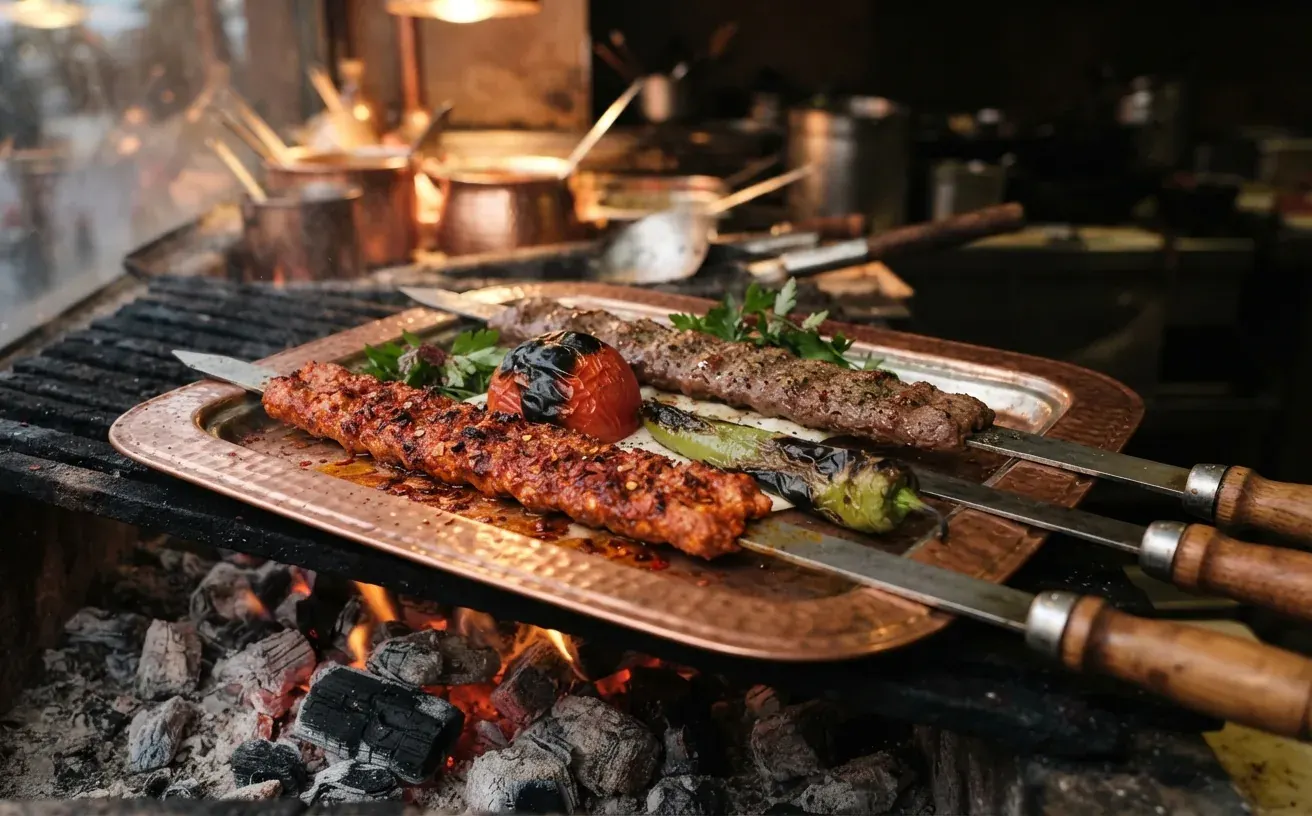
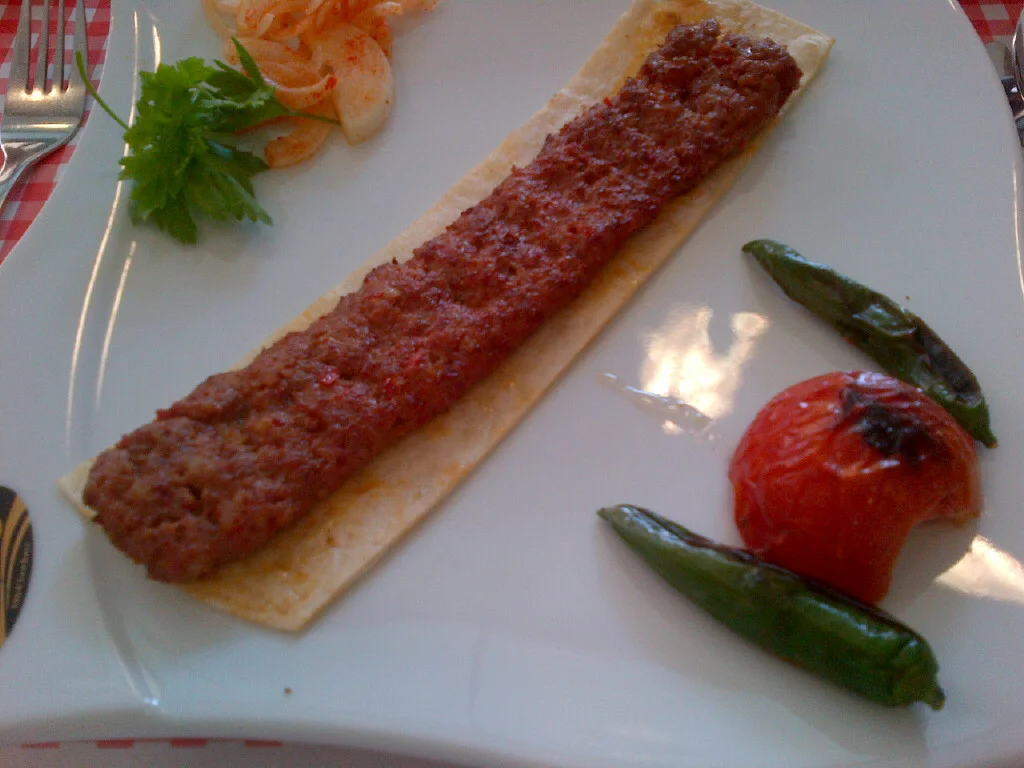
While the kebab cooks, do what every kebab house in Adana and Urfa does: press flatbread onto the cooking skewers or hold it under them so it catches the fat and juices. That stained, softened bread — lavash or thin durum bread — is not garnish, it is the first thing everyone fights over. Serve both kebabs identically: pulled onto the fat-soaked bread with charred tomatoes and green peppers, a pile of sumac onions (sliced onion, 1 teaspoon sumac, pinch of salt, squeezed by hand), and cold ayran. If you want a sauce course to build the wider plate, the site's ezme and sauce guides carry the details; neither kebab traditionally takes a heavy sauce the way doner or a halal-cart platter does.
The verdict: which one to cook, by situation
Cooking for chili lovers, or for anyone who orders their doner spicy: Adana, no debate. Its whole identity is heat riding on lamb fat, and dialing it down produces something with no reason to exist.
Cooking for a mixed table, kids, or spice-shy guests: Urfa. It delivers the full hand-minced, charcoal, tail-fat experience at a heat level closer to black pepper than to chili, and the isot smokiness gives even cautious eaters something to talk about.
First time making any minced skewer kebab: start with Urfa. The technique is identical to Adana, but a slightly imperfect Urfa is still delicious, while an Adana whose pepper outruns its fat balance punishes mistakes. Once your meat stays on the skewer for a full cook, graduate to Adana. If you came here from souvlaki or gyros territory and hand-minced skewers are new to you entirely, cevapi is an even more forgiving entry point — small, caseless, no skewer to lose.
Only one pepper in the cupboard: let the pepper decide. Real isot in hand means Urfa. Hot pul biber or fresh hot red peppers mean Adana. Cooking the wrong kebab with the right pepper beats cooking the right kebab with the wrong one — the pepper is the dish.
Where each one fails: the real mechanisms
Meat slides off the skewer. This is the classic failure and it has exactly four causes: fat too warm (it smeared instead of gripping — chill everything to 4 C), meat too wet (unsqueezed onion or watery pepper paste — squeeze and drain), salt added too late (no protein tack developed — salt first, knead briefly), or a round skewer (physics — buy flat ones or shape patties and cook them like cevapi on a grate instead).
Bouncy, rubbery texture. You over-kneaded or over-ground. Kneading past the tacky stage emulsifies the mix like a hot dog; a coarse chop and a 90-second mix are all either kebab wants. There is no rescue once it happens — note it and chop coarser next time.
Adana that is hot but flavorless. The fat ratio is too low. Below about 20 percent fat, the pepper has nothing to carry it and the heat turns thin and aggressive. Capsaicin is fat-soluble; the tail fat is not a garnish, it is the delivery system.
Urfa that tastes flat. Nine times out of ten the isot is stale or fake. Real isot is moist, almost oily, and nearly black; if yours is dry, bright red, and dusty, it is ordinary chili sold under a better name. Buy isot in small amounts, keep it sealed in the fridge, and use it within six months.
Acrid, sooty crust on either kebab. You cooked over flames instead of embers, or the coals were too close. Wait for the gray ash coat, keep the meat 10 to 15 cm above the coals, and move the skewer, not the fire, when fat flares.
Sources and further reading
- Adana Kebabı - Coğrafi İşaretler Portalı — TÜRKPATENT (Turkish Patent and Trademark Office)
- Coğrafi İşaret Sicil Belgesi No: 65 - Adana Kebabı — TÜRKPATENT registration certificate (copy hosted by Adana Ticaret Borsası)
- Urfa Haşhaş Kebabı (Şanlıurfa Haşhaş Kebabı) - Coğrafi İşaret No: 275 — TÜRKPATENT (Turkish Patent and Trademark Office)
- Urfa biber — Wikipedia
- Safe Minimum Internal Temperature Chart — USDA Food Safety and Inspection Service
Cook These Next

Related Collections
More Guides
Serving guide
What To Serve With Cevapi
Serve cevapi properly with somun, onion, ajvar, kajmak, and practical Balkan plate-building advice for home cooks.
Meat guide
Best Cut For Shish Kebab
Choose the best cut for shish kebab with a practical guide to lamb, beef, and chicken options, cube size, fat balance, and what actually stays juicy on skewers.
Technique guide
How To Marinate Kebab Properly
Learn how to marinate kebab without making the meat mushy, watery, or flat, with clear guidance for chicken, lamb, beef, and yogurt-based marinades.
Heat guide
What Temperature to Cook Kebab
The heat each method needs, from charcoal to oven, and the internal temperature that makes chicken, minced and cubed kebabs safe: 74 °C, 71 °C and 63 °C with a rest.
Serving guide
Best Onion Salad For Kebab
Build the right onion-and-sumac side for kebab, Adana, Urfa, doner, and cevapi with a guide to slicing, seasoning, resting, and balancing sharpness.
Technique guide
How To Shape Minced Kebab On Skewers
Shape Adana-style, koobideh, and seekh kebabs correctly with better hand pressure, skewer coverage, thumb patterning, and grill-ready thickness.
Keep cooking
Readers of this page also look up gemüse kebab, yaprak döner and shishlik. For the basics, see how to make a kebab.
How People Search for This
Readers find this page on Google with these searches:
urfa kebab english · a grilled meat known for its long shape and juicy bite · difference between kofta and adana kebab · unterschied urfa und adana kebap
In other languages:
урфа кебаб и адана разница
Comments
Cooked it, changed something, or spotted a mistake? Say so here. Every comment is read before it is published.