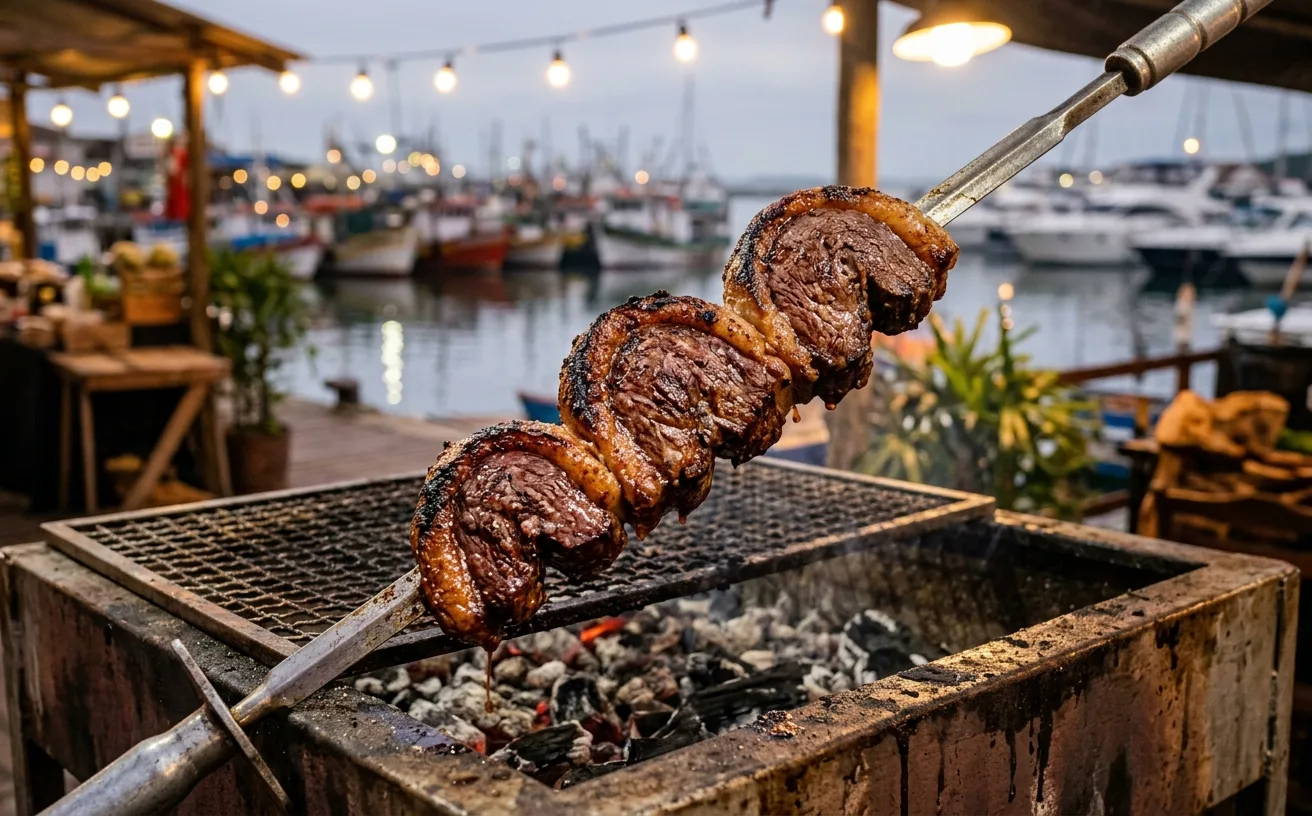
The gaucho barbecue of southern Brazil, where large cuts like picanha are threaded onto metal swords, roasted slowly over embers, and carved directly off the skewer at the table in rodizio service. Seasoned traditionally with only coarse salt, it is skewer cooking scaled up to whole-cut size.
Also known as churrasco skewers, espeto corrido, rodizio skewers.
Ingredients
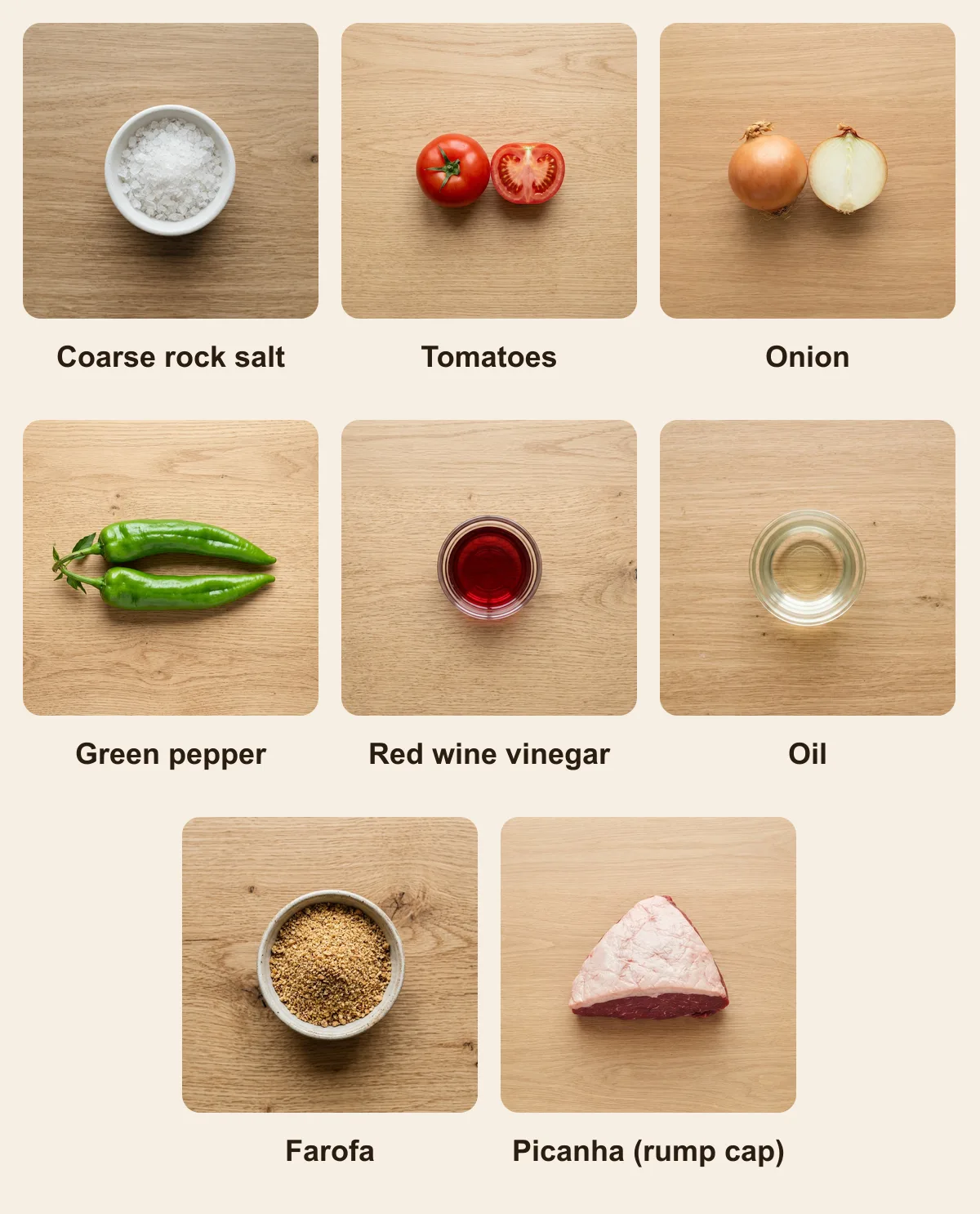
- 1.2 kg picanha (rump cap) with its full fat cap
- 3 tbsp coarse rock salt
- 2 tomatoes, 1 onion and 1/2 green pepper, diced, for vinagrete
- 3 tbsp red wine vinegar
- 3 tbsp oil
- farofa, to serve (optional)
How to make it
- 1
Cut the picanha with the grain into 4-5 thick strips, bend each into a C and spear onto long skewers with the fat cap on the outside of the curve.
- 2
Crust generously with rock salt and let the skewers stand while the charcoal burns down to strong, even embers.
- 3
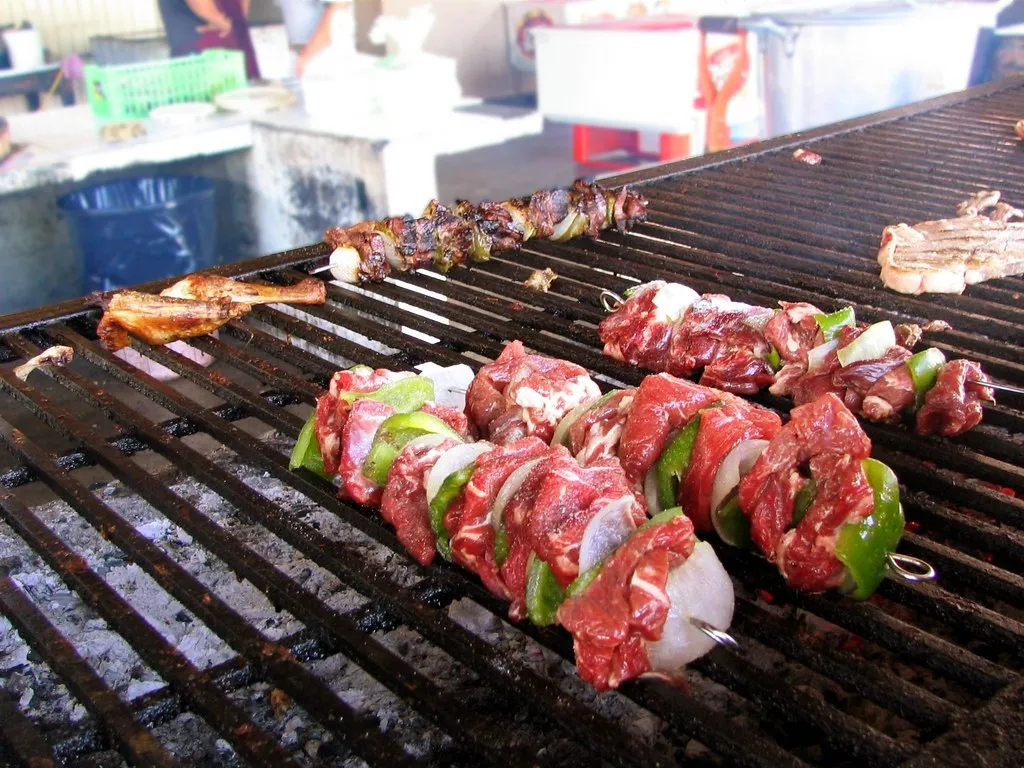
Roast 15-20 cm above the coals, fat side toward the heat first, 15-20 minutes for a rosy centre, rotating a half-turn every 5.
- 4
Knock off the loose salt and carve thin slices straight off the outside of each skewer at the table, then return the espeto to the fire so the newly exposed layer browns for the next pass.
- 5
Serve each round of slices with the vinagrete (vegetables, vinegar, oil, pinch of salt) and farofa.
Pro tip: Rodízio logic works at home: never carve to the centre in one go — shave, re-fire, repeat, so every slice arrives with its own charred edge.
Where Churrasco Espeto comes from
Rodízio, the format in which waiters circulate with swords of meat and carve to order until the diner turns the card, is a twentieth-century restaurant invention built on the gaúcho barbecue tradition. It has since been exported worldwide, and it remains one of the most successful pieces of restaurant theatre anyone has designed.
Whole picanha on a sword, carved at the table
Picanha goes on whole, not cubed. Thick steaks of rump cap are bent into a C with the fat cap facing out and threaded on a metal sword, so the rendering fat bastes the meat below; Espetada and South African espetada both work with large beef cubes instead. Coarse rock salt is traditionally the only seasoning, while the Madeiran and South African skewers add garlic and bay. In rodízio service the outer layer is shaved off and the sword goes back to the embers, a progressive carve unlike the single hanging skewer of an espetada. Farofa, vinagrete, rice and beans fill the plate.
Compare: Espetada · South African espetada
How Churrasco Espeto is cooked
Picanha — the top sirloin cap — is the signature cut and the way it is threaded is the technique. The whole cap is scored on the fat side, cut into thick steaks, and each steak is bent into a C shape and threaded onto the sword with the fat cap outward, so the rendering fat runs down over the meat below.
Salt is applied as coarse rock salt, in quantity, and much of it is knocked off before serving; it forms a crust that seasons and protects. The espeto rotates or is turned over embers at a moderate distance, and the outer layer is carved off as it reaches temperature while the interior continues cooking — the same progressive logic as a doner spit.
Ingredients and shopping
Picanha with its fat cap intact is the cut to seek; a butcher may call it rump cap or coulotte. Fraldinha (flank), alcatra (top sirloin) and linguiça are the other standards. The fat cap must not be trimmed — it is the entire basting mechanism.
Coarse rock salt, and nothing else in the traditional version. Chimichurri is Argentine rather than Brazilian; the Brazilian table has vinagrete and farofa instead. A proper espeto sword and a grill that can hold it; a rotisserie is the practical home equivalent.
How Churrasco Espeto is served
Carved from the sword directly onto the plate, with farofa, vinagrete, rice, beans and grilled cheese. In a rodízio, continuously, until the diner turns the card to red. Caipirinha or a cold beer. It is a long meal by design.
Common mistakes
Trimming the fat cap
It is the basting system and the flavour. Score it, never remove it.
Fine salt
Coarse rock salt forms a protective crust and much of it is knocked off before serving. Fine salt simply over-salts the meat.
Threading the steaks flat
They are bent into a C with the fat outward so the fat renders down over the meat below.
Cooking it through in one go
The outer layer is carved as it is ready and the rest keeps cooking. That progressive service is the format.
Churrasco Espeto: questions and answers
Why is the meat bent into a C on the skewer?
So the fat cap faces outward and renders down over the meat below it, basting as it cooks.
What is rodízio?
The all-you-can-eat service format where waiters circulate with skewers and carve to order until the diner signals to stop.
What seasoning is used?
Coarse rock salt, generously, and traditionally nothing else. Much of it is knocked off before serving.
Sources and further reading
- Picanha — Wikipedia
- Churrascaria — Wikipedia
- Lei nº 11.929, de 20 de junho de 2003 (Lei do Churrasco e Chimarrão) — State of Rio Grande do Sul (text hosted by Movimento Tradicionalista Gaúcho)
- 5 dicas de preparo de um típico churrasco gaúcho — Bom Gourmet (Gazeta do Povo)
- Rodízio de churrasco: como o espeto corrido nasceu e evoluiu — UOL Nossa