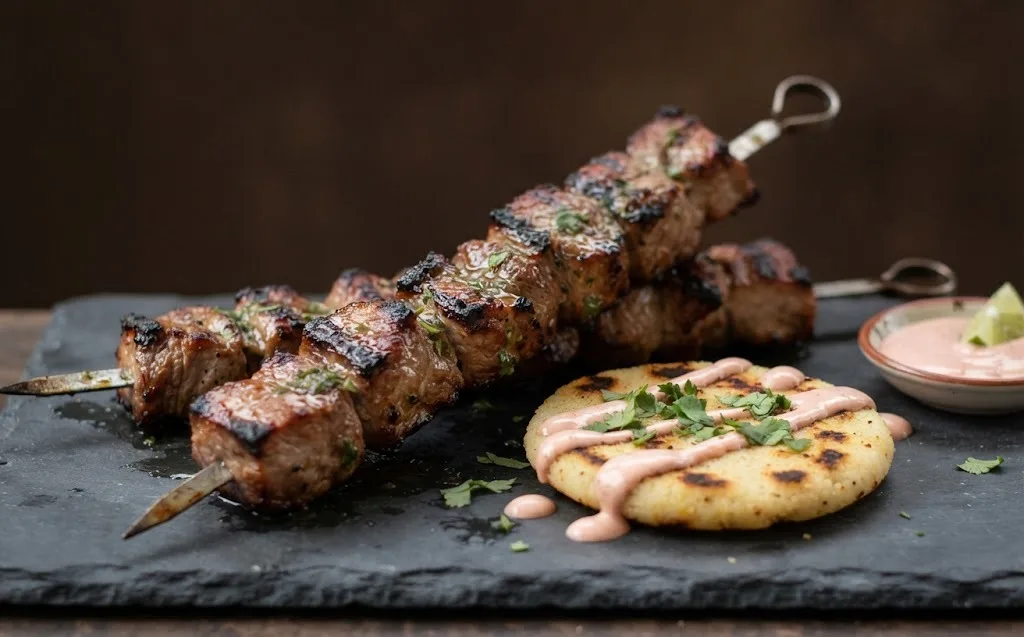
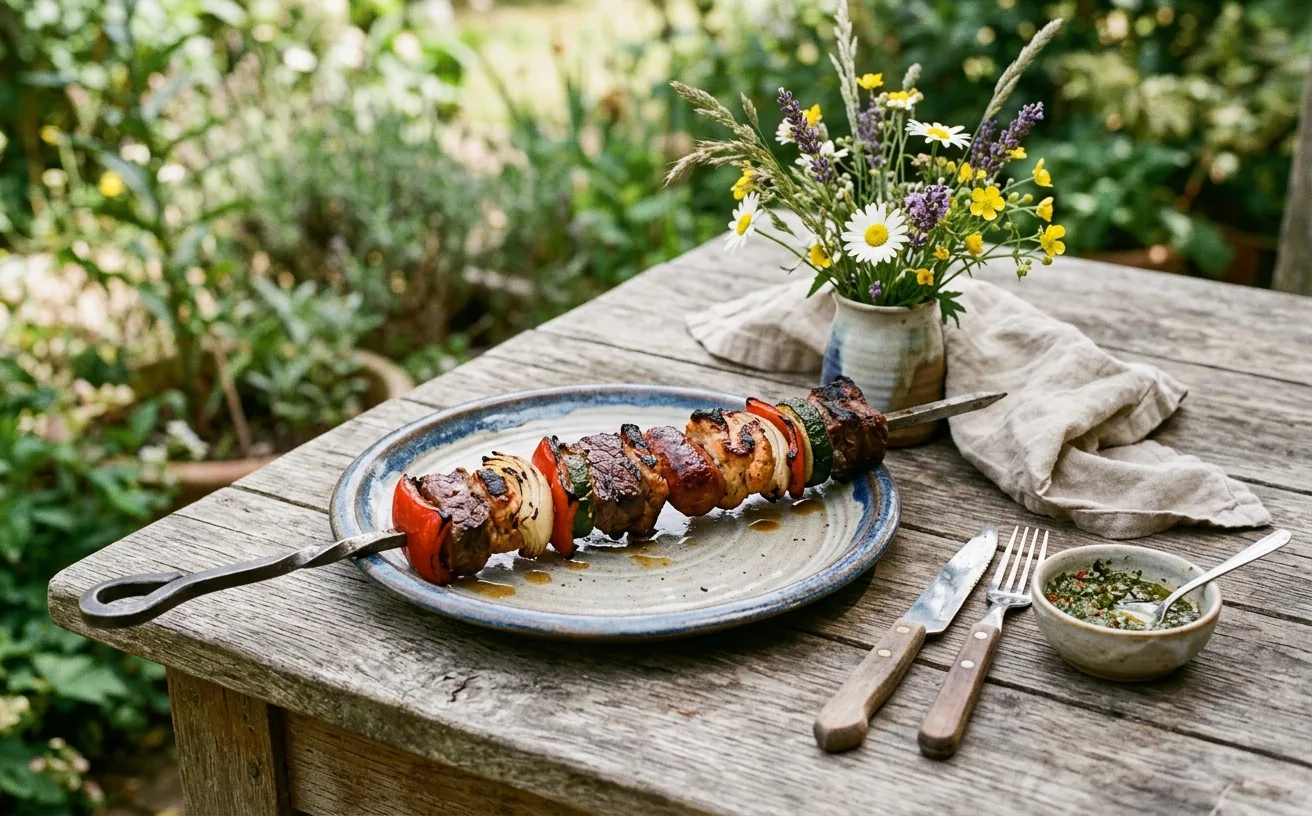
The seasoned ground beef-and-onion flat skewer that anchors the Persian-American 'kabob house', a restaurant genre built by post-1979 Iranian exiles in Los Angeles ('Tehrangeles') and the Washington DC area. Served over buttered saffron rice with a charred tomato, it made the wide-blade minced kebab an American strip-mall staple.
Also known as kabob koobideh, kubideh, koobideh kabob.
Reference video
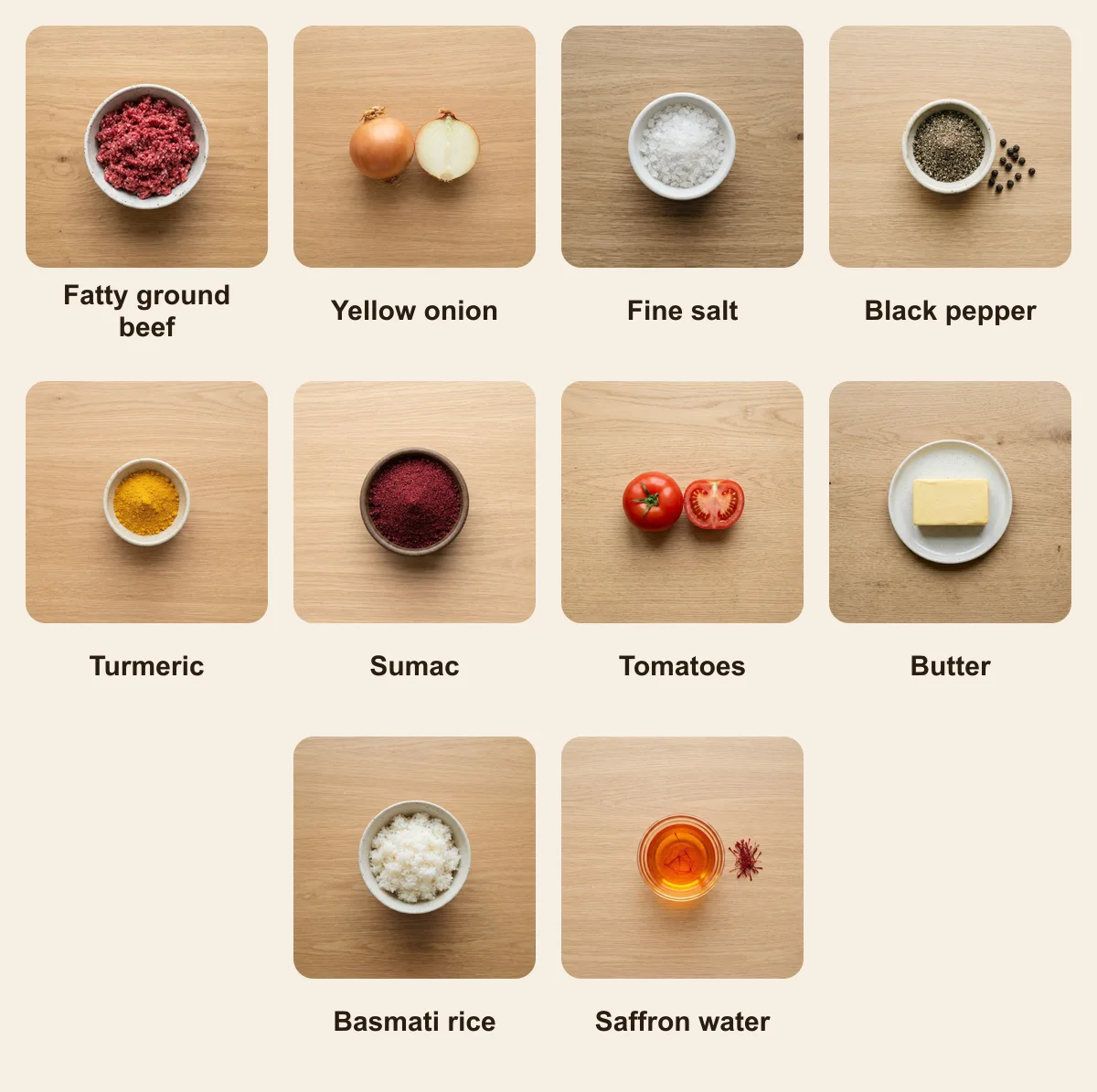
Ingredients
- 600 g ground beef, 20% fat
- 1 large yellow onion
- 1.5 tsp fine salt
- 1 tsp black pepper
- 0.5 tsp turmeric
- 1 tbsp sumac, to serve
- 4 tomatoes
- 30 g butter
- 600 g cooked basmati rice, plus a pinch of saffron steeped in 2 tbsp hot water
How to make it
- 1
Grate the onion and wring it bone-dry in a tea towel — leftover juice is exactly what makes koobideh slide off the skewer.
- 2
Knead the onion pulp into the beef with salt, pepper and turmeric for a full 5 minutes until the mix turns tacky and paste-like, then chill 1 hour.
- 3
With wet hands, mold the paste along flat 2 cm-wide metal skewers and pinch ridges down the length with two fingers.
- 4
Suspend the skewers over hot coals (or across a deep roasting tin under a maximum broiler) and cook 3-4 minutes per side, turning only once the surface has set.
- 5
Blister the tomatoes alongside, then melt the butter with the saffron water, spoon it over the rice, slide the meat on top and finish with a shower of sumac.
Pro tip: If the meat slumps mid-grill, the mix got warm — the cold fat is what grips the skewer, so re-chill before threading the next batch.
Where Koobideh comes from
In the kabob houses of Los Angeles and Washington, koobideh's Americanisation is visible in the details. Beef replaces or joins lamb, portions are larger, and the plate is designed to read as a complete meal to an American diner rather than as one element of a Persian table. What did not change is the technique, which is still judged by whether the meat stays on the skewer.
How Koobideh is cooked
The bind is mechanical and unforgiving. Ground beef — often a beef and lamb mix — is kneaded with grated onion that has been squeezed nearly dry, plus turmeric, salt and pepper, until the mass turns genuinely tacky. No egg, no breadcrumb. Then it is chilled hard before it goes near a skewer.
The skewers must be wide and flat, roughly two to four centimetres, and the meat is pressed along them with a wet hand and dimpled with the fingers at intervals, which both grips the metal and creates the characteristic ridged surface. Grilling is fast over hot coals, a few minutes a side, and the skewers are never laid flat on a grate — they rest on rails so nothing touches.
Ingredients and shopping
Ground beef at 20 percent fat, or a beef-lamb mix. Onion grated on the fine side of a box grater and squeezed in a cloth until it stops dripping — this single step decides whether the dish works. Turmeric is the Persian seasoning, not cumin.
Wide flat skewers are worth buying; this dish genuinely cannot be made on round ones. Basmati rice cooked Persian-style with saffron and butter, a whole tomato grilled alongside, sumac at the table, and raw onion and fresh herbs on the side.
How Koobideh is served
Over buttered saffron basmati with a charred tomato, sumac, raw onion, fresh herbs and flatbread, with doogh or tea. American kabob houses serve it as a full plate, often with two skewers, which is more than a Persian portion and is part of the genre's local adaptation.
Common mistakes
Wet onion
It is why koobideh falls into the coals. Grate and squeeze until it stops dripping.
Narrow or round skewers
The meat needs a wide flat blade to grip. On a round skewer it rotates and drops.
Skipping the chill
The mixture must be cold when it is shaped. Warm fat makes it slack.
Laying skewers on a grate
They rest on rails so the meat touches nothing. Contact with a grate tears it.
Koobideh: questions and answers
Why does my koobideh fall off the skewer?
Almost always wet onion, a mixture that was not kneaded until tacky, a skewer that is too narrow, or meat that was not chilled before shaping.
Can I use egg or breadcrumb to bind it?
You can, and it will hold — but it is considered a failure of technique and it changes the texture into a meatball.
What spice goes into koobideh?
Turmeric, salt and black pepper. Cumin is not part of the Persian seasoning for this dish.
Sources and further reading
- Kabab koobideh — Wikipedia
- Tehrangeles — Wikipedia
- Two food writers eat at all the Persian restaurants in SoCal (OK, 18 of them) — Los Angeles Times