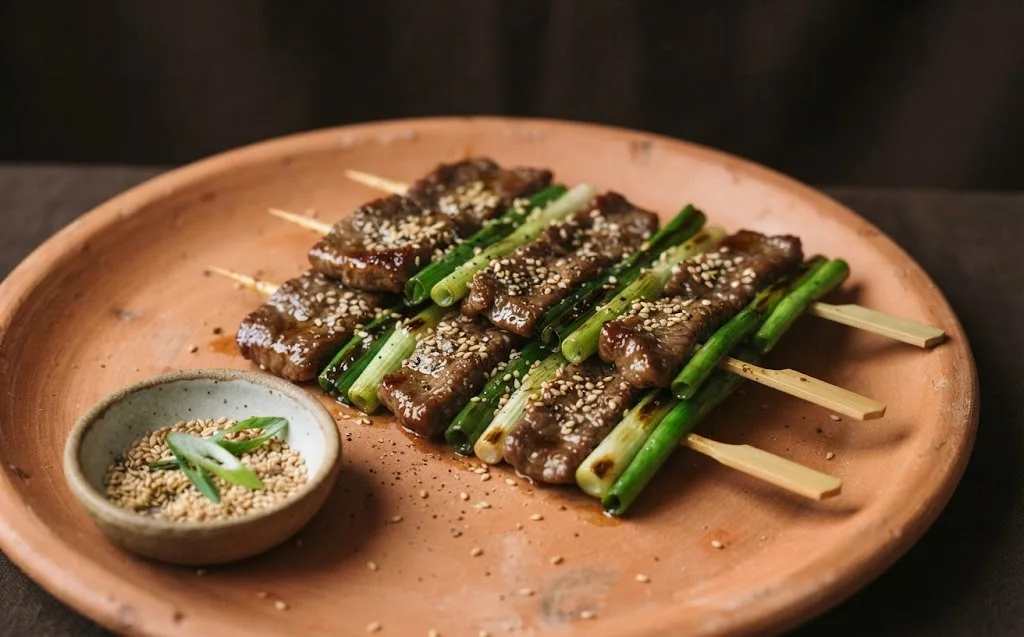
A Korean royal-court and holiday dish: strips of soy-marinated beef threaded on skewers alternating with green onion, mushrooms or rice cake, then pan-griddled rather than open-flame grilled. Its neat color-alternating pattern makes it a fixture of Chuseok and Lunar New Year ancestral tables.
Also known as Korean beef skewers, pa sanjeok, haemul sanjeok.
Reference video
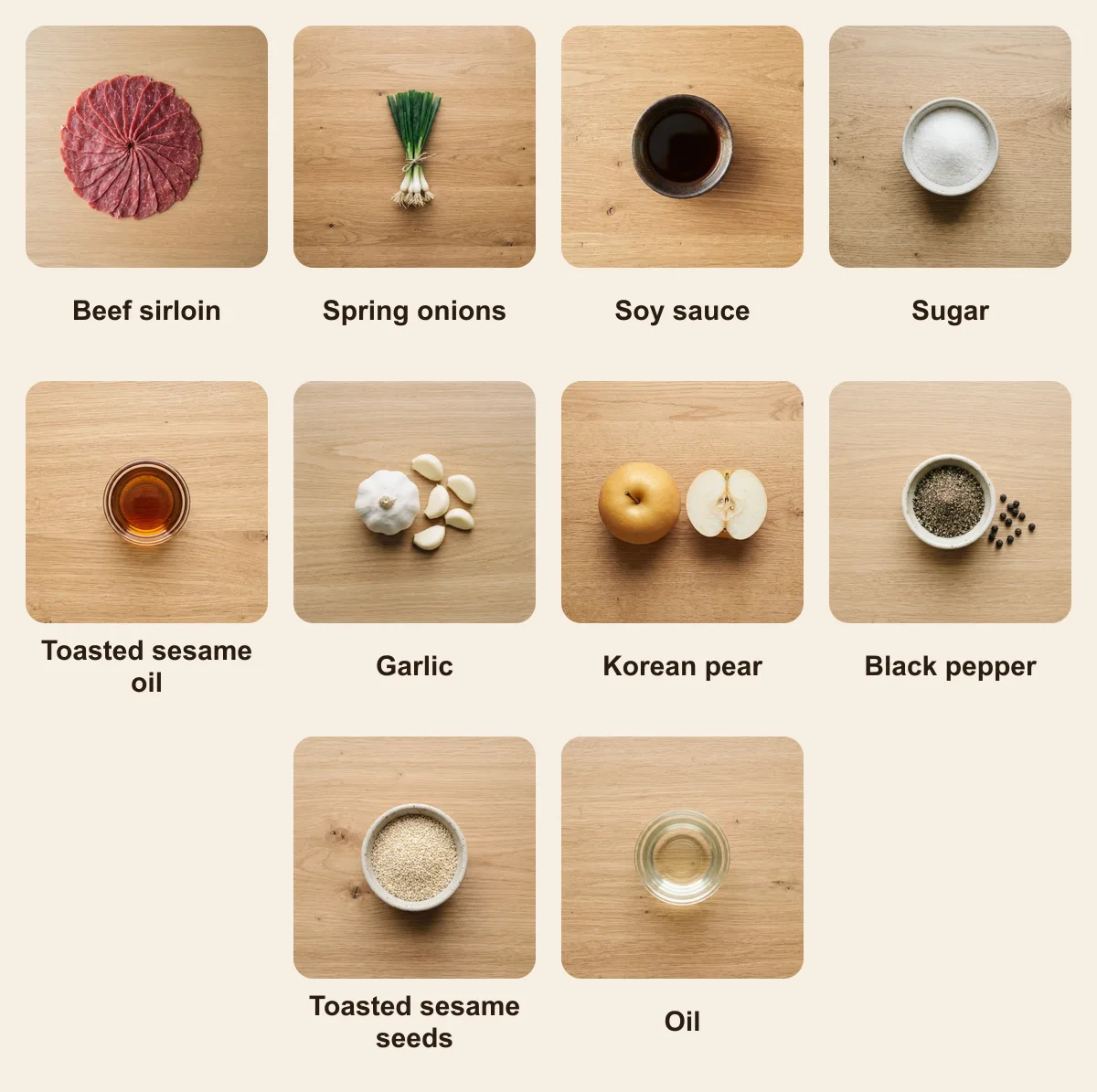
Ingredients
- 400 g beef sirloin, in strips 1 cm thick and 8 cm long
- 8 spring onions, cut to match the beef
- 3 tbsp soy sauce
- 1 tbsp sugar
- 1 tbsp toasted sesame oil
- 2 tsp minced garlic
- 2 tbsp grated Korean pear (or 1 tbsp pear juice)
- 1/4 tsp black pepper
- 1 tsp toasted sesame seeds
- oil, for the pan
How to make it
- 1
Whisk the soy, sugar, sesame oil, garlic, pear and pepper, and marinate the beef strips 30 minutes.
- 2
Thread beef and spring-onion lengths alternately onto skewers, laying everything flat like a little fence.
- 3
Press each skewer gently level with your palm, then pan-fry in a lightly oiled skillet over medium heat 3 minutes per side, spooning over the leftover marinade.
- 4
Scatter with sesame seeds and serve warm, cut between the pieces for sharing.
Pro tip: Sanjeok is a griddle dish, not a barbecue one — a flat, evenly pressed skewer is the difference between royal-court neat and campfire ragged.
Where Sanjeok comes from
The visual arrangement is not decoration but ritual: jesa, the ancestral memorial ceremony, has rules about the appearance and placement of food, and sanjeok's ordered stripes of red, white and green belong to that tradition. It is one of the few dishes in this atlas whose form is determined by ceremony rather than by cooking.
How Sanjeok is cooked
Griddling rather than grilling is the defining choice, and it follows from the ingredients: rice cake and green onion would char and dry over an open flame, while a flat griddle with a little oil cooks them gently and evenly alongside the beef.
The components are cut to identical lengths and widths so the finished skewer is a neat rectangle, and many households dip the assembled skewer in beaten egg and flour before griddling, which binds everything together and gives the pale yellow coating seen on holiday tables.
Ingredients and shopping
Beef sirloin or skirt cut into long strips, marinated in soy sauce, sesame oil, garlic, sugar and pear juice — the Korean tenderiser of choice. Spring onions, plus garaetteok (cylindrical rice cake) and shiitake or oyster mushrooms as optional extras for a fuller holiday skewer.
Everything cut to the same length, around eight centimetres, and the same width. Flour and beaten egg if you are making the coated version. Short flat skewers. A heavy griddle or frying pan with a little oil.
How Sanjeok is served
On a flat plate, arranged in rows, as part of a holiday or ancestral-rite spread with other jeon (griddled dishes). It is served at room temperature as often as hot, which suits the ceremonial context, and it is eaten with chopsticks straight off the skewer.
Common mistakes
Grilling over an open flame
Rice cake and spring onion char and dry. A flat griddle is the correct heat for a mixed skewer like this.
Components of different sizes
The neat rectangle is the point, particularly for ceremonial use. Cut everything to matching lengths and widths.
Over-marinating the beef
Pear juice contains enzymes that tenderise fast. A few hours, not overnight.
Skipping the egg coating on the holiday version
It binds the skewer and gives the pale yellow finish expected on a ceremonial table.
Sanjeok: questions and answers
Why does it look so neat?
Its appearance matters for jesa, the ancestral memorial rite, which has rules about how food is presented. The alternating colours are part of the tradition.
When is it eaten?
At Chuseok and Lunar New Year, and at ancestral rites. It is holiday food rather than everyday cooking.
Sources and further reading
- Sanjeok — Wikipedia
- Korean royal court cuisine — Wikipedia
- Meat and Vegetable Skewers (산적 / Sanjeok) — VisitKorea (Korea Tourism Organization)