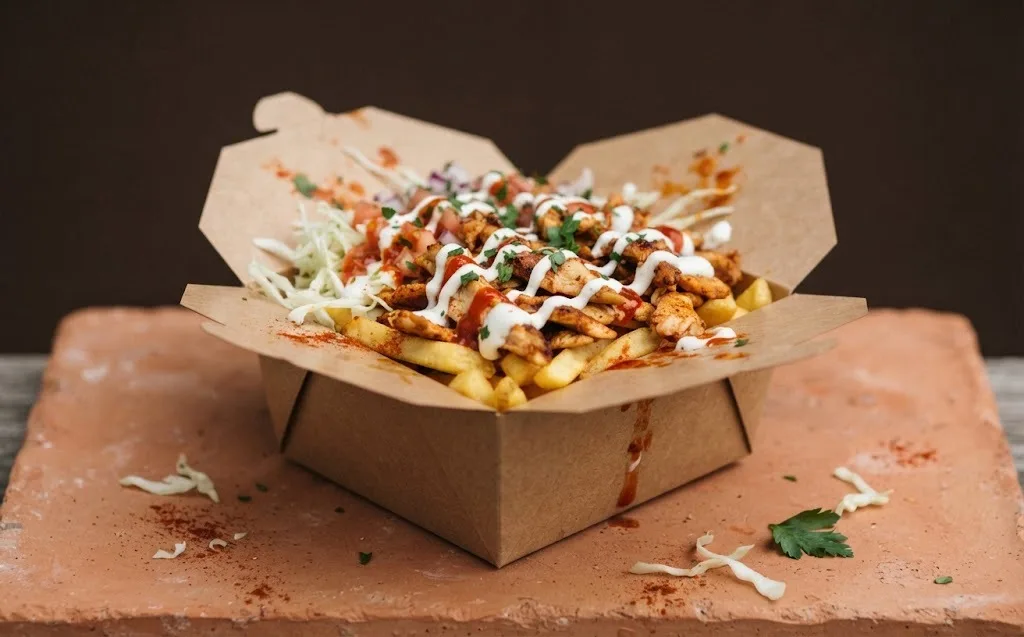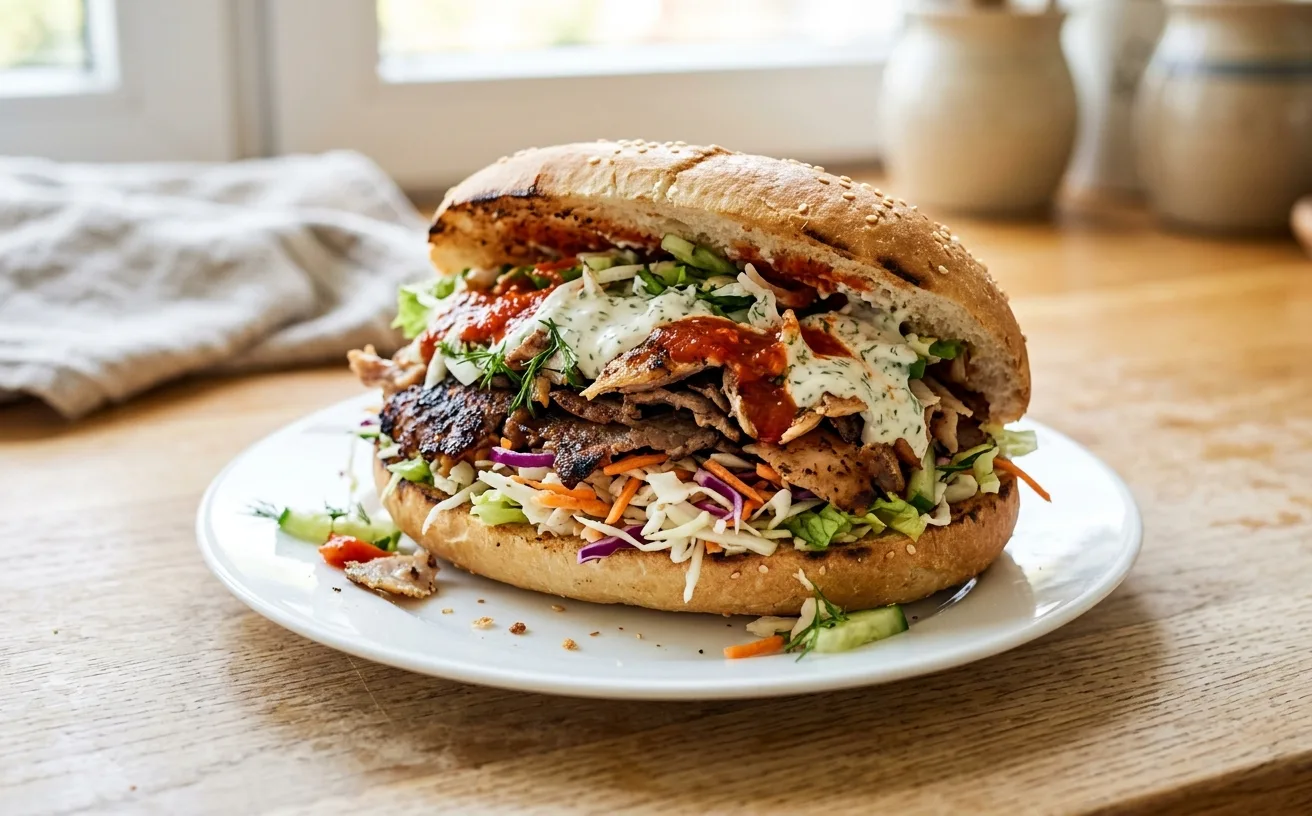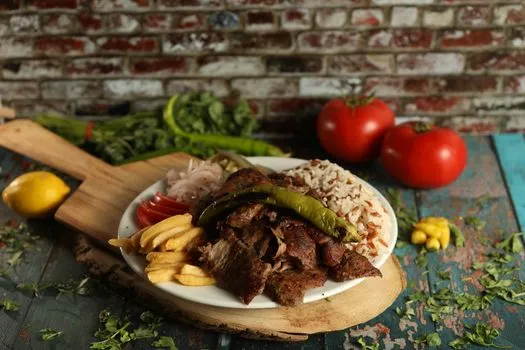
The German imbiss 'doner plate': spit-carved meat served open on a plate with fries or rice, salad, and garlic-yogurt sauce instead of stuffed into bread. It anchors the sit-down end of Germany's Turkish-founded doner economy, the largest kebab market in Europe.
Also known as doner plate, Kebab Teller, Teller Döner.
Ingredients
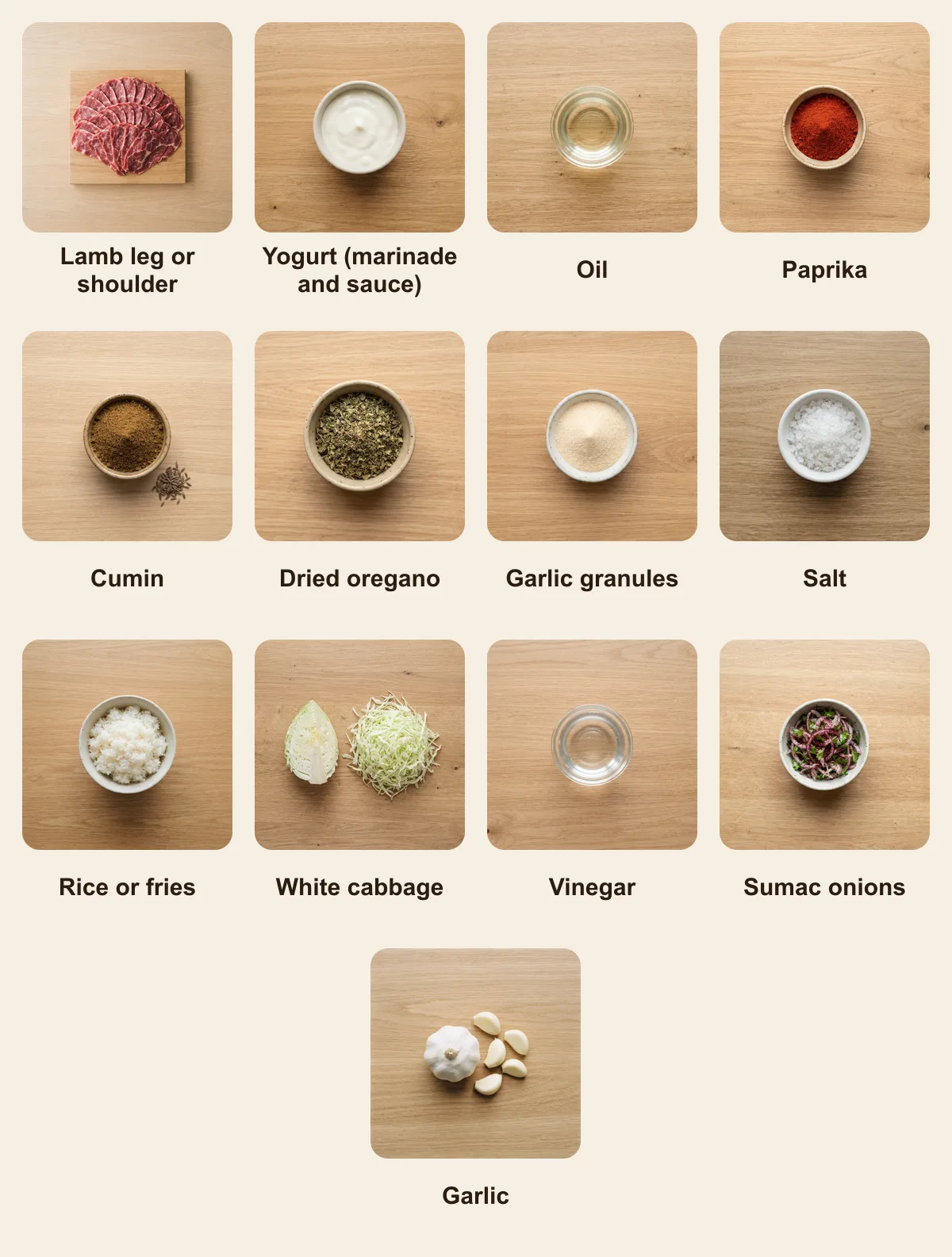
- 700 g lamb leg or shoulder, sliced as thin as you can
- 3 tbsp yogurt and 2 tbsp oil, for the marinade
- 1 tbsp paprika, 1 tsp cumin, 1 tsp dried oregano, 1 tsp garlic granules and 1 tsp salt
- cooked rice or fries, to plate
- 300 g white cabbage, 2 tbsp vinegar, 1 tbsp oil and salt, for the krautsalat
- 1 onion, sliced, with 1 tsp sumac
- 200 g yogurt with 1 crushed garlic clove, for the sauce
How to make it
- 1
Massage the cabbage with vinegar, oil and salt until it slackens; park it in the fridge.
- 2
Marinate the lamb slices in the yogurt, oil and spices for 2 hours.
- 3
Griddle the slices in a ripping-hot dry pan in two batches, pressing them flat so they catch charred spots like spit-carved doner, then snip into ribbons.
- 4
Toss the onion with sumac and stir the garlic into the yogurt.
- 5
Plate imbiss-style: rice or fries, a fan of meat, krautsalat, sumac onions and the garlic-yogurt in a bowl on the side, not poured over.
Pro tip: Press the meat hard into the dry pan — those flat scorched patches are the closest a home kitchen gets to the knife-edge of a rotating spit.
Where Döner Teller comes from
The Döner Teller — literally the doner plate — is what happens when a sandwich culture meets a country that eats lunch sitting down. Germany's doner arrived as street food in the 1970s, but as Turkish-run restaurants moved from counters to tables they needed a version of it that justified a knife and fork and a higher price. The Teller was the answer: the same spit-roasted meat, served on a plate with rice or fries, salad and sauce, no bread required.
It is now the standard sit-down order across German Imbiss and Turkish restaurants and has effectively become a German dish in its own right, with conventions that would puzzle a cook in Istanbul — the automatic side of pommes, the small tub of tzatziki, the iceberg-and-red-cabbage salad mix. It is one of the clearest examples of a migrant dish evolving a second, local grammar.
Döner Teller: the doner you eat with a knife and fork
Take the Doner Kebab (Germany), lose the toasted fladenbrot, and you have the Teller: the same spit-carved meat laid on a plate beside rice or fries and eaten with cutlery. You get a similar cabbage-and-iceberg salad, but the garlic yoghurt, herb and chilli sauces arrive in tubs on the side rather than spooned into bread. Fries also meet doner in the Mitraillette with doner, where they are crammed into a demi-baguette on top of the meat. Rice links it to the New Zealand doner wrap, whose shops also offer their doner meat over rice.
Compare: Doner Kebab (Germany) · Mitraillette with doner · New Zealand doner wrap
How Döner Teller is cooked
At a restaurant the meat comes off a vertical spit, shaved in wide thin curls as the outer layer crisps. Recreating that at home means abandoning the spit and reproducing its two effects instead: seasoned layered meat, and a dry crisp surface on thin slices. The reliable method is a loaf — seasoned minced lamb and beef pressed hard into a tin, roasted to about 65°C internal, chilled until firm, then shaved cold with a sharp knife; the quicker route, used in the recipe above, is thin marinated lamb slices griddled flat instead.
The crisping is a separate, non-negotiable step. Those cold shavings go into a dry, very hot pan in a single layer and are left until the edges brown and curl. Skip it and you have warm mince on rice; do it and you have something genuinely close to the spit. The plate is then assembled hot-and-cold deliberately: hot meat and hot side against cold salad and cold sauce.
Ingredients and shopping
For the loaf route, a mix of lamb and beef around 70:30 gives the flavour Germans actually associate with doner; all-beef is common in cheaper shops and tastes flatter. Fat should be around 20 percent — a doner loaf that is too lean will not hold together when shaved. The seasoning is oregano-forward with cumin, paprika, coriander and a good amount of black pepper, and the mince must be worked until sticky so it slices cleanly rather than crumbling.
For the plate itself, long-grain rice cooked with a little butter and, in the Turkish style, a handful of toasted orzo is the more traditional side; fries are the more common one in Germany and entirely legitimate. Sauces are garlic yoghurt, herb, and a chilli sauce, usually offered together rather than chosen between.
How Döner Teller is served
The full plate is meat, rice or fries, a shredded salad of iceberg, red and white cabbage, cucumber and tomato, and two or three sauces in tubs on the side rather than poured over. Pickled chillies and a lemon wedge are standard, and grilled long green peppers appear in the better places. Ayran remains the drink of record, though in Germany the honest answer is that it is as often ordered with a Cola or a Pils.
Common mistakes
Serving the meat straight from the loaf
Un-crisped slices are the single biggest difference between a home attempt and a shop plate. The dry hot pan is what creates the doner texture.
Slicing the loaf while it is warm
It will tear and crumble. Chill it fully — ideally overnight — and it shaves into clean thin sheets.
Under-seasoning the mince
The meat is eaten in thin slices alongside rice, salad and sauce, so it needs to be assertively seasoned to register at all. Season more than feels right for a raw mince.
A warm plate all through
The contrast is the dish. Hot meat, hot side, cold salad, cold sauce. Warming the salad or the sauce flattens it into a single note.
Döner Teller: questions and answers
What is the difference between a Döner Teller and a Döner Kebab?
The kebab is served in bread as a sandwich. The Teller is the same meat served on a plate with rice or fries and salad, eaten with cutlery. Same meat, different meal.
Can I make Döner Teller without a rotisserie?
Yes — griddle thin marinated lamb slices flat in a ripping-hot dry pan, pressing them so they catch charred spots. The other route is a loaf: press seasoned mince into a loaf tin, roast to 65°C, chill until firm, shave thin and crisp the slices in a dry hot pan.
What is served with a Döner Teller?
Rice or fries, a cabbage-and-iceberg salad, garlic yoghurt and chilli sauce, pickled peppers and lemon. Grilled peppers and tomatoes in the better restaurants.
Is Döner Teller Turkish or German?
Both, honestly. The meat and method are Turkish; the plate format, the fries and the sauce tubs are German conventions that developed in Germany. It is a German-Turkish dish.
Is a Kebab Teller the same as a Döner Teller?
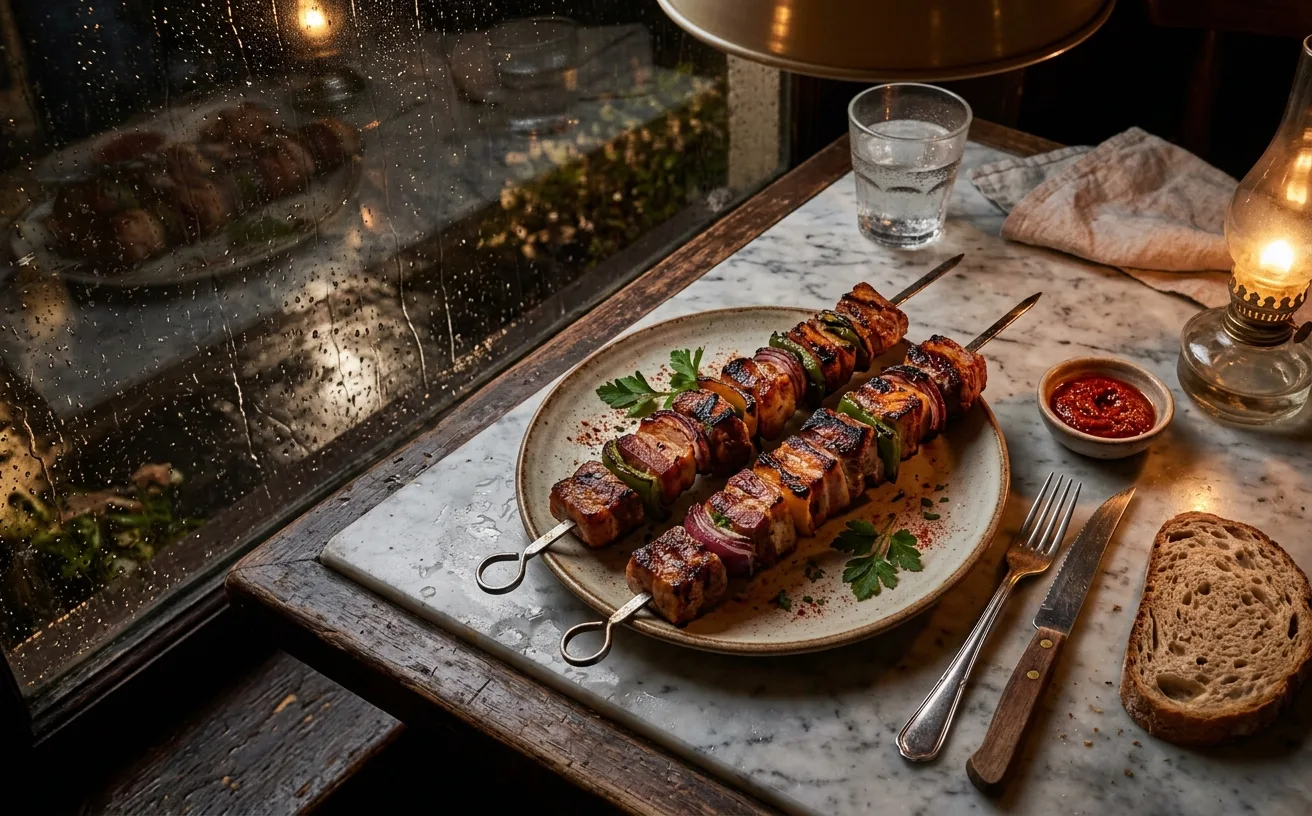
On an imbiss menu, yes — Kebabteller, Dönerteller and Teller Döner name the same order, because German shops use kebab and döner interchangeably for spit meat. Only in a sit-down Turkish restaurant might a kebab plate mean grilled skewers instead, so check what the kitchen is carving from.
Sources and further reading
- Döner kebab — Wikipedia
- How the Döner kebab consumed Germany — IamExpat