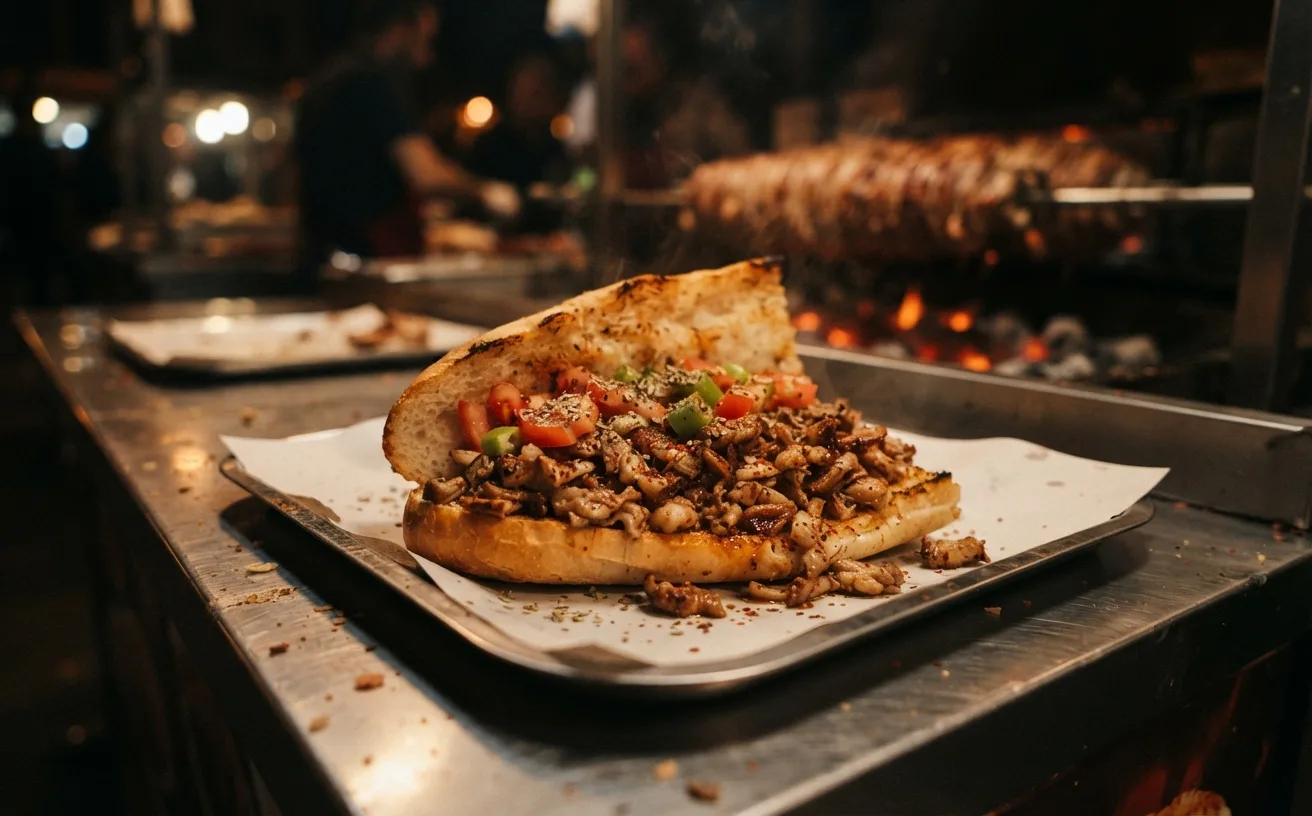
Seasoned lamb intestines wound tightly around sweetbreads on a horizontal spit and roasted until crackling, then chopped fine with tomato and oregano into a half loaf of bread. A polarizing late-night icon of Turkish street food, cousin to Greek kokoretsi.
Also known as kokoretsi, grilled lamb intestines.
Reference video
Ingredients
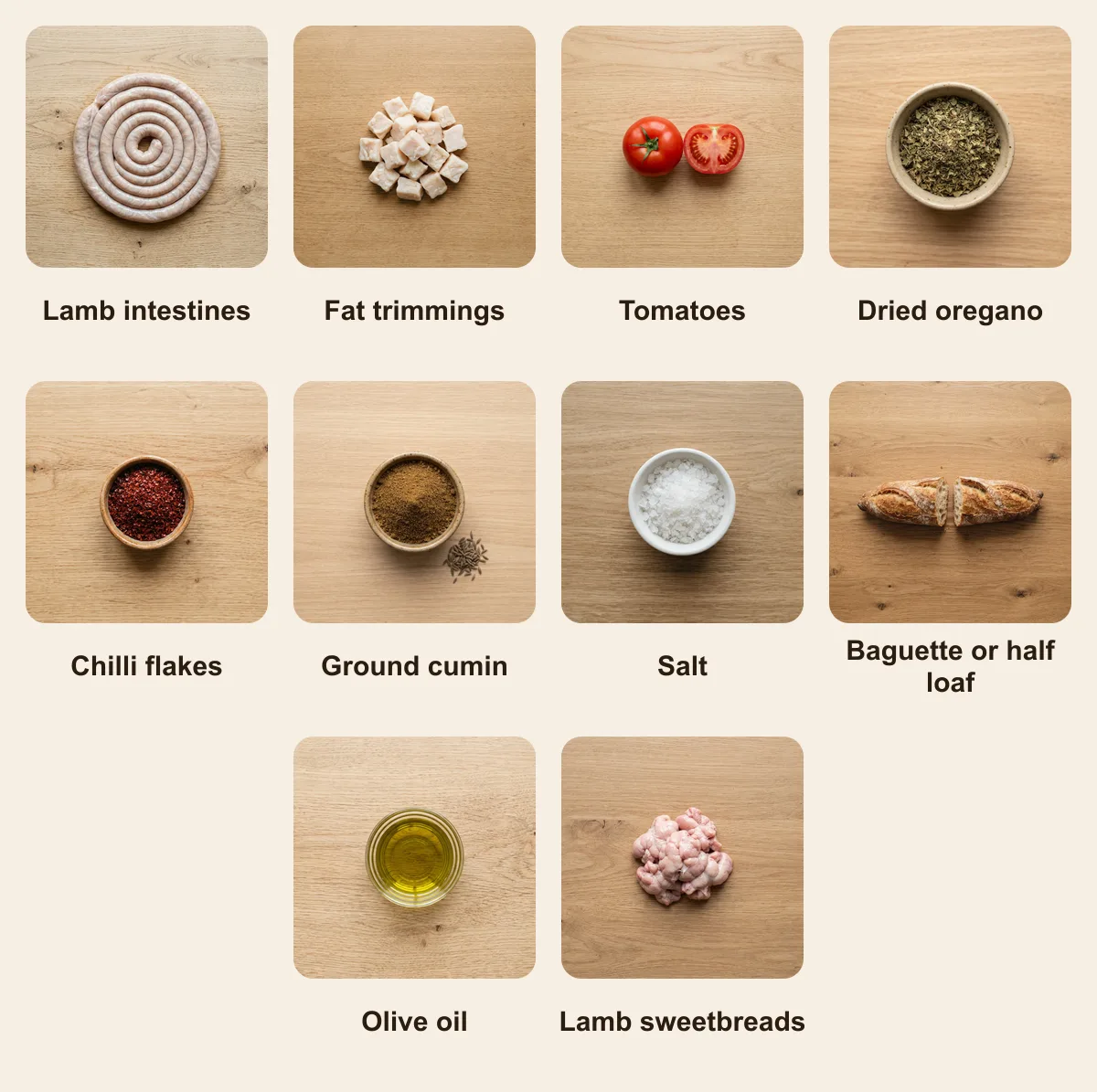
- 800 g cleaned lamb small intestines
- 300 g lamb sweetbreads and fat trimmings
- 2 ripe tomatoes, finely chopped
- 1.5 tsp dried oregano
- 1 tsp chilli flakes
- 1 tsp ground cumin
- 1.5 tsp salt
- 1 crusty baguette or half loaf, split
- 30 ml olive oil
How to make it
- 1
Toss the sweetbreads, fat and intestines with half the oregano, cumin, chilli and salt, then shape the sweetbreads and fat into a core along a long metal skewer and wind the intestines around it in tight overlapping coils until fist-thick.
- 2
Wrap in foil and roast at 180 C for about 1 h 15 min, turning every 20 min, until firm and rendered, then unwrap.
- 3
Blast at 230 C for 15 min to get the crust crackling and deep amber.
- 4
Chop the whole roll fine on a board together with the tomatoes.
- 5
Reheat the chop 2 min in an oiled pan with the remaining oregano, cumin, chilli and salt, then stuff into the toasted bread.
Pro tip: Wind the intestines under real tension; loose coils trap steam and go rubbery where tight ones roast crisp.
Where Kokorec comes from
Kokoreç is Turkish street food at its most divisive and most beloved: lamb intestines cleaned, seasoned and wound tightly around a core of sweetbreads and offal, then roasted on a horizontal spit until the outside crackles. It is a late-night institution in Istanbul, Izmir and Ankara, and its Greek cousin kokoretsi is the same idea served at Easter.
Its history is Balkan and Anatolian at once, and both countries claim it with some heat. It survived a genuine political fight in Turkey in the 2000s, when EU accession discussions raised the possibility that it might be regulated out of existence — a rumour, never an actual EU proposal, that produced public protest and a great deal of newspaper coverage.
How Kokorec is cooked
Cleaning is nine-tenths of the work and it is not optional. Intestines are turned inside out, washed repeatedly, rubbed with salt, lemon and often flour, and rinsed until there is no smell at all. Any shortcut here shows up unmistakably in the finished dish, which is why kokoreç is judged first on whether it smells clean.
The cleaned casings are then wound in tight overlapping spirals around a core of sweetbread and offal skewered lengthways, forming a dense cylinder. It roasts slowly on a horizontal spit for an hour or more so the fat renders and the outer layer crisps. At service it is chopped fine on a board with tomato, oregano and pepper flakes, and packed into half a loaf.
Ingredients and shopping
Lamb intestines and sweetbreads from a butcher who deals in offal, as fresh as possible. This is emphatically not a dish to attempt with anything of uncertain freshness. The seasoning is simple — salt, cumin, oregano, pul biber, and a great deal of it, applied both during the winding and at the chopping board.
Domestic versions exist: a tight roll wrapped in foil and oven-roasted, then finished uncovered to crisp, is the usual home approach. It will not have the spit's even rendering, but it works. The bread should be a plain white half loaf, split and slightly hollowed so the chopped filling packs in.
How Kokorec is served
Chopped fine on the board with tomato, oregano and pepper flakes, then packed into a half loaf or served on a plate with the same seasoning and a squeeze of lemon. It is eaten late, standing, often after a night out, and pickled peppers are the standard accompaniment. Ayran or, honestly, whatever is left over from the evening.
Common mistakes
Insufficient cleaning
This is the whole dish. Salt, lemon, flour and repeated rinsing until there is no odour whatsoever — anything less is inedible.
Winding it loosely
A loose roll unravels on the spit and cooks unevenly. It should be dense and tight.
Cooking it fast
The fat needs time to render out. Rushed kokoreç is greasy rather than crisp.
Under-seasoning at the board
Half the seasoning goes on at the chopping stage, with tomato and oregano. Skipping it leaves the dish flat.
Kokorec: questions and answers
How do you clean the intestines properly?
Turn them inside out and wash repeatedly with salt, lemon juice and flour, rinsing until no smell remains at all. This step cannot be shortened.
Is kokoreç Turkish or Greek?
Both traditions have it — kokoreç in Turkey, kokoretsi in Greece, where it is an Easter dish. The technique is shared across the region and both claim it.
Can I make kokoreç at home without a spit?
Yes. Wind it tightly, wrap in foil, roast slowly in the oven, then finish uncovered at high heat to crisp the outside.
How do you pronounce kokoreç?
Ko-ko-RETCH, stress on the last syllable — the Turkish ç is the ch of 'church'. The Greek kokoretsi adds a final syllable: ko-ko-REH-tsee.
What does kokoreç taste like?
Richer than ordinary grilled lamb but milder than most organ meat: crackling, deeply browned edges over a tender chew, carried by rendered fat, char, oregano and chilli. Well-washed casings themselves taste of very little — the seasoning and the crust do the talking.
Sources and further reading
- Kokoretsi — Wikipedia
- What is Kokoreç Anyway? — Global Country Meats