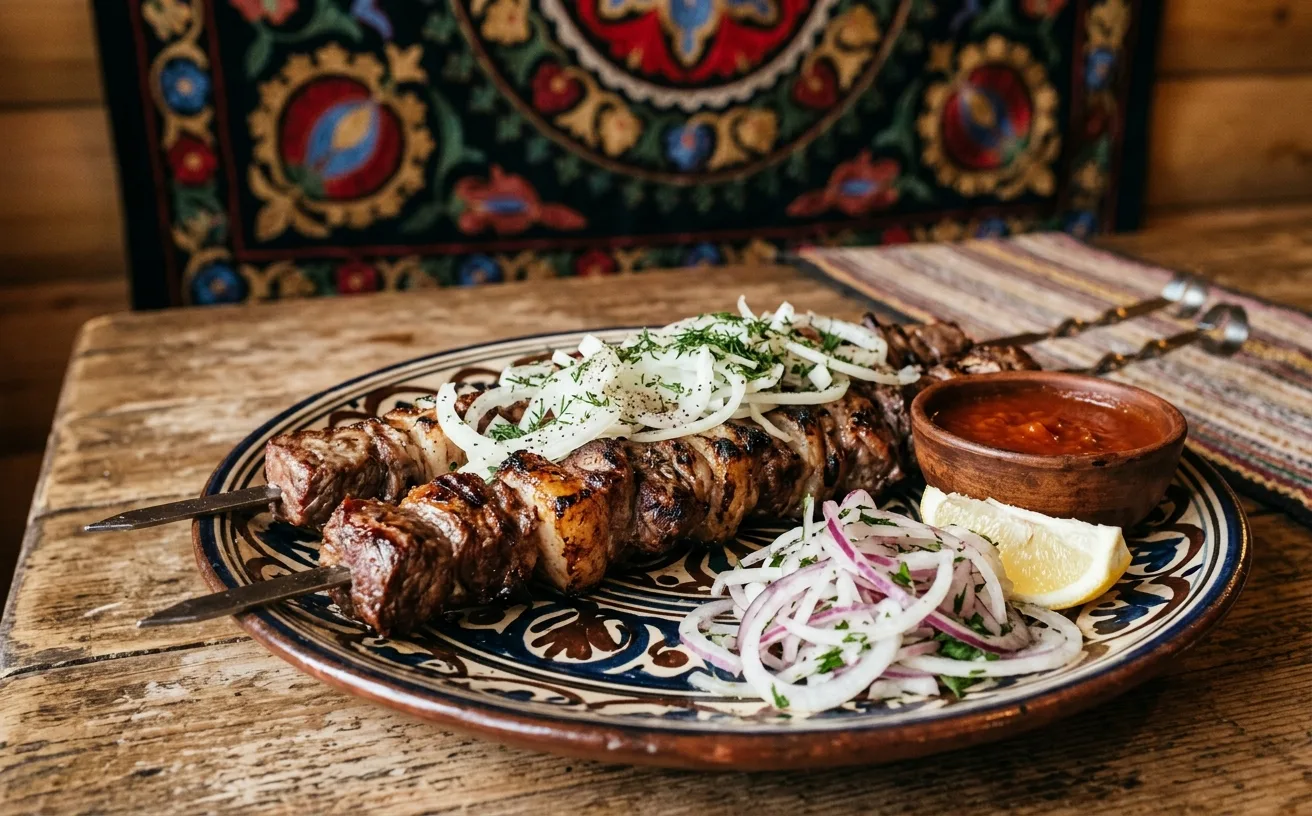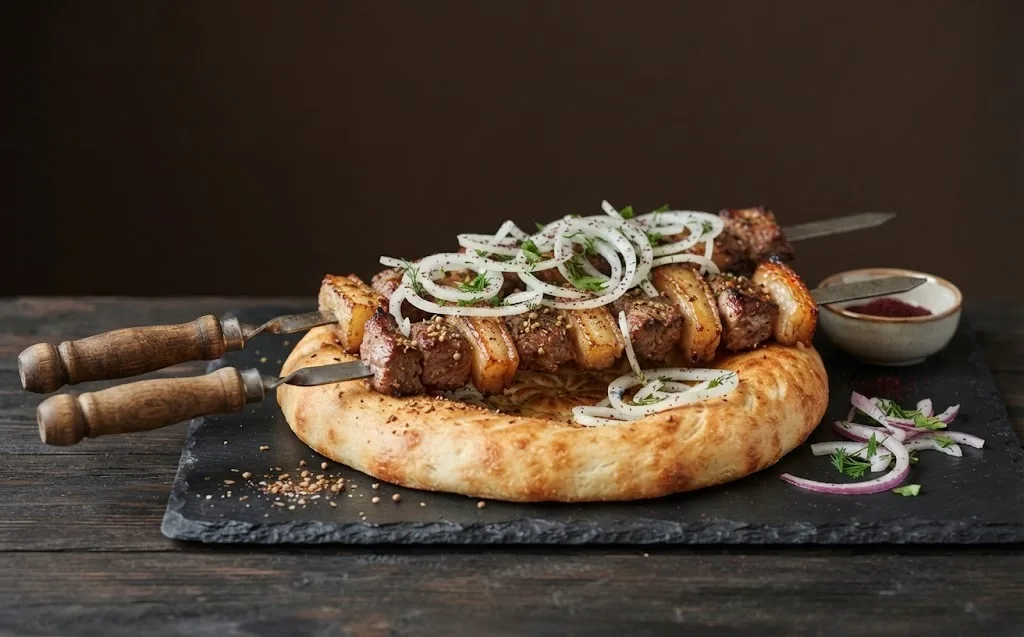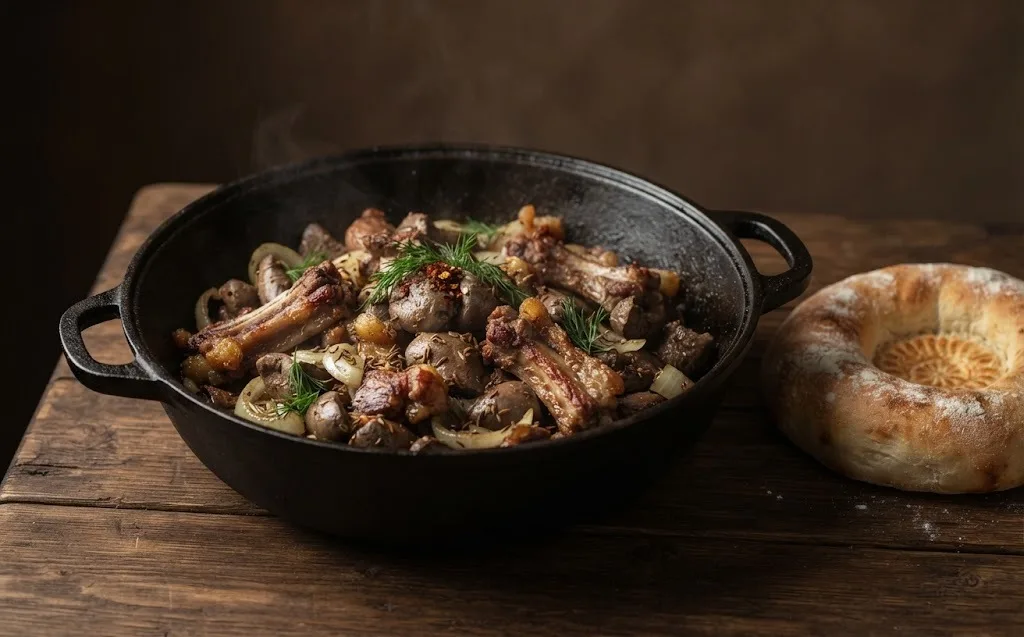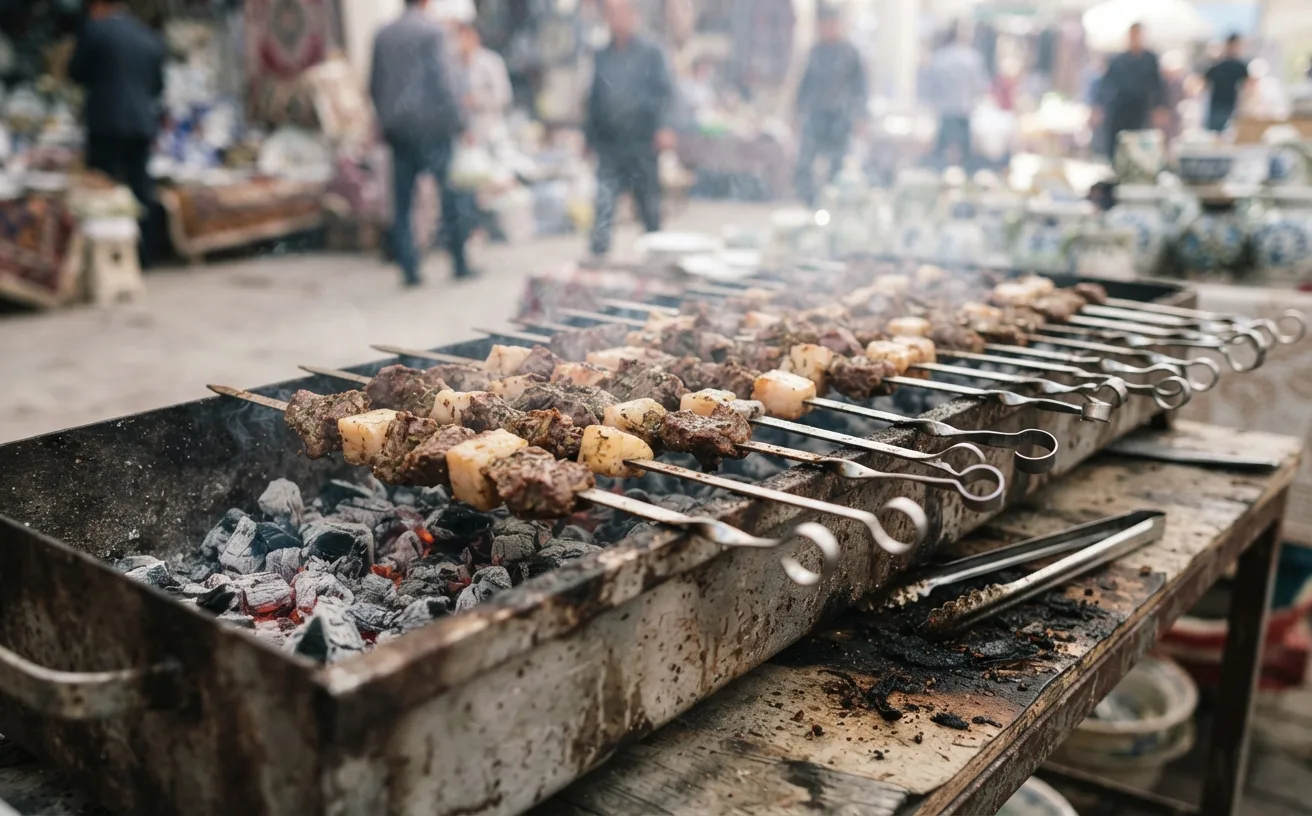
Tajikistan's shashlik, whose name comes straight from 'six' (skewer): lamb marinated overnight in onion, vinegar, and cumin, often interleaved with tail fat or made in a two-meat version combining cubes and minced patties on the same skewer. It is served on hot non flatbread with pomegranate seeds in season.
Also known as sikh kabob, shishkabob tajik, sixkabob tajik.
Ingredients
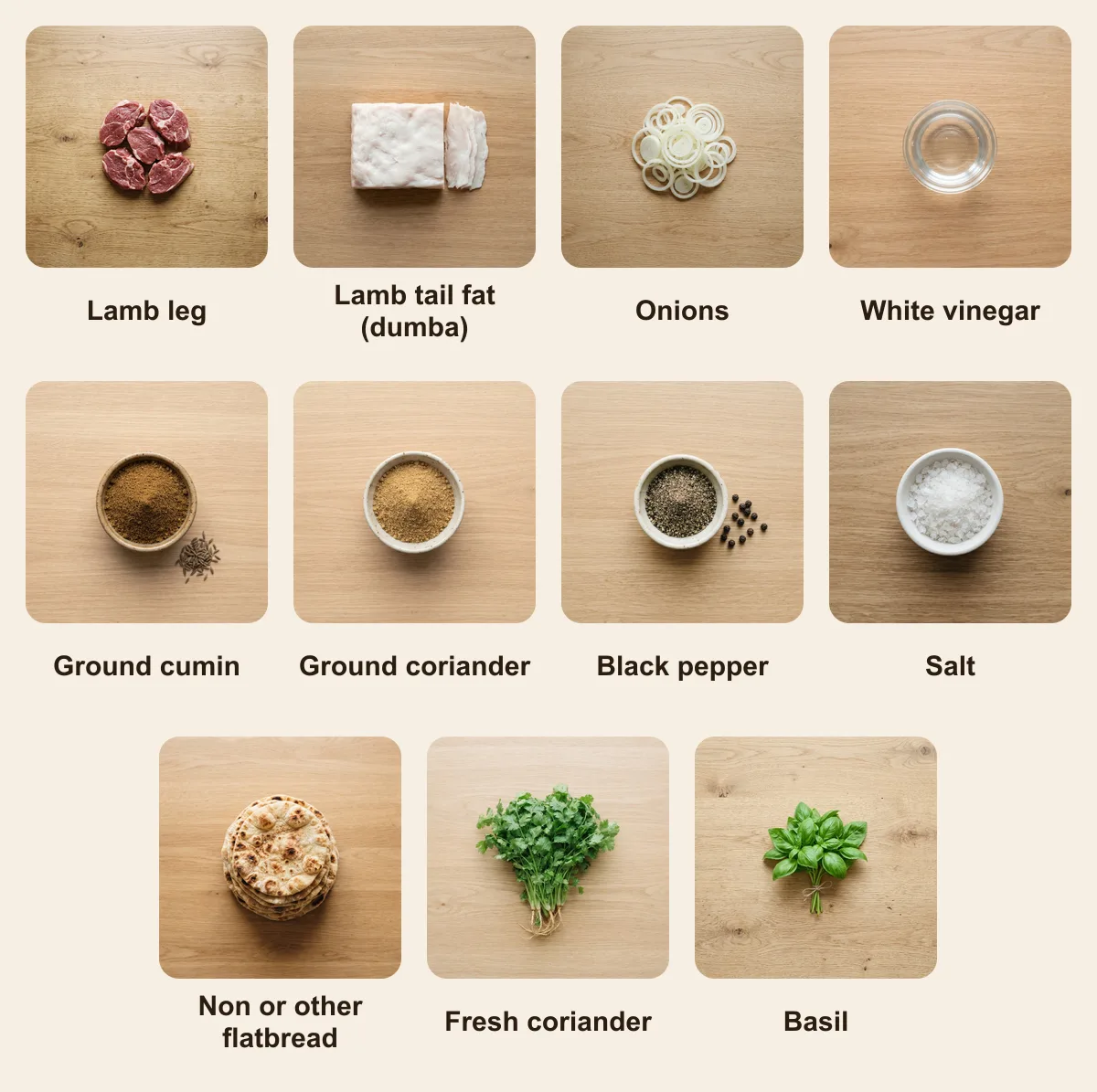
- 700 g lamb leg, in 3.5 cm cubes
- 150 g lamb tail fat (dumba), in slices
- 2 onions, thinly sliced
- 3 tbsp white vinegar
- 2 tsp ground cumin
- 1 tsp ground coriander
- 1 tsp black pepper
- 1.5 tsp salt
- non or other flatbread, to serve
- fresh coriander and basil, to serve
How to make it
- 1
The night before, work the lamb by hand with the sliced onion, vinegar, cumin, coriander, pepper and salt, squeezing the onion so it gives up its juice, and refrigerate.
- 2
Next day, scrape the cubes clean and thread them onto the 'six' — the skewer that gives the dish its name — alternating with slices of tail fat, five or six pieces per stick.
- 3
Sear over hardwood coals about 2 minutes per face, 8-10 minutes in all, until crusted but still juicy.
- 4
Serve on flatbread scattered with fresh herbs, with a few marinade onions charred quickly at the grill's edge.
Pro tip: Vinegar and onion juice need the full overnight to work through leg meat — a two-hour version grills up chewy, as any Dushanbe kabobchi will tell you.
Where Sixkabob comes from
Sixkabob is Tajikistan's shashlik, and the name is a straightforward borrowing — six is the Tajik word for skewer, from the same root as the Turkish şiş. It is the default street and celebration food across the country, from Dushanbe's grills to roadside stands in the Pamirs.
Tajik cooking sits between Persian and Turkic worlds and sixkabob shows it: Persian in its patience with marinades and its love of pomegranate, Turkic in its tail fat and its bazaar-grill culture.
How Sixkabob is cooked
The marinade is longer here than in Uzbekistan — often overnight — with onion, vinegar and cumin doing the work on shoulder meat. That longer soak is why Tajik sixkabob can use tougher cuts than a Fergana bazaar version, and it is the main technical difference between them.
Tail fat is threaded between the cubes as elsewhere in Central Asia. In the two-meat version, a minced patty is pressed onto the same skewer alongside the cubes, which requires the mince to be kneaded to stickiness first and the cook to manage two textures on one piece of steel — the minced part cooks faster and is placed toward the cooler end.
Ingredients and shopping
Lamb leg or shoulder in three-and-a-half-centimetre cubes, with dumba (tail fat) between them. For the minced portion, fatty lamb kneaded with grated onion until tacky. Onion for the marinade should be sliced so it lifts off before grilling rather than burning on.
Cumin is the dominant spice, with coriander and black pepper behind it. Vinegar rather than lemon is traditional. Non — the round Central Asian flatbread — is the serving vessel and should be warm. Pomegranate seeds when in season are scattered over at the table and are not just decorative.
How Sixkabob is served
On hot non bread with sliced raw onion, fresh herbs and pomegranate seeds in season. Green tea in a piala. In Dushanbe it comes with a tomato and cucumber salad and sometimes a bowl of vinegared onions. Bread is used to strip the skewer, as everywhere in the region.
Common mistakes
Leaving onion pulp on the meat
Slice the onion so it lifts off. Pulp burns bitter on hot coals.
Putting minced and cubed meat side by side without thought
The mince cooks faster. Place it toward the cooler end of the skewer or grill it on its own.
Skipping the tail fat
As across Central Asia, the rendering fat is what keeps the lamb from drying.
Over-marinating in vinegar
Overnight is the tradition, but with a strong vinegar that becomes too much. Dilute it, or shorten the soak.
Sixkabob: questions and answers
What does sixkabob mean?
Six is the Tajik word for skewer, from the same root as the Turkish şiş. Sixkabob is simply skewer kebab.
What is the two-meat version?
A skewer carrying both cubed lamb and a pressed minced patty. It is a distinctive Tajik habit, and the mince goes toward the cooler end because it cooks faster.
Sources and further reading
- Shish kebab — Wikipedia
- Central Asian cuisine — Wikipedia
- The Tajik Food Dictionary — Folkways Today (SRAS)