Charcoal makes the better kebab, but not for the reason most people give, and not for every kebab. The fuel adds almost no flavour; well-burned charcoal is close to pure carbon. What it gives you is heat: glowing coals throw intense radiant heat straight at the meat and can run far hotter than most domestic gas grills. That matters most for minced kebab on flat skewers, adana and koobideh above all, which must set a crust before its fat melts. For chicken and quick chunk kebabs, a properly preheated gas grill loses very little.
Heat guide
Charcoal vs Gas for Kebab: The Heat Matters More Than Smoke
Charcoal vs gas for kebab: why coals win for minced adana and koobideh, where gas loses almost nothing, and the settings that close the gap on a gas grill.
By Ali Ocak
Updated 2026-09-15
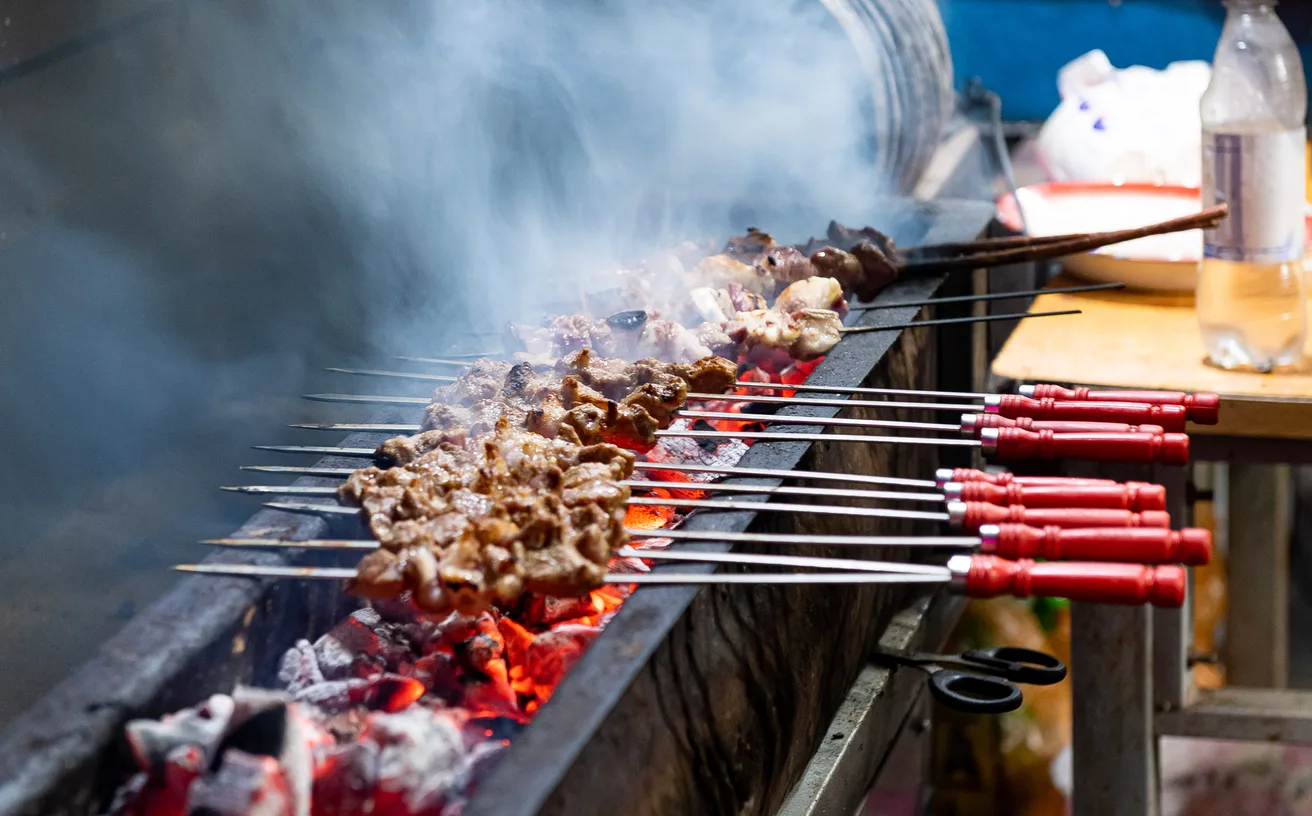
The evidence for a small gap is better than the folklore. In a Consumer Reports blind test, 113 staff tasted chicken thighs cooked with only oil and salt: 36 percent preferred gas, 34 percent pellet, 30 percent charcoal, and only about a third could match the food to the grill, roughly chance.
So the useful question is which fire puts the most heat into the surface of the meat in the first minutes. Your temperature bands and internal targets stay the ones in What Temperature To Cook Kebab; what changes with the fuel is how easily you reach them.
Source-backed support
Sources Worth Watching
Reference material this guide draws on — each link opens with its original publisher.
Source video
Easy Homemade Turkish Shish Kebap Recipe | Make Shish Kebab at Home with Real Charcoal!
Another way to chase the charcoal taste: Refika makes a Tarsus-style minced beef kebab at home, with beef, finely chopped beef fat, grated onion paste, red pepper and salt kneaded and shaped on cold skewers, then cooked in a 250 °C oven on grill mode with red-hot charcoal pieces spread on a baking tray. Lit charcoal gives off carbon monoxide, so if you try it indoors, keep the kitchen well ventilated.
Source: Refika's Kitchen
Embedded from the original YouTube source. Not hosted locally.
Watch On SourceGrilling science
Charcoal Grill vs. Gas Grill Throwdown - Meathead's AmazingRibs.com
https://amazingribs.com/ratings-reviews/how-to-buy-a-grill/charcoal-vs-gas/
Fuel reference
Charcoal Science: How Charcoal Is Made and How It Works - AmazingRibs.com
https://amazingribs.com/more-technique-and-science/grill-and-smoker-setup/how-charcoal-is-made/
Taste test
Which Grill Makes the Tastiest Food? - Consumer Reports blind taste test
https://www.consumerreports.org/grills/which-grill-makes-the-tastiest-food
Safety reference
Charcoal and Carbon Monoxide - U.S. Consumer Product Safety Commission
https://www.cpsc.gov/Safety-Education/Safety-Education-Centers/Carbon-Monoxide-Information-Center/Charcoal
Heat check
Measuring Heat: The Hand Test - Weber
https://www.weber.com/US/en/grill-skills/mastering-charcoal/charcoal/measuring-heat-the-hand-test/weber-34145.html
What charcoal really does, and the flavour myth
Charcoal is wood with most of its flavour already cooked out. Carbonising drives off the volatile compounds, which is why only about 25 percent of the original wood weight survives and why charcoal is classed as a near-smokeless fuel. The idea that fully lit coals season the kebab is the myth.
The grilled taste comes from the meat. Fat, water, protein and marinade sugars drip onto the heat, vaporise, and part of that vapour settles back on the kebab. Minced kebab at 20 to 25 percent fat drips the most. The same drippings are the risk: fat that burns incompletely forms PAHs, polycyclic aromatic hydrocarbons including benzo[a]pyrene, which ride the smoke back onto the meat. One study measured 0.22 µg/kg of benzo[a]pyrene on meat from a beech-charcoal flat grill against 1.21 µg/kg from an asado grill over live beech-wood flame.
The real advantage is radiant heat. Glowing coals throw a lot of direct infrared, while a conventional gas grill cooks mostly with hot air. Radiated power rises with the fourth power of absolute temperature: as an illustration, not a measurement, an 800 °C surface emits about five times as much as a 450 °C one. Intensity also falls off with distance.
Charcoal also has a higher ceiling. A typical set-up runs around 260 °C, but with coals raised close to the grate, AmazingRibs says the coals can blast the food with about 425 °C or more. The kebab target stays 230 to 290 °C at grate level; charcoal simply reaches it easily, with heat in reserve when cold meat goes on.
What gas does well, and where it falls short
Gas is not flavourless heat. Most gas grills cover the burners with metal bars, tents, lava rock or ceramic that re-radiate heat, and drippings landing on them vaporise just as they do on coals. Boston University engineering professor Greg Blonder says the flavour on a gas grill typically comes from burnt fat falling on the heat source, since properly burned gas makes none. The odorant burns to sulfur dioxide in amounts far below the sulfur already in food.
What gas cannot give is any smoke of the fuel's own. Fully burned propane yields only carbon dioxide and water, while a charcoal fire, especially lump with pieces not fully carbonised, still gives off some wood-smoke compounds. On a short kebab cook that barely registers: smoke sits on the surface, rarely deeper than about 3 mm, and shows mainly on thick cuts and long cooks.
Where gas falls short is intensity. Low- to mid-price gas grills typically top out around 260 °C; Weber designs its grills to reach 260 to 290 °C with all burners on high and the lid closed. Expensive grills with sear burners and double-layered hoods can reach about 480 °C, but most gas grills cook by convection. The lid thermometer flatters them further: one tester found it reading about 28 °C above the grate, and gaps up to about 55 °C are reported. A lid showing 260 °C can mean a grate below 230 °C.
Then there is water. Burning a kilogram of propane releases about 1.6 kg of water vapour; charcoal, mostly carbon, releases very little. Whether that slows browning is disputed: Meathead Goldwyn wrote in 2009 that propane makes more steam, while a later AmazingRibs science page says so much air moves through a working cooker that combustion water has little impact on humidity. No measured study settles it. The better-supported reasons gas browns slower are lower radiant intensity and a lower top temperature.
Lump, briquettes or wood for kebab
Lump is carbonised hardwood. Briquettes are compressed sawdust and charcoal with binders and additives such as brown coal, starch, sodium nitrate, limestone and borax. So briquettes smoke unpleasantly while lighting and must be fully ashed over before meat goes on, and they can leave ash approaching half their original volume; lump leaves much less.
In Meatwave's chimney-for-chimney test, lump was ready in 19 minutes against 29 and peaked around 300 °C on the hood thermometer against 260 °C, but gave only about 15 minutes of high heat, then slid from medium-high to low over about 30. Briquettes held medium-high to medium for about 45 minutes. Cook's Illustrated found both burn about the same, by volume, for the first half hour. Lump also responds to airflow changes about twice as fast.
The rule for kebab: lump for a short, fierce cook of a few skewers; briquettes for a long session or a crowd. Never self-lighting briquettes, whose pre-treatment Blonder calls a flavour that never disappears.
Tradition sides with hardwood: adana over oak charcoal on an open mangal, hardwood lump for Persian koobideh, wood charcoal in Istanbul's ocakbasi grills. Raw wood still holds the volatiles carbonising removes, so it must burn down to embers first. For every fuel, cook over embers, never flames.
The verdict by kebab style
Minced kebab on flat skewers is where charcoal matters most. Adana, urfa, koobideh and seekh must set a skin before fat that softens from about 40 °C turns liquid, and the first 90 to 120 seconds decide whether they hold. A close bed of glowing coals delivers that set; a gas grill reading 260 °C on the lid but running cooler at the grate often does not, and the kebab slides. Cevapi, shaped by hand and cooked on a grate, are quicker and more forgiving.
Chunk kebabs sit in the middle. Lamb shish and souvlaki need 2 to 3 minutes per face over high heat, which a well-preheated gas grill can supply. Charcoal may pull ahead as cooks lengthen: Good Housekeeping Institute tests from 1998, reported second-hand, found no difference on burgers and chicken breasts but a charcoal advantage on sirloin steaks, credited to their roughly doubled cooking time. By that logic bigger cubes may gain more from coals, though no test has measured kebab.
Chicken loses almost nothing on gas. Tawook and joojeh cook fast, their marinades brown readily, and what they need is 74 °C in the centre without drying. The Consumer Reports test used plain chicken thighs, and the three grills finished within six points of each other. Cook chicken on gas without apology and spend the charcoal on the minced skewers.
Setting up a charcoal fire for kebab, step by step
Step one: light the coals in a chimney starter with paper or lighter cubes. Why: Weber calls lighter fluid dangerous and bad for flavour. The trap is fluid to hurry things along.
Step two: wait for the coals, not the clock. You cook once every coal is ashed over, roughly 20 to 30 minutes by the heat guide, and the fuel sets the pace: Meatwave had lump blazing at 19 minutes, briquettes at 29. The trap: waiting long past that with lump, whose high heat lasted about 15 minutes.
Step three: bank two-thirds of the coals on one side, the rest thin or bare. Why: the hot side sets the crust, the cool side finishes and absorbs flare-ups. The trap is one even bed with nowhere to retreat.
Step four: keep the coals close, 8 to 15 cm below the grate, shallower for a mangal. Why: radiant heat weakens with distance. The trap is a deep kettle with coals far below the meat.
Step five: suspend minced kebab across rails, as the mangal section below shows. Why: raw mince sticks to grate bars and tears. The trap is laying it on the grate.
Step six: hand test over the hot side, palm 10 cm above the grate: only 2 to 3 seconds means the zone is right. Why: it measures heat where the meat sits. The trap is starting at 4 to 5 seconds, where kebabs go grey.
Step seven: sear, then finish. Turn minced skewers early: Persian cooks flip within seconds of placing so the soft underside does not fall away, and the site's shaping guide turns every 30 to 45 seconds until the surface sets. Istanbul ocakbasi cooks give each side about a minute over the hottest coals, then move to the cooler side. Why: crust first, then 71 °C in the centre. The trap is water on a flare-up.
Getting kebab-shop results from a gas grill, step by step
Step one: preheat with every burner on high and the lid closed for 10 to 15 minutes. Why: the grill must heat the air, then the grates. The trap is a 5-minute preheat.
Step two: check heat at grate level, not on the lid. Why: the dial reads hotter air several inches up, and two spots on one grate can differ by about 11 °C. The trap is trusting 260 °C on the lid; use the 2 to 3 second hand test or a surface thermometer, and err hotter.
Step three: turn one burner to low or off once preheated. Why: gas needs a cool zone too. The trap is nowhere to move a flaming skewer.
Step four: if your grill runs cool, add aluminium grill-grate panels, which AmazingRibs recommends for gas grills to amplify heat and cut flare-ups. The trap is assuming heavier is better: AmazingRibs argues thick cast-iron grates block radiant heat.
Step five: run minced kebab hot and turn it constantly. A Persian gas-grill koobideh recipe asks for about 230 °C so the meat sets before sliding, on wide flat skewers (that recipe uses 2.5 cm; 1.5 cm is the working minimum). Treat 230 °C as the floor, not the goal. The trap is round skewers.
Step six: cook with the lid open; the closed lid is for preheating. The trap is closing it to rescue a pale kebab when the fix is more heat.
Step seven: for smoke, start before the meat. Put wood chips in a smoker box or perforated foil pan under one burner, turn it to medium or low once smoking, as Weber does, and place kebabs nearest the box. The trap is timing: chips can take up to about 20 minutes to smoke. Soaking is disputed: Weber soaks 30 minutes so chips smoulder; AmazingRibs says water does not penetrate wood and only cools the fire.
The simple mangal: bricks, rails and flat skewers
A mangal is an open bed of coals with skewers resting across it; the Istanbul ocakbasi is the long version, built into a counter under a hood, where the usta works each skewer individually. The meat touches nothing: fat drips straight onto the coals, each face gets the same radiant heat in turn, and soft mince never welds to hot bars.
You can build one on any charcoal grill. Persian Mama lays two hollow square steel pipes across the grate as rails and rests flat stainless skewers, 2.5 cm wide, across them over grey coals. Bricks either side of the coal bed do the same job. Mangal recipes use flat skewers about 1.6 to 2.5 cm wide.
Set the rails so the meat hangs roughly 8 to 10 cm above glowing, flameless, ash-covered coals, with a deep bed under one end and a thin one under the other: sear over the hot end, slide along to finish. Minced kebab takes about 8 to 12 minutes over a proper fire, longer over tired coals; trust the probe and cook minced kebab to 71 °C.
Indoors, bridge the skewers across a rimmed tray under the broiler, minced kebab about 8 cm below the element, the distance the oven guide gives. Never bring coals inside.
Safety: fumes, fluid and fat fires
Charcoal never burns indoors. The US Consumer Product Safety Commission's rule covers homes, garages, tents, campers, vans and cars, because the carbon monoxide can kill. The CDC applies it to gas grills too: never inside the home, garage or carport, never near doors, windows or vents. Carbon monoxide is colourless and odourless.
If you use lighter fluid, the NFPA says use only charcoal starter fluid and never add it, or any flammable liquid, to a lit fire. Let coals cool completely before putting them in a metal container.
Flare-ups blacken the crust and drive PAH formation, so never leave kebab cooking in the smoke of burning fat. Move it to the cool zone, on gas as on charcoal.
Quick answers
Is charcoal really better than gas for kebab? For minced kebab on flat skewers, yes, because coals give more radiant heat and a higher ceiling. For chicken and quick chunk kebabs, blind tests on plain grilled chicken suggest most people cannot tell.
Can you get smoky flavour on a gas grill? Some. Drippings vaporising on the heat tents give the grilled taste, and a smoker box adds real smoke if it is smoking before the kebabs go on. Expect a light surface effect.
Lump or briquettes for kebab? Lump for a short, hot cook: in one side-by-side test it lit faster, and it leaves less ash. Briquettes for a long session or a crowd.
How hot should the grill be for kebab? 230 to 290 °C at grate level: palm 10 cm above the grate, 2 to 3 seconds before you pull away. On gas, check at the grate, not on the lid.
Cook These Next

Lamb / 45m
Adana Kebab
The spicy gold standard of Turkish BBQ. Hand-minced lamb with tail fat.
Beef / 2h 30m
Kabab Koobideh
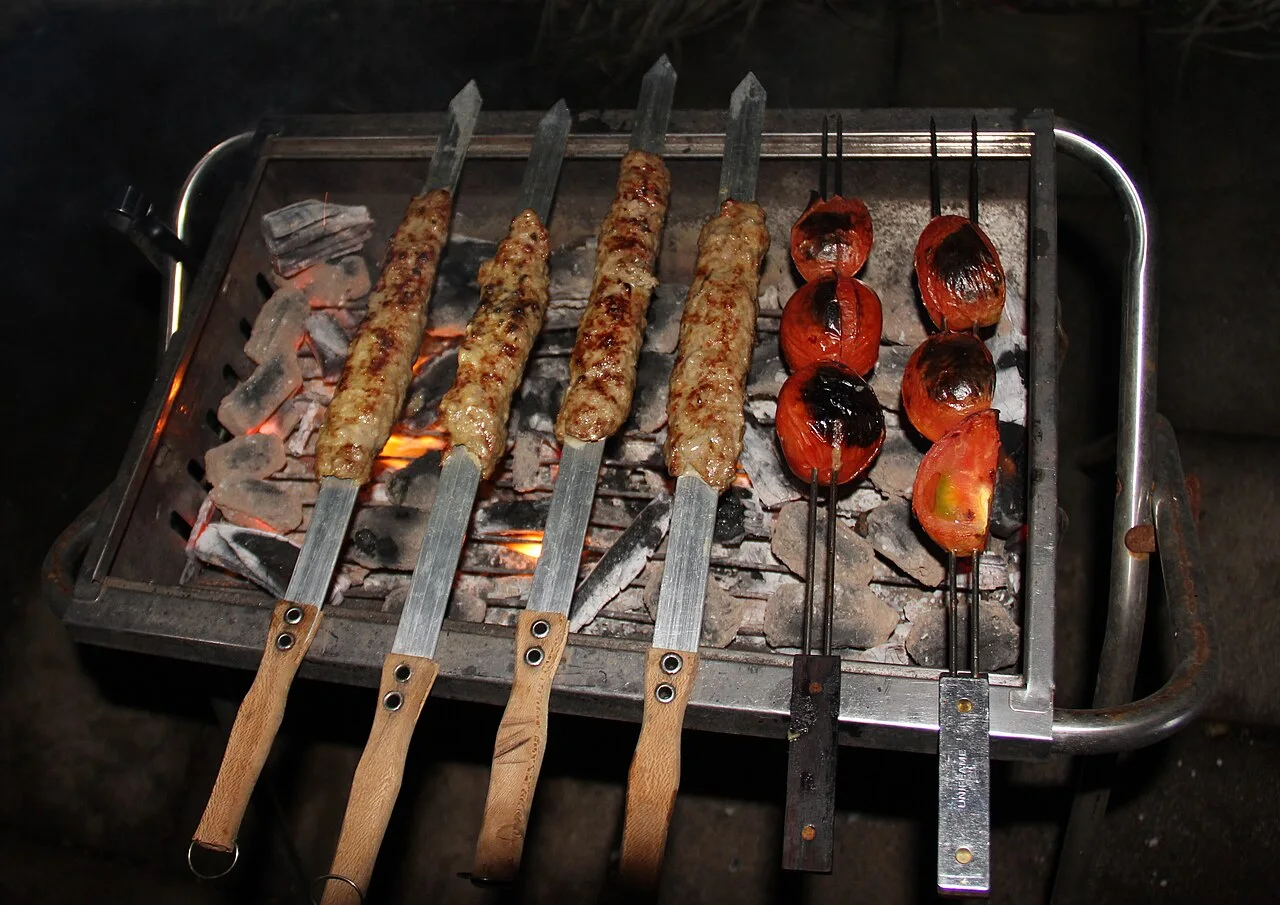
The national dish of Iran. Ground meat with onion, grilled on wide skewers.
Pork / 2h
Souvlaki
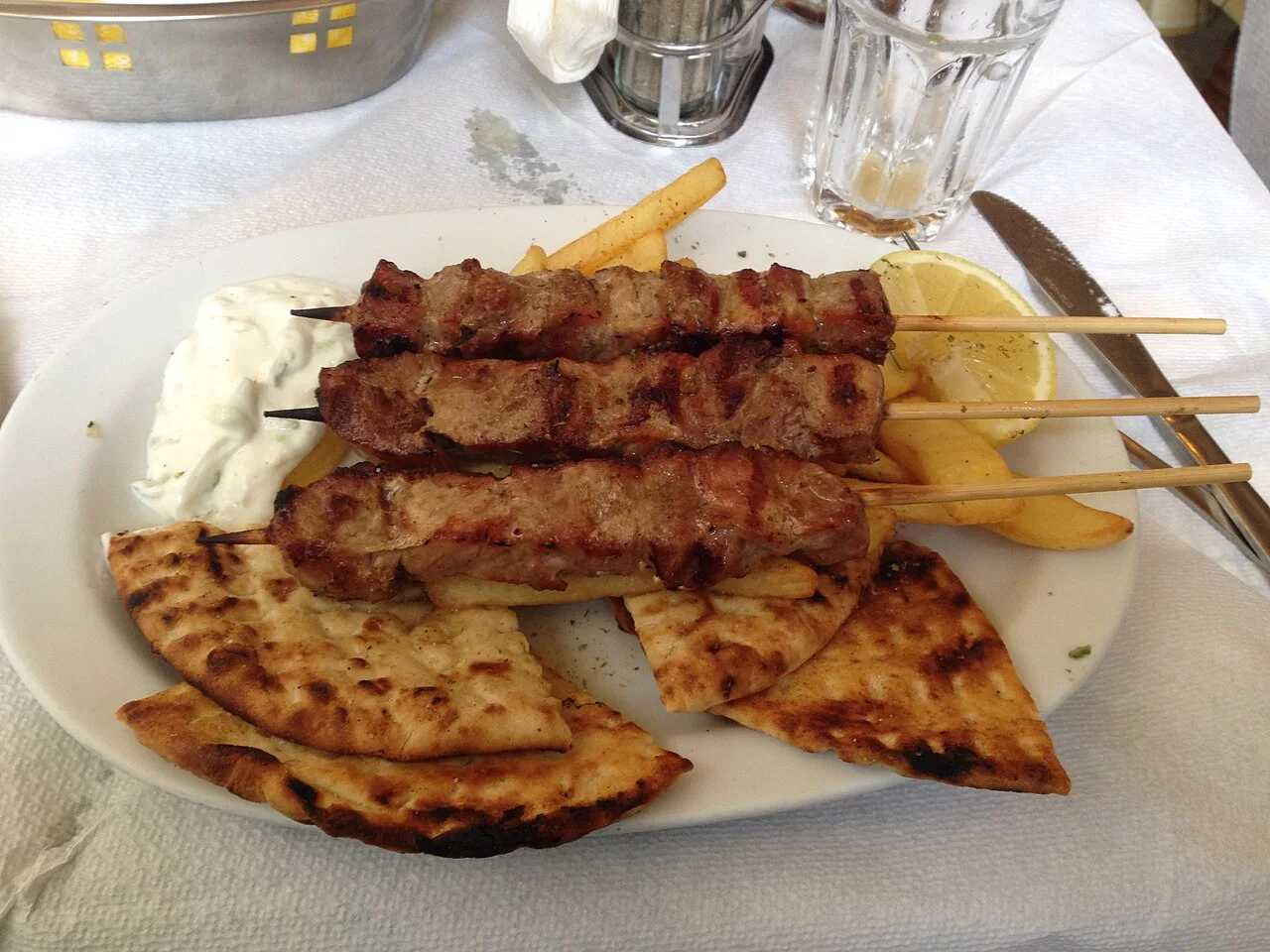
Classic Greek skewers. Traditionally Pork, marinated in lemon and oregano.
 AI illustration
Chicken / 24h
Joojeh Kabab
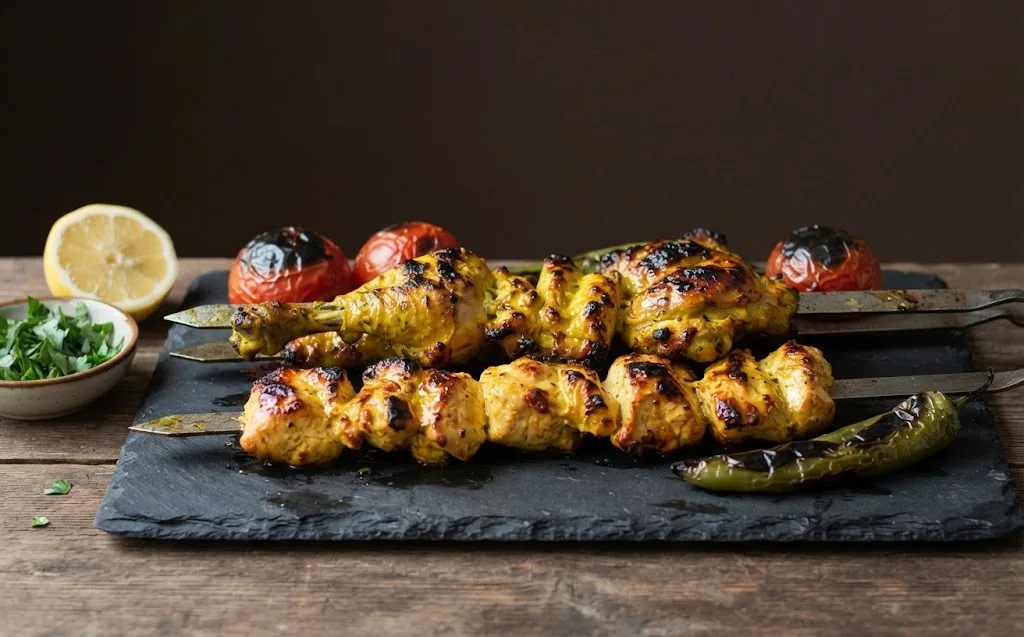
Classic Persian saffron chicken. Golden, citrusy, and tender.
Related Collections
Turkish Kebab Guides
A focused collection for Turkish kebab styles including Adana, Urfa, Cag, Iskender, and supporting bread pages.
Persian Kebab Recipes
A collection of Persian grilling styles, from koobideh and barg to joojeh and other skewer traditions.
Balkan Kebab Recipes: Cevapi, Somun, Lepinja, Raznjici
Compare Balkan kebab recipes, breads, and serving traditions including cevapi, somun, lepinja, raznjici, onion garnish, ajvar, and kajmak.
More Guides
Greek guide
Gyro vs Souvlaki: Spit, Skewer and the Pita Between
Gyro vs souvlaki: vertical spit versus skewer, why pork rules in Greece, what goes in the pita, and how to make both properly at home without a rotisserie.
Meat guide
Best Meat For Kebab
Choose the best meat for kebab by fat ratio, cut, grind, and cooking style, whether it ends up on a skewer, in a wrap, or on a plate.
Technique guide
How To Keep Kebab On The Skewer
Learn how to keep kebab on the skewer with the right fat level, onion handling, kneading, skewer shape, and grill timing.
Bread guide
Best Bread For Kebab Wraps
Choose the best bread for kebab wraps, gyros, shawarma, doner, and plate service with lavash, pita, somun, pide, and durum explained clearly.
Comparison
Gyros Vs Shawarma Vs Donair
Compare gyros, shawarma, and donair by meat style, bread, sauce, garnish, and wrap structure so you know which page to cook next.
Bread comparison
Lavash Vs Pita Vs Durum
Compare lavash, pita, and durum for kebab wraps so you know which bread to use for gyros, shawarma, Adana wraps, and sliced-meat rolls.