Gyros is meat cooked on a vertical spit and shaved off in thin slices; souvlaki is small cubes of meat threaded on a skewer and grilled over charcoal. Same country, often the same pork, frequently the same pita, but two different fires and two different textures: gyros is crisp edges and soft layers, souvlaki is a charred cube with a juicy centre.
Greek guide
Gyro vs Souvlaki: Spit, Skewer and the Pita Between
Gyro vs souvlaki: vertical spit versus skewer, why pork rules in Greece, what goes in the pita, and how to make both properly at home without a rotisserie.
By Ali Ocak
Updated 2026-09-17
The confusion is real and partly Greek. In Athens, ordering a souvlaki usually gets you a wrapped pita sandwich, filled either with skewer meat or with gyros, while in Thessaloniki and the north souvlaki means the skewer itself. The dishes are still distinct: one is a stack, one is a stick.
For the home cook the verdict is simple. Souvlaki is the easier win: a pork neck, a short marinade, a hot grill and about ten minutes. Gyros takes a day, because the flavour is built by marinating and stacking, but you do not need a rotisserie. A loaf tin and a hot pan get you very close.
Source-backed support
Sources Worth Watching
Reference material this guide draws on — each link opens with its original publisher.
History and naming
Gyros - Wikipedia
https://en.wikipedia.org/wiki/Gyros
Etymology and kalamaki
Souvlaki - Wikipedia
https://en.wikipedia.org/wiki/Souvlaki
Athens ordering guide
Everything You Need to Know About Souvlaki in Athens - This is Athens (official city guide)
https://www.thisisathens.org/restaurants/cheap-eats/souvlaki-gyros-street-food
Gyros vs souvlaki naming
Your guide to Greek gyros - Souvlakination
https://souvlakination.com/souvlakipedia-index/gyros
Souvlaki method
Authentic Greek Souvlaki Recipe (Pork Skewers) - Real Greek Recipes
https://realgreekrecipes.com/greek-souvlaki-recipe/
Home pork gyros
Greek Gyros Recipe - Homemade & Authentic Pork Gyros - The Greek Foodie
https://thegreekfoodie.com/homemade-traditional-greek-pork-gyros/
Loaf-pan gyros on the grill
Greek Pork Gyro Pita Sandwiches - The Meatwave
https://meatwave.com/recipes/greek-pork-gyro-pita-sandwiches-recipe
Food safety
USDA: 145 degrees is safe temp for pork - CIDRAP
https://www.cidrap.umn.edu/foodborne-disease/usda-145-degrees-safe-temp-pork
The short answer
Gyros is a cone of thin, seasoned meat slices pressed tightly onto a vertical spit, roasted as it turns and carved to order. In Greece that cone is whole-muscle meat, not mince. The name means turn, which is exactly what the spit does.
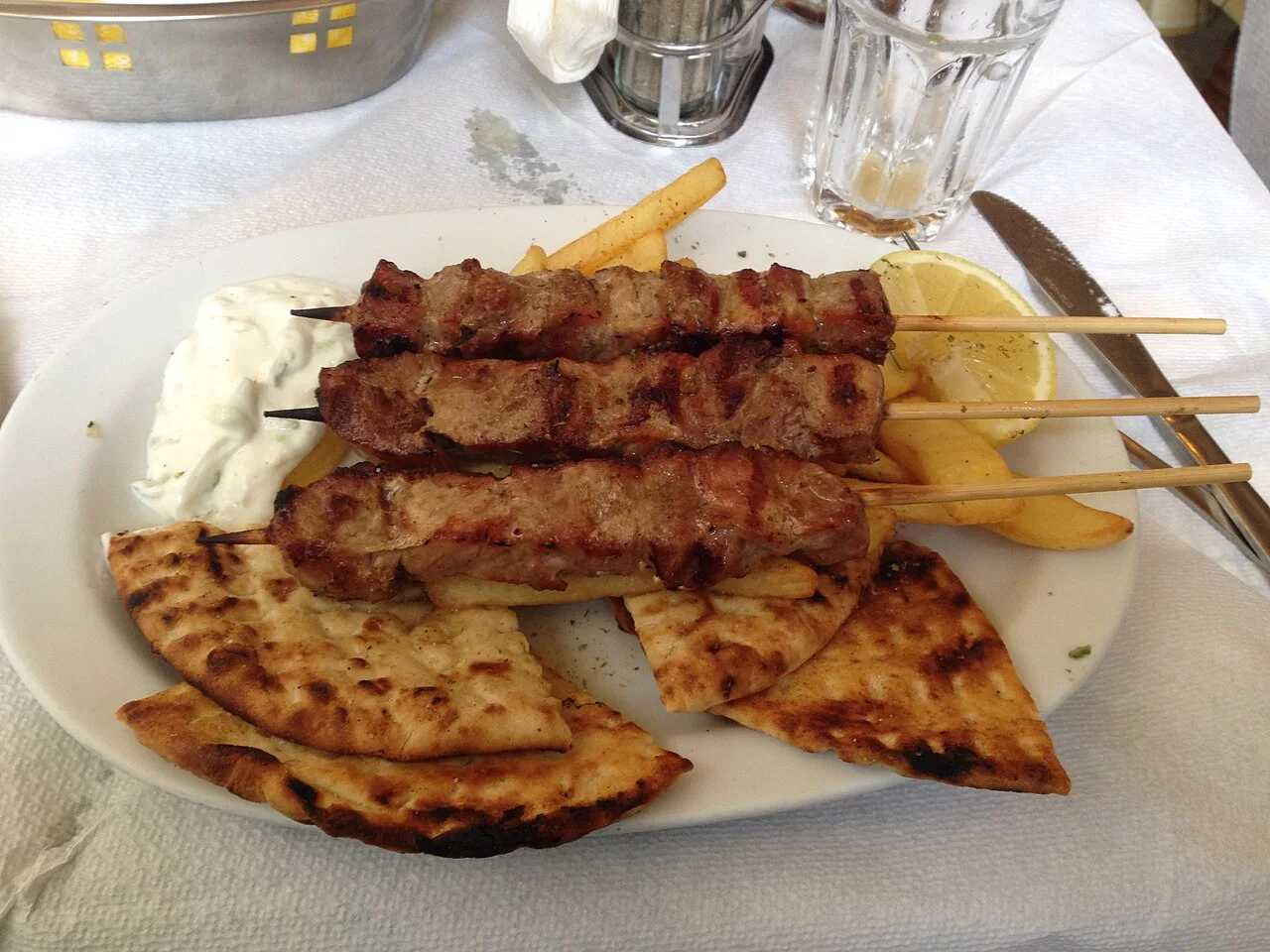
Souvlaki is cubes of meat on a skewer, grilled over charcoal in minutes. The word is a diminutive of souvla, the Greek for skewer or spit, which came from the Latin subula. In Athens and southern Greece the plain skewer is ordered as kalamaki, little reed, after the reed skewers once used, and it arrives with lemon and a piece of bread.
Both are usually pork in Greece, with chicken as the standard alternative. Both end up in the same thick, soft pita with tomato, onion, chips and tzatziki. Gyros is shaved, souvlaki is cubed.
Spit versus skewer
The vertical spit is the younger technology and it is not Greek. It is usually traced to Bursa in the Ottoman period, where Iskender Efendi's family says he began roasting lamb upright in the mid-19th century. Greek refugees most likely brought the technique with them in the 1920s, after the population exchange that followed the Asia Minor war, many of them from Constantinople and Smyrna. It was first sold in Greece as döner. Critics objected to the Turkish word, gyros took over, and by the 1970s it was the standard name and the national street food.
The skewer is far older. Greeks have cooked meat on skewers since the Bronze Age: stone trays for skewers turned up at Akrotiri on Santorini, in ruins buried by the eruption of the 17th century BC, and the Iliad has meat roasting on spits. Street souvlaki spread after the Second World War and became fast food in the 1960s.
The two fires cook in opposite ways. A spit roasts a large mass slowly while the outside keeps turning past the heat; the cook shaves only the crisped outer layer, so every portion is part crust, part soft basted meat. A skewer puts small pieces over intense direct heat, so the whole cube cooks at once and the char is on every face.
Scale is the thread that ties the family together. Cypriot souvla uses the same spit word for big chunks slow-turned for hours, and kontosouvli is the marinated Greek cousin: fist-sized chunks packed onto a long spit. Souvlaki is the small, fast end: little cubes, a few minutes.
Meat and marinade
Pork is the Greek default for both dishes. The Greek-American gyro cone, a finely ground beef and lamb mixture pressed into shape and mass-produced from the early 1970s, is a different product, and in Greece a beef, lamb or minced cone is more likely to be called döner than gyros.
Why pork? The popular story credits the 1967 to 1974 military junta, with enthusiast sites saying a hygiene ban on minced meat pushed shops towards pork gyros. It is often repeated, but no primary legal source backs it, so treat it as folklore. The better reason is in the meat itself: marbled pork neck and fatty shoulder stay juicy under strong heat, whether that is a hot grill for minutes or a turning spit for hours.
For souvlaki, use boneless pork neck, also sold as collar. Its 10 to 15 percent fat is what keeps a small cube moist. Shoulder is the alternative. Loin and tenderloin work, but they are lean and turn dry within a few degrees of 63 °C. Cut the cubes 2 to 2.5 cm, smaller than lamb or beef shish, and keep the fat on.
For gyros, the cut is sliced shoulder with its fat, layered with belly. Fat is not optional here: a stack of lean slices roasts into dry, grey sheets. The Gyros Recipe calls belly plus shoulder mandatory, and it is right.
The marinades differ in length more than in spirit. Souvlaki takes a short one: olive oil, lemon juice and dried oregano, with pepper, and garlic if you like it. Two hours in the fridge is enough, and recipes run up to overnight. Gyros marinates longer, 4 to 24 hours, and the site's Gyros Recipe cures overnight in grated onion juice, red wine vinegar, olive oil, a little honey, oregano and thyme.
The pita and what goes in it
The pita is where the two dishes meet, and it is not the pocket bread most supermarkets sell. Greek pita for gyros and souvlaki is thick, 5 to 8 mm, soft and pocketless. It is brushed with a little oil and warmed on a griddle or grill for 30 to 45 seconds per side, then folded open-topped around the filling rather than rolled tight.
The pita differs in role more than in recipe. Gyros is almost always eaten in pita or on a plate, because shaved meat has nothing to hold on to. Souvlaki can skip the bread entirely: a kalamaki is eaten off the stick, with bread on the side. Wrapped, it becomes pita kalamaki, and the cubes come off the skewer into the fold.
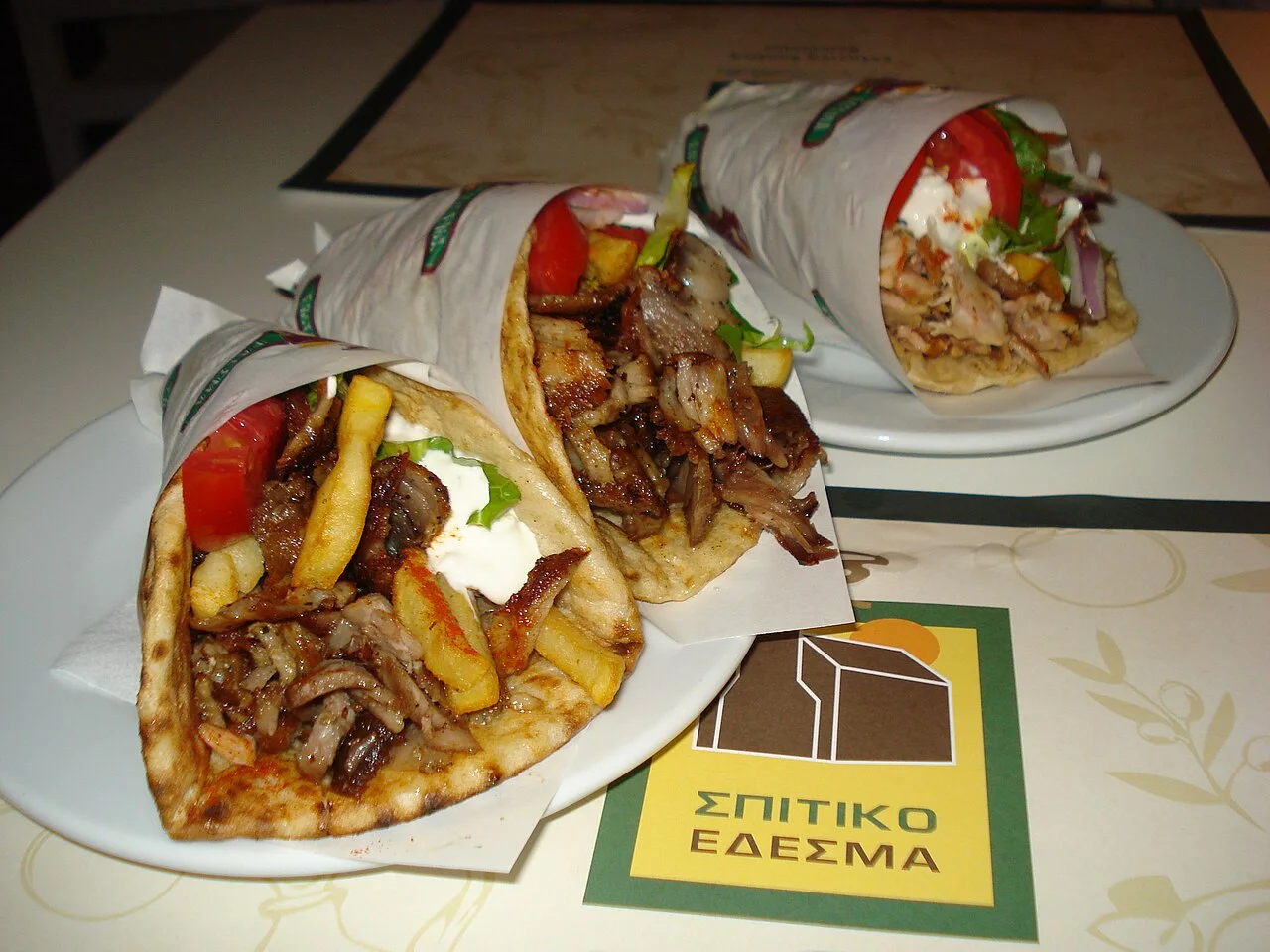
A standard wrap holds 150 to 200 g of filling: meat, tomato, raw onion, chips inside the wrap, and tzatziki for pork. Chicken often gets a mustard and mayonnaise sauce instead, and in northern Greece you may see ketchup or mustard.
Tzatziki is the sauce for both, and it lives or dies on water. Salt grated cucumber at about 1 percent of its weight for 15 to 20 minutes, squeeze until it has lost 40 to 50 percent of its weight, then mix 2 parts strained yogurt to 1 part cucumber by weight, with garlic, olive oil and a little vinegar or lemon. The full method is in Best Yogurt Sauce For Gyro And Kebab. The pita itself is covered in the kebab breads guide.
Which one to make at home
Make souvlaki first. It needs no special equipment beyond skewers and a grill, the marinade is four ingredients, and the margin for error is wide as long as your heat is high and you use neck rather than loin.
Make gyros when you have a day and a crowd. The loaf-tin method gets the two things that matter: layered, well-seasoned pork and a crisp edge added at the end in a very hot pan. What it cannot fully copy is the continuous shaving of a turning cone, so the final crisping step is not optional.
If you want the US-style gyro, that is a separate recipe: ground lamb and beef processed to a paste and baked as a loaf. It is not Greek gyros, and it follows ground-meat safety rules, not whole-muscle ones.
How to make souvlaki at home, step by step
Step one: cut 1 kg of boneless pork neck into 2 to 2.5 cm cubes and keep the fat. Why: small cubes cook through while the outside chars, and the fat bastes them. The trap is loin, which dries past 63 °C.
Step two: marinate in olive oil, lemon juice, 2 tbsp dried oregano and pepper, covered, for about 2 hours in the fridge. Why: that is enough for the surface flavour souvlaki needs. The trap is salt in the marinade; the Souvlaki Recipe salts just before grilling instead.
Step three: soak wooden skewers in water for about 30 minutes. Why: dry wood burns through over high heat. The trap is forgetting until the coals are ready.
Step four: thread the cubes snugly, without crushing them together. Why: snug pieces turn as one and cook evenly. The trap is threading them loosely, so they spin when you turn the skewer.
Step five: build a hot fire, 230 to 290 °C at the grate. Hold your palm above the grate: if you can only manage 2 to 3 seconds, it is ready. Why: souvlaki depends on fast searing. The trap is putting the meat on a medium fire, where it greys and dries before it colours.
Step six: salt the skewers, then grill for about 8 to 10 minutes in total, turning as needed, roughly 2 to 3 minutes per side. Why: each face needs time on the heat to char. The trap is fiddling with them every 30 seconds so no side ever browns.
Step seven: check the thickest cube. Pork is safe at 63 °C with a 3-minute rest; neck is at its best at 63 to 68 °C. Why: for whole cuts of pork the old 71 °C rule is outdated; mince still needs 71 °C. The trap is cutting cubes open to check, which lets the juice out.
Step eight: rest the skewers 3 to 5 minutes while you warm the pita, then squeeze over lemon. Serve off the stick or slide the cubes into the pita with tzatziki, tomato, onion and chips. The trap is building the wrap on cold bread.
How to make gyros without a spit, step by step
Step one: slice 2 kg of pork shoulder and belly into sheets 5 to 10 mm thick, keeping them even. The Gyros Recipe cuts 5 mm, and other methods use slabs up to 10 mm. Why: thin layers season through and stack into a dense block that slices cleanly. The trap is trimming off the belly fat.
Step two: marinate overnight. Use the Gyros Recipe cure: 1 grated onion's juice, 3 tbsp red wine vinegar, 2 tbsp olive oil, 1 tbsp honey, 2 tsp dried oregano, 1 tsp dried thyme, salt and pepper. Why: the flavour of gyros comes from that long marinade more than from the fire. The trap is cutting it to an hour.
Step three: stack the slices flat in a loaf tin, alternating shoulder and belly, and finish with a layer of fat on top. Press down and weight the stack. Why: pressure welds the layers into one block, as the cone does on a spit, and the top fat bastes it. The trap is loose layers that fall apart when sliced.
Step four: roast in a moderate to hot oven. The site's comparison uses about 200 °C for about 90 minutes, and The Greek Foodie roasts sliced pork at 177 °C for 1.5 hours; an upright skewer stood in a pan works the same way if you prefer it to the tin. Why: the block needs long enough for the fat to render through every layer. The trap is pulling it early.
Step five: know your target. Whole-muscle pork is safe at 63 °C with a 3-minute rest, the same figure as souvlaki, but a gyros stack is cooked well past that because the fat must render and the layers must set. That is texture, not a different safety rule. Only a ground-meat loaf has to reach 71 °C.
Step six: rest the block, then chill it for 20 to 30 minutes before slicing. Why: warm layers smear and tear under the knife. The trap is slicing straight from the oven.
Step seven: slice 2 to 3 mm thin, then crisp the slices in a very hot dry pan or under the grill for 60 to 90 seconds. Why: this replaces the shaved crust of a turning cone. Slices over 4 to 5 mm taste like a roast dinner. The trap is skipping the hot pan.
Step eight: fill each warm pita with 150 to 200 g of filling in total, meat, tomato, raw onion, chips and tzatziki, and fold it open-topped. The trap is a thin pocket pita, the wrong bread for a Greek wrap.
Quick answers
Is a gyro the same as souvlaki? No. Gyros is shaved from a vertical spit; souvlaki is cubes on a skewer. In Athens the word souvlaki also covers any pita wrap, including one filled with gyros.
Is gyros minced meat? Not in Greece. Greek gyros is stacked slices of whole meat. The minced beef and lamb cone is the American version.
What meat is traditional? Pork for both, with chicken as the common alternative. In Greece a beef or lamb cone is usually called döner rather than gyros.
What is kalamaki? The Athens name for a plain souvlaki skewer, served with lemon and bread.
What is the best cut for souvlaki? Boneless pork neck. For chicken souvlaki, use thigh, safe at 74 °C and best at 80 to 85 °C.
Can I make gyros without a rotisserie? Yes. Stack marinated shoulder and belly slices in a weighted loaf tin, roast, chill, slice thin and crisp the slices in a very hot pan.
Where do souvla and kontosouvli fit? They are the big-chunk spit roasts of the same family, turned for hours rather than minutes. See Souvla and Kontosouvli.
Cook These Next
Related Collections
Gyros, Shawarma, and Donair Guide
Compare gyros, shawarma, donair, souvlaki, and tawook with bread pairings, sauce choices, wrap assembly, and serving ideas.
Balkan Kebab Recipes: Cevapi, Somun, Lepinja, Raznjici
Compare Balkan kebab recipes, breads, and serving traditions including cevapi, somun, lepinja, raznjici, onion garnish, ajvar, and kajmak.
Best Bread for Kebab, Shawarma, and Gyros
Learn which bread to use for kebab wraps, gyros, shawarma, doner, and grilled meat plates, including lavash, pita, pide, somun, lepinja, and durum.
More Guides
Meat guide
Best Meat For Kebab
Choose the best meat for kebab by fat ratio, cut, grind, and cooking style, whether it ends up on a skewer, in a wrap, or on a plate.
Technique guide
How To Keep Kebab On The Skewer
Learn how to keep kebab on the skewer with the right fat level, onion handling, kneading, skewer shape, and grill timing.
Bread guide
Best Bread For Kebab Wraps
Choose the best bread for kebab wraps, gyros, shawarma, doner, and plate service with lavash, pita, somun, pide, and durum explained clearly.
Comparison
Gyros Vs Shawarma Vs Donair
Compare gyros, shawarma, and donair by meat style, bread, sauce, garnish, and wrap structure so you know which page to cook next.
Bread comparison
Lavash Vs Pita Vs Durum
Compare lavash, pita, and durum for kebab wraps so you know which bread to use for gyros, shawarma, Adana wraps, and sliced-meat rolls.
Oven guide
How To Cook Kebab In The Oven
Learn how to cook kebab in the oven with better browning, broiler timing, pan setup, and moisture control for minced and chunked kebabs.