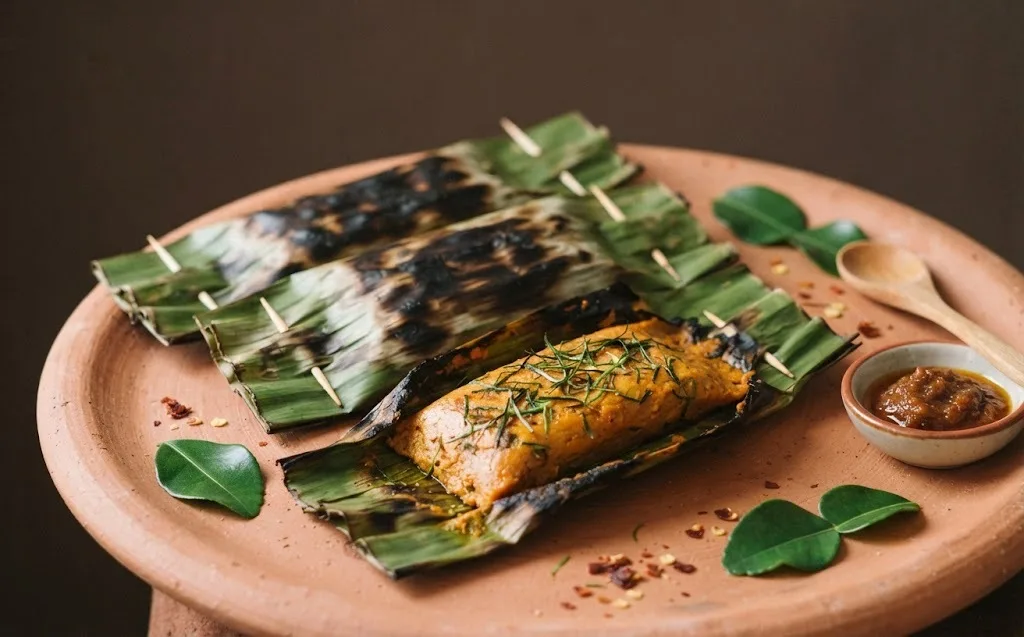
A spiced fish mousse of mackerel blended with coconut milk, chili and lemongrass, wrapped flat in banana or coconut leaf and grilled over charcoal until smoky at the edges. Nyonya in origin, it ranges from Singapore's firm orange otah to Muar's custardy version, eaten straight from the charred leaf.
Also known as otah, otah otah, grilled fish cake in banana leaf.
Reference video
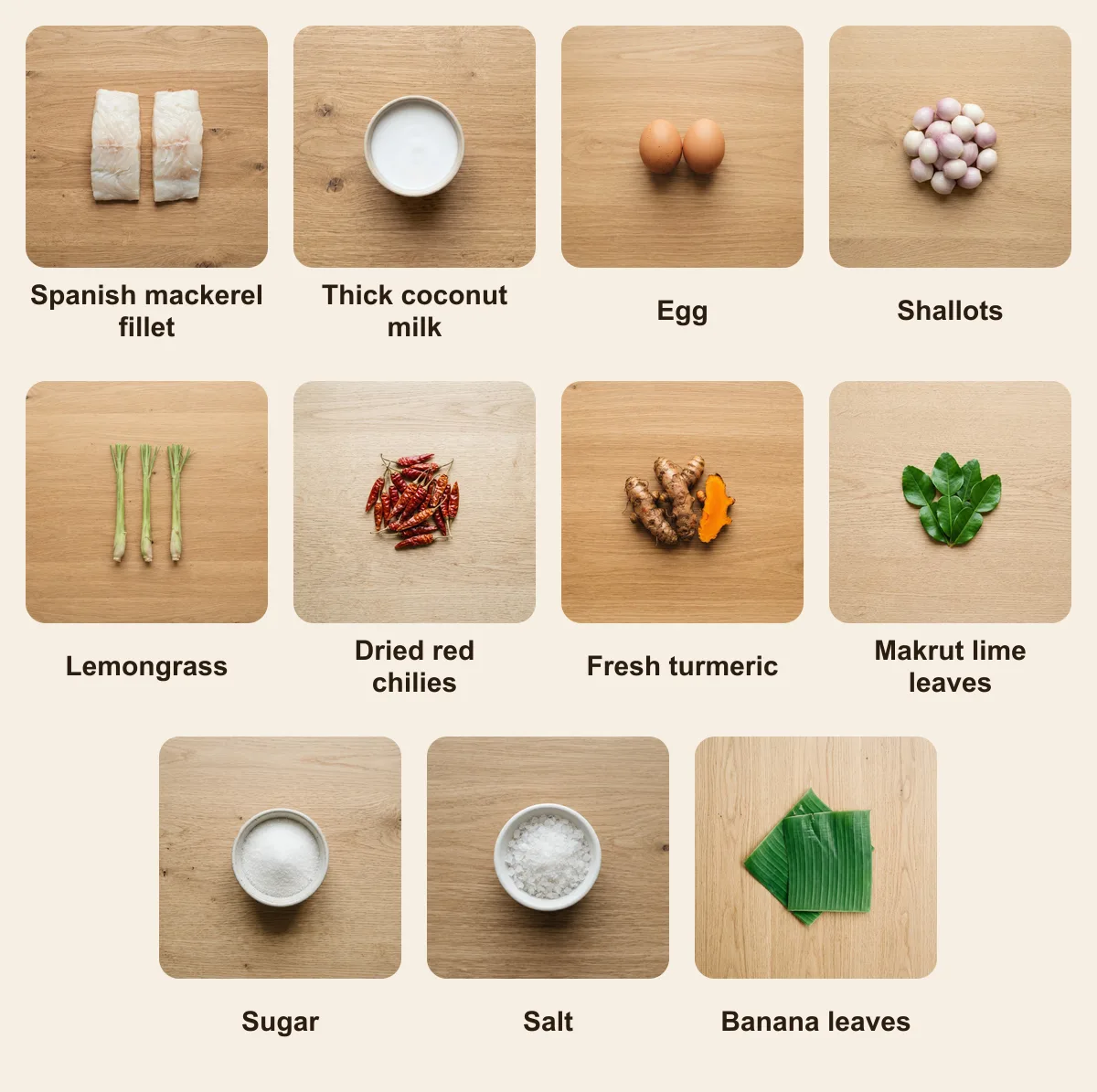
Ingredients
- 400 g Spanish mackerel fillet, skinned
- 100 ml thick coconut milk
- 1 egg
- 3 shallots
- 2 lemongrass stalks, tender core only
- 3 dried red chilies, soaked
- 2 cm fresh turmeric (or 1/2 tsp ground)
- 1 tsp belacan (shrimp paste)
- 3 makrut lime leaves, sliced hair-thin
- 1 tsp sugar and 1 tsp salt
- banana leaves and cocktail sticks
How to make it
- 1
Blend the shallots, lemongrass, chilies, turmeric and belacan into a fine rempah paste.
- 2
Pulse the mackerel with the rempah, coconut milk, egg, sugar and salt into a coarse mousse, then fold in the lime-leaf slivers.
- 3
Pass banana-leaf rectangles over a flame until glossy and pliable, spread 2 tablespoons of mousse flat along each, fold over and pin the ends.
- 4
Grill the parcels over medium coals 4-5 minutes a side, until the leaf chars and the mousse springs back when pressed.
- 5
Serve still wrapped, to be opened at the table.
Pro tip: Muar-style otak-otak is spread thin and flat, never lumped — a 1 cm layer sets in exactly the time the leaf needs to perfume it.
Where Otak-Otak comes from
The name means brains, which describes the texture rather than the ingredients. Regional variation is extreme: the Singapore and Muar versions differ enough that people travel for the one they prefer, and the Palembang version in Sumatra is a different dish again, bound with sago or tapioca starch and eaten with cuko, a sweet, sour and spicy vinegar sauce.
How Otak-Otak is cooked
The mousse texture comes from working the fish paste with coconut milk and egg until it is smooth and emulsified, and the amount of liquid decides where on the firm-to-custardy spectrum the result lands. Muar's version carries much more coconut milk and sets soft; Singapore's is firmer and slices cleanly.
The leaf is not a wrapper for convenience — it steams the mousse from inside while the outside chars, and banana leaf in particular contributes a distinct grassy aroma. Leaves must be softened first, over a flame or in hot water, or they split when folded.
Ingredients and shopping
Spanish mackerel (ikan tenggiri) is the standard fish and its texture is well suited to this; any firm white fish works. Fresh, not previously frozen, gives a better set.
Coconut milk, egg, and a rempah of dried chilli, shallot, lemongrass, turmeric and belacan (shrimp paste), with makrut lime leaf folded in; many cooks also add garlic and galangal. Banana leaves, softened over a flame. Some versions add a little rice flour or tapioca flour for structure.
How Otak-Otak is served
Straight from the charred leaf, eaten with the fingers, as a snack or with rice and other dishes. In Singapore it is a standard hawker item and a breakfast food; in Muar it is bought by the bundle. A squeeze of lime for the firmer versions.
Common mistakes
Unsoftened banana leaves
They split when folded. Pass them over a flame or dip in hot water until they turn glossy and pliable.
Too much liquid
Coconut milk decides the texture. Too much and it will not set; the Muar custardy style is deliberate, not accidental.
Skipping the belacan
Shrimp paste supplies the savoury depth. Without it the mousse tastes flat and sweet.
Grilling too hot
The leaf burns through before the mousse sets. Moderate coals and turning.
Otak-Otak: questions and answers
What does otak-otak mean?
Brains — a reference to the soft mousse texture, not the ingredients.
Why does mine not set?
Too much coconut milk. The liquid ratio decides where it falls on the firm-to-custardy spectrum, and Muar's soft version is a deliberate style rather than a failure.
Sources and further reading
- Otak-otak — Wikipedia
- Peranakan cuisine — Wikipedia
- Otak-otak — Singapore Infopedia (National Library Board Singapore)