The parchment paper doner is the home hack that spread on TikTok and Instagram: seasoned mince rolled into a thin sheet between two pieces of baking paper, rolled up with the paper into a tight log, baked hot, then unrolled and torn into strips. It works because a sheet about 3 mm thick is already the shape of meat shaved off a spit, so there is nothing left to carve. Where versions fall short is the finish. A log sealed in parchment cooks in its own steam, and steamed meat goes grey, not brown. The fix is to take the meat off the paper and crisp it in a dry, very hot pan until the edges catch.
Technique guide
Viral Parchment Paper Doner: Why It Works and How to Fix It
The viral parchment paper doner: why thin rolled mince imitates spit meat, what it misses (salt, fat, a dry crisp) and a step-by-step method to 71°C.
By Ali Ocak
Updated 2026-09-14
The method is credited to UK creator Meze Mike. Allrecipes' version names him as its inspiration and uses lamb; Feelgoodfoodie and Foolproof Living credit him too. Behind the one clever idea, the published recipes disagree on nearly every number that matters.
Three things decide whether yours tastes like a kebab shop or like flattened meatloaf: about 20 percent fat, enough salt worked in until the mince turns sticky, and a dry, hot finish.
Source-backed support
Sources Worth Watching
Reference material this guide draws on — each link opens with its original publisher.
Source video
Viral Donér Kebab
A 70-second short crediting Meze Mike: seasoned beef mince with grated onion and yogurt rolled thin inside parchment into a log, then served in pita with tomatoes, jalapeños, a tahini sauce and a red chilli sauce.
Source: The Golden Balance
Embedded from the original YouTube source. Not hosted locally.
Watch On SourceViral version
I Tried Making the Viral Doner Kebab in the Oven (Feelgoodfoodie)
https://feelgoodfoodie.net/recipe/doner-kebab/
Meat science: salt and bind
Tips for Improving Burger and Meatball Shape and Texture (American Meat Science Association)
https://themeatlocker.org/wp-content/uploads/sites/2/2024/07/AMSA-2024-MeatLocker-Improve-Burger-Shapes.pdf
Science of the crisp finish
The Maillard Reaction (Modernist Cuisine)
https://modernistcuisine.com/mc/the-maillard-reaction/
Food safety reference (USDA)
Ground Beef and Food Safety (USDA-FSIS fact sheet)
https://extension.usu.edu/fscreate/files/2020-22-staff/FFU_Ground_Beef_and_Food_Safety.pdf
Food safety reference (UK)
Cooking your food (Food Standards Agency)
https://www.gov.uk/government/publications/cooking-your-food/cooking-your-food
What the parchment doner actually is
Every version runs the same sequence: season the mince, usually with grated onion, garlic and a spoon of yogurt, work it until tacky, roll it thin between two sheets of parchment, roll paper and meat into a tight, flat log, bake at 190 to 220 °C, then unroll and tear into strips, usually with a short spell under the grill.
One detail separates it from the site's loaf: the meat is not stacked. Every viral version checked rolls a single sheet into a spiral, Swiss-roll style, or, in Budget Bytes' case, folds the packet in thirds. None builds a block to chill and shave. The meat is torn warm, because the thin sheet has already done the carving knife's job.
Two textures travel under the same name. Amira's Pantry, Mum in the Madhouse and Meze Mike's original, described as blended until the fat emulsifies, blitz the mix in a food processor to a smooth, pale paste: the British kebab-shop cone in miniature. Little Nomads, Girl Carnivore and Foolproof Living knead by hand for 1 to 3 minutes until tacky, closer to a German-style mince doner. Both work if the mix is sticky.
Why a thin sheet imitates meat shaved from a spit
A vertical spit gives two things at once: thin pieces, and a crisp outer layer on each. Without a spit, the site's advice is to reproduce those two effects rather than the machine. The parchment sheet handles the first. Rolled to about 3 mm, it leaves the oven already the thickness of a shaving.
Thin also cooks evenly. In heat-diffusion terms, cooking time grows roughly with the square of thickness, so twice as thick takes about four times as long. The rule is a model and gets rough at sizes this small, but the direction holds: the rolled logs mostly bake in 15 to 25 minutes at 190 to 220 °C, while the site's loaf needs about 50 minutes at 180 °C. Do not mix the two sets of numbers; they belong to different shapes.
The springy bite comes from bind, not from the paper. Salt plus mechanical work draws the salt-soluble muscle proteins actin and myosin out to the surface of the mince, and those sticky proteins set as they cook, holding the meat together like a sausage. Too little extraction and fat and juice escape and the sheet crumbles; too much and it turns rubbery. Salt added earlier binds tighter. J. Kenji Lopez-Alt's Serious Eats gyro works the same way, salting lamb, chilling it at least an hour and pureeing it to a paste.
Fat does a different job: it carries flavour and keeps thin meat moist. A lean sheet bakes dry and cracks at the edges, which is why the site asks for about 20 percent fat in a doner loaf.
The viral numbers, side by side
Fat runs from 85/15 beef at Feelgoodfoodie and Foolproof Living, which says 80/20 renders out too much, through 20 percent at Weelicious, Amira's Pantry and Mum in the Madhouse, to 73/27 at Budget Bytes and 25 to 30 percent at The Cooking Foodie. The site's 20 percent is the middle of that spread.
Salt per roughly 500 g runs from half a teaspoon at Little Nomads to a teaspoon at Budget Bytes and a teaspoon and a half of kosher salt at Weelicious. Sausage makers use 1.8 to 2.2 percent of the mix for proper bind, so the low end of the viral range may help explain the crumbling people report.
Thickness runs from about 3 mm at Weelicious and Girl Carnivore to about 6 mm at Marathons & Motivation; Foolproof Living warns that paper-thin sheets dry out. Most recipes give no internal temperature at all. Only Girl Carnivore and Budget Bytes name one, 160 °F. Most finish under the grill; Foolproof Living tested that step and dropped it, arguing doner should be tender rather than crisp. The browning science below says otherwise.
How to make the parchment paper doner properly, step by step
Step one: choose 500 g of mince at about 20 percent fat, lamb for the British style or lamb and beef around 70:30 for the German one. Why: fat keeps a 3 mm sheet moist through a hot bake. The trap is 85/15 or leaner, which bakes dry.
Step two: grate half an onion finely, squeeze it dry in a cloth as Girl Carnivore does, and add 2 grated garlic cloves. Why: onion flavour spread through the meat, not pieces of onion. The trap is double: chunky onion breaks the sheet, and wet onion steams the roll apart.
Step three: salt at about 1.8 percent of the meat, 9 g for 500 g, the bottom of the sausage range. Add cumin, paprika, dried oregano, black pepper and coriander; published versions use half a teaspoon to 2 teaspoons of cumin, half a teaspoon to 3 of paprika and half a teaspoon to 2 of oregano per roughly 500 g, and the German canon leans on oregano and pepper. Add 2 tablespoons of Greek yogurt. Why: salt added early binds tighter. The trap is timid seasoning: thin meat eaten with bread and salad needs more than feels right raw.
Step four: chill it at least 30 minutes before working it; Kenji Lopez-Alt's gyro salts the meat and chills it for an hour before processing. Why: the salt needs time on the proteins. The trap is stirring the salt in at the last minute.
Step five: pulse it in a food processor until smooth and sticky, or knead firmly by hand for 2 to 3 minutes until it clings to your fingers. Why: this extracts the binding protein. The trap is stopping when it merely looks mixed; push it to a rubbery bounce and you have gone too far.
Step six: divide into two portions of about 250 g and roll each between two lightly oiled sheets of parchment about 30 by 40 cm to an even 3 mm, a rectangle of roughly 25 by 33 cm; spread edge to edge, 250 g would only reach about 2 mm. Why: at that thickness it heats through fast and comes out shaving-thin. The trap is uneven rolling; thin patches dry while thick ones lag.
Step seven: roll paper and meat together from the long side into a tight, flat log and twist the ends, as The Cooking Foodie does. The trap is expecting a carving block; this is a spiral to tear, not shave.
Step eight: bake the logs on a tray at 200 °C for 15 to 25 minutes, until the centre of each log reads 71 °C. Why: 200 °C sits inside the viral range and below the roughly 220 °C Reynolds rates its parchment for. The trap is overbaking, which makes it firm and crumbly, so start probing at 15 minutes.
Step nine: rest 5 minutes, unroll, lift the meat off the paper, pour off excess fat as Budget Bytes suggests, and tear it into large pieces. The trap is taking the paper to the next step: parchment never goes under a grill.
Step ten: heat a wide pan, dry, until very hot, lay the pieces in a single layer in batches and leave them until the edges brown and curl, or grill them on a bare tray for 2 to 3 minutes. Why: this is the spit's crust. The trap is time: Marathons & Motivation reckons about 2 minutes separates crisp from dry.
What the viral versions miss, and how to fix each failure
Crumbly sheets come from chunky onion, mixing stopped before the meat turns sticky, wet onion, and, The Cooking Foodie adds, overbaking. Low salt likely belongs on the list too, since salt drives the bind. Fix: grate and squeeze the onion, salt at 1.8 percent, knead until tacky, and pull the log at 71 °C.
Dry meat comes from lean mince, overbaking, sheets rolled too thin or unevenly, and too long under the grill. Fix: about 20 percent fat, an even 3 mm, a thermometer from 15 minutes, and eyes on the crisping.
Grey, steamed meat is the failure built into the method. While a surface is wet, evaporation holds it near 100 °C; browning gets going around 140 to 155 °C and runs fast above about 175 °C. A log wrapped in parchment sits in its own steam and juice, so it browns little in there, however long it bakes. Extra moisture in the mix and a crowded pan make it worse. Fix: the dry, very hot finish off the paper, in one layer, is not optional. It is what turns warm mince into doner.
Bland meat comes from half a teaspoon of salt, timid spicing and lost juices. Fix: weigh the salt, season assertively, and fry a pinch of the raw mix to taste before rolling.
What temperature it should reach, and why the paper matters
Cook the log to 71 °C (160 °F) in the centre, checked with a thermometer. That is the USDA minimum for ground beef and meat loaf, because grinding spreads surface bacteria through the meat. The UK Food Standards Agency wants minced meat and kebabs steaming hot, no pink, with the centre at 70 °C for 2 minutes or an equivalent such as 75 °C for 30 seconds. A flat log only a few centimetres thick gets there quickly, so there is no reason to aim lower.
Do not part-cook logs to finish later. Cook fully, chill, and reheat leftovers to 74 °C (165 °F), once. As for the paper, Reynolds rates parchment as oven-safe to about 220 °C and says never to put it under a grill, which can pass 260 °C. Unroll first, every time.
Parchment log, loaf tin or seared slices: which to cook
The site's Doner Kebab recipe is the slow route: 700 g of beef and 300 g of lamb sliced 3 to 4 mm, 150 g of fat slices, an onion-juice and yogurt marinade cured 12 to 24 hours, everything pressed hard into a loaf tin and chilled overnight, roasted at 180 °C for about 50 minutes, chilled, shaved paper-thin and crisped in a screaming-hot dry pan. The mince loaf on the site's Germany and British kebab shop pages follows the same shape.
The loaf wins on texture: cold shavings off a pressed block give the long curls of spit meat, and the fat layers melt between the sheets. A warm loaf does tear when sliced, which is why the loaf is chilled before shaving. The parchment log skips the chill on purpose, because its sheet is already the shaving. For neater pieces, The Cooking Foodie's optional hour in the fridge is the compromise.
The seared-slices route, thin marinated slices seared hard in a wide, very hot pan, is the quick whole-muscle answer, with no bind problem and ragged, sliced-stack edges.
One number needs saying plainly for any minced or layered loaf. The USDA minimum for ground meat is 71 °C in the centre, and the FSA accepts 65 °C only when the centre is held there for 10 minutes; it puts kebabs and rolled joints in the same cook-through group as mince. The final crisp heats thin shavings, but none of the sources checked treats it as the safety step, so probe the loaf and take the core to 71 °C before it is chilled, whichever route you cook.
Verdict: the parchment log for a weeknight, about 90 minutes from bowl to bread, chill included; the loaf tin when you have a day and want the carved curl; seared slices for fast whole muscle. All three end in the same dry, hot pan.
Serving it: bread, salad and the sauces
A lamb paste log eats best British style: warm pitta, which splits if filled cold, shredded white cabbage and raw onion, chilli sauce and garlic sauce, pickled chillies. A lamb-and-beef sheet suits Berlin: Fladenbrot split and toasted before filling, sauce on the bread first, then meat, then finely cut white and red cabbage, iceberg, tomato, cucumber and onion, then more sauce. The three Berlin sauces are garlic yoghurt, herb and chilli, and the usual answer is all three.
Do not overfill the wrap, and keep the contrast: hot, just-crisped meat against cold salad and sauce. For a Döner Teller, plate it with rice or fries, the cabbage salad and the sauces in tubs on the side.
Quick answers
Does the parchment paper doner really taste like a kebab shop? Close, with about 20 percent fat, salt kneaded in until sticky, and a dry, hot crisp off the paper. Blitzed lamb comes nearest to a British cone. Skip the crisp and it tastes like thin meatloaf.
Can I use beef only, or chicken? Beef only is what most American versions use; take 80/20 and season hard, since all-beef tastes flatter. None of the viral versions checked uses chicken, so there are no tested numbers; use thigh mince rather than lean breast and cook poultry to 74 °C.
What temperature should it reach? 71 °C (160 °F) in the centre of the log, the USDA minimum for ground meat, checked with a thermometer.
Can I make it ahead and reheat it? Yes, fully cooked first, never part-cooked. Chill the unrolled meat and reheat it once in a dry, very hot pan to at least 74 °C, which crisps it in the same move.
Cook These Next
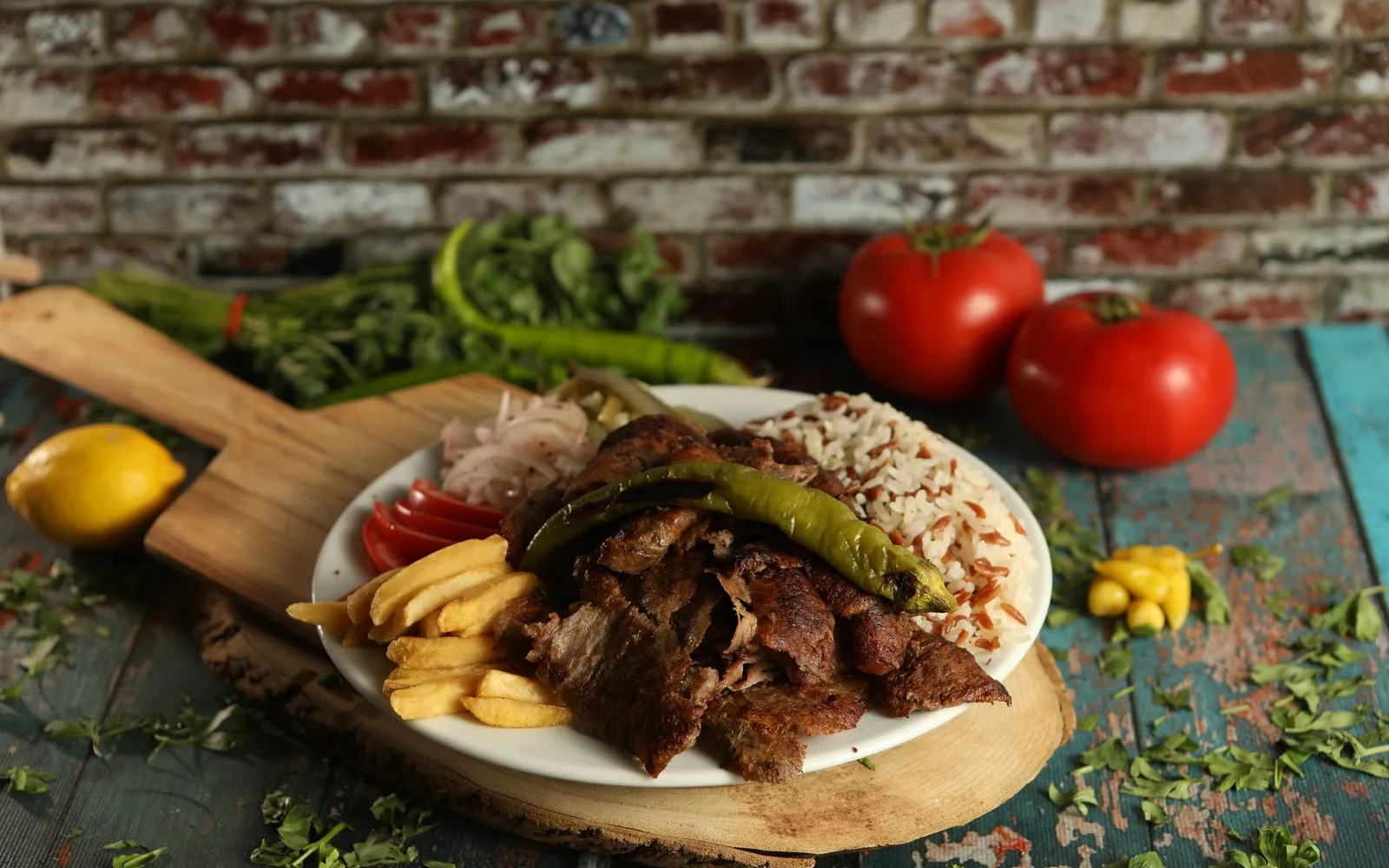
Mixed / 24h
Authentic Doner Kebab
The most eaten kebab on Earth, rebuilt for a home oven. Stacked, roasted, shaved thin, and pan-crisped.

Lamb / 45m
Adana Kebab
The spicy gold standard of Turkish BBQ. Hand-minced lamb with tail fat.
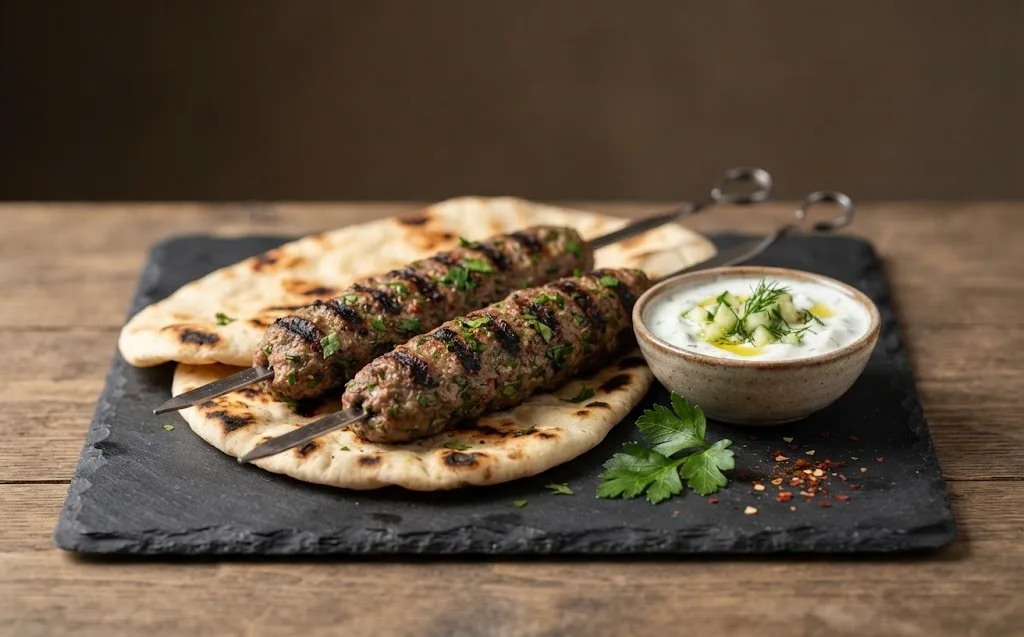 AI illustration
Lamb / 1h
Classic Kofta Kebab
The universal Middle Eastern meatball skewer. Heavy parsley and mild spices.
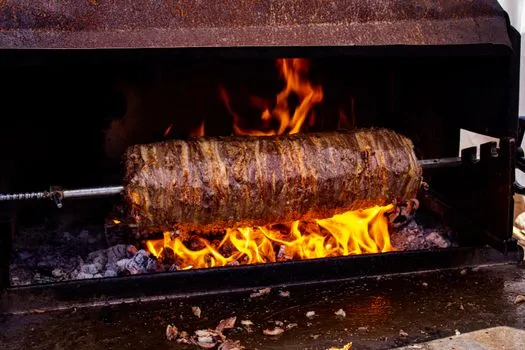
Lamb / 12h
Cag Kebabi
The horizontal ancestor of Doner. Marinated lamb slices on a wood fire.
Related Collections
Turkish Kebab Guides
A focused collection for Turkish kebab styles including Adana, Urfa, Cag, Iskender, and supporting bread pages.
Gyros, Shawarma, and Donair Guide
Compare gyros, shawarma, donair, souvlaki, and tawook with bread pairings, sauce choices, wrap assembly, and serving ideas.
Best Bread for Kebab, Shawarma, and Gyros
Learn which bread to use for kebab wraps, gyros, shawarma, doner, and grilled meat plates, including lavash, pita, pide, somun, lepinja, and durum.
More Guides
Heat guide
Charcoal vs Gas for Kebab: The Heat Matters More Than Smoke
Charcoal vs gas for kebab: why coals win for minced adana and koobideh, where gas loses almost nothing, and the settings that close the gap on a gas grill.
Greek guide
Gyro vs Souvlaki: Spit, Skewer and the Pita Between
Gyro vs souvlaki: vertical spit versus skewer, why pork rules in Greece, what goes in the pita, and how to make both properly at home without a rotisserie.
Meat guide
Best Meat For Kebab
Choose the best meat for kebab by fat ratio, cut, grind, and cooking style, whether it ends up on a skewer, in a wrap, or on a plate.
Technique guide
How To Keep Kebab On The Skewer
Learn how to keep kebab on the skewer with the right fat level, onion handling, kneading, skewer shape, and grill timing.
Bread guide
Best Bread For Kebab Wraps
Choose the best bread for kebab wraps, gyros, shawarma, doner, and plate service with lavash, pita, somun, pide, and durum explained clearly.
Comparison
Gyros Vs Shawarma Vs Donair
Compare gyros, shawarma, and donair by meat style, bread, sauce, garnish, and wrap structure so you know which page to cook next.